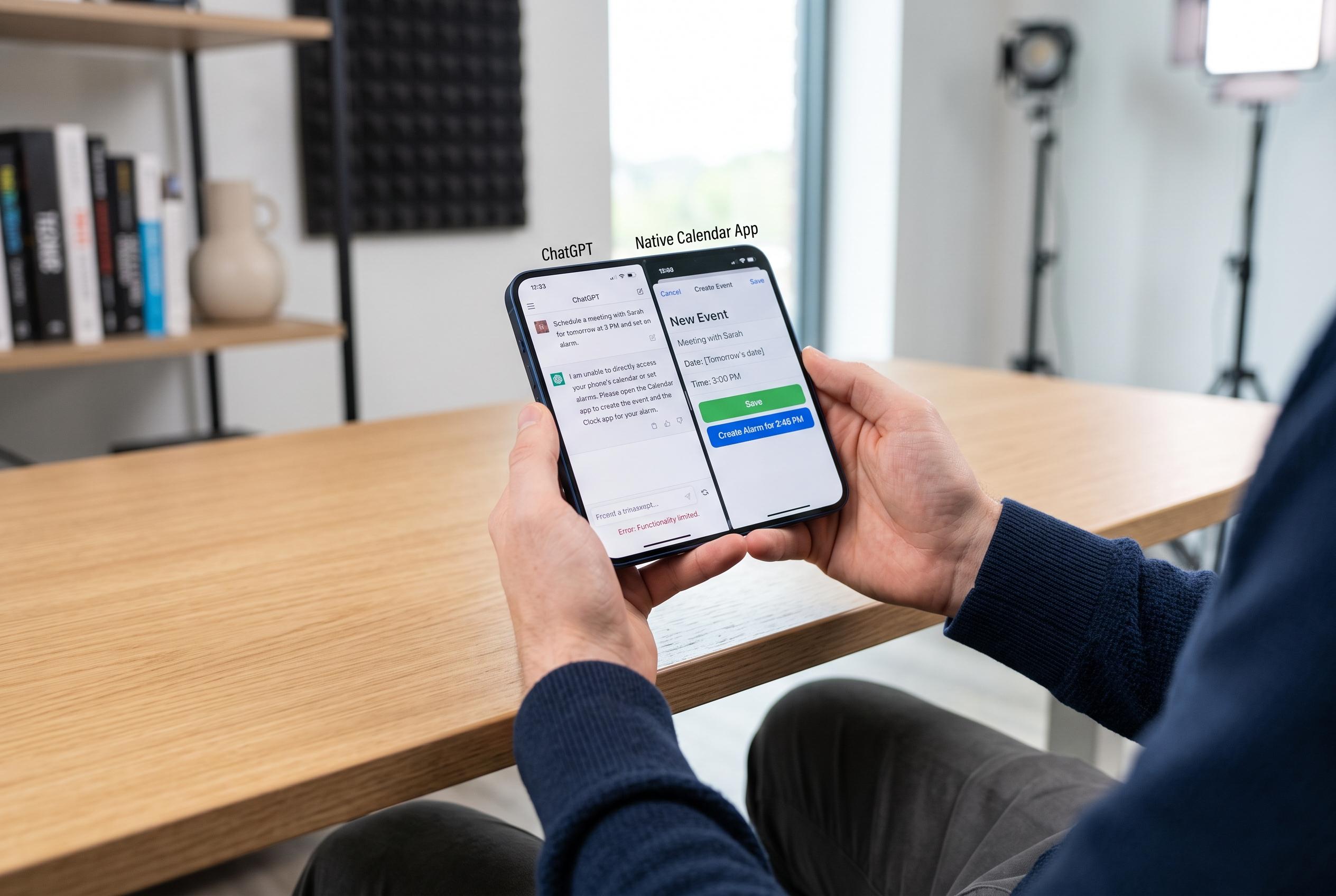

A recent TechRadar test assessing ChatGPT’s performance on common phone tasks highlights AI’s current capabilities and shortcomings, amid ongoing legal tensions between Apple and OpenAI over trade secrets and AI integration.
Apple’s lawsuit against OpenAI has sharpened an already uneasy relationship between the two companies, with Apple accusing the ChatGPT maker of stealing trade secrets and recruiting staff with access to confidential information. OpenAI has rejected the allegations and, in a public response, called the case unfounded and overly combative. The dispute comes as both companies compete more directly in artificial intelligence, including over the next generation of hardware.
That tension makes the question raised by a recent TechRadar experiment feel more immediate: if a phone were reorganised around AI rather than apps, what would still work well and what would quickly break down? The test used ChatGPT as a substitute for a dozen common phone tasks, from timers and alarms to maps, language practice and plant identification. The results suggested that AI can already handle some information-heavy jobs, but remains far less convincing when a task depends on speed, device integration or a carefully designed interface.
The weakest areas were the most basic utility functions. ChatGPT could not act as a stopwatch and struggled with alarms, where the answer appeared in chat but failed to reach the user in a practical way. It also proved awkward for food delivery and route planning, where it could offer suggestions and explain options but could not match the directness of a dedicated app. In several cases, the problem was not the quality of the information but the friction of having to negotiate with a chatbot instead of tapping a button.
By contrast, the chatbot performed much better on tasks built around explanation and discovery. It handled weather queries well, produced usable calculator results and gave strong film recommendations. It also did a solid job identifying plants from photographs and could help with language practice in a conversational format. But even where the answers were useful, the experience was not always better than an app. For guided meditation, the voice mode’s odd delivery made the exercise more distracting than calming. For word games and star gazing, it could reproduce some mechanics, but not the cleaner, more immersive design of a specialist app.
The broader conclusion is that AI is already replacing a narrow class of apps, particularly those whose main purpose is to provide information, context or suggestions. It is less ready to replace tools designed for immediate action, live navigation or fast, repeatable use. TechRadar’s experiment also underlined a separate issue: confidence. A chatbot may sound certain even when it is wrong, whereas a dedicated app often draws on specialist data and a clearer interface. That matters if AI is to move from being a clever assistant to the main way people interact with a phone.
OpenAI’s own plans point in that direction. The company has already deepened its ties with Apple through ChatGPT support on Apple devices, while also pushing towards hardware of its own after acquiring io, the startup founded by former Apple design chief Jony Ive. Apple, meanwhile, has opted to work with Google’s Gemini for Siri rather than OpenAI. However the legal fight ends, the commercial logic is clear enough: both companies are exploring a future in which AI is not just one app among many, but the layer that sits above them all. For now, though, the experiment suggests that such a future is still incomplete.
Disclaimer: This content is intended for informational purposes only. Readers are advised to exercise their own judgement, conduct due diligence, or consult a qualified expert before acting on any information provided.