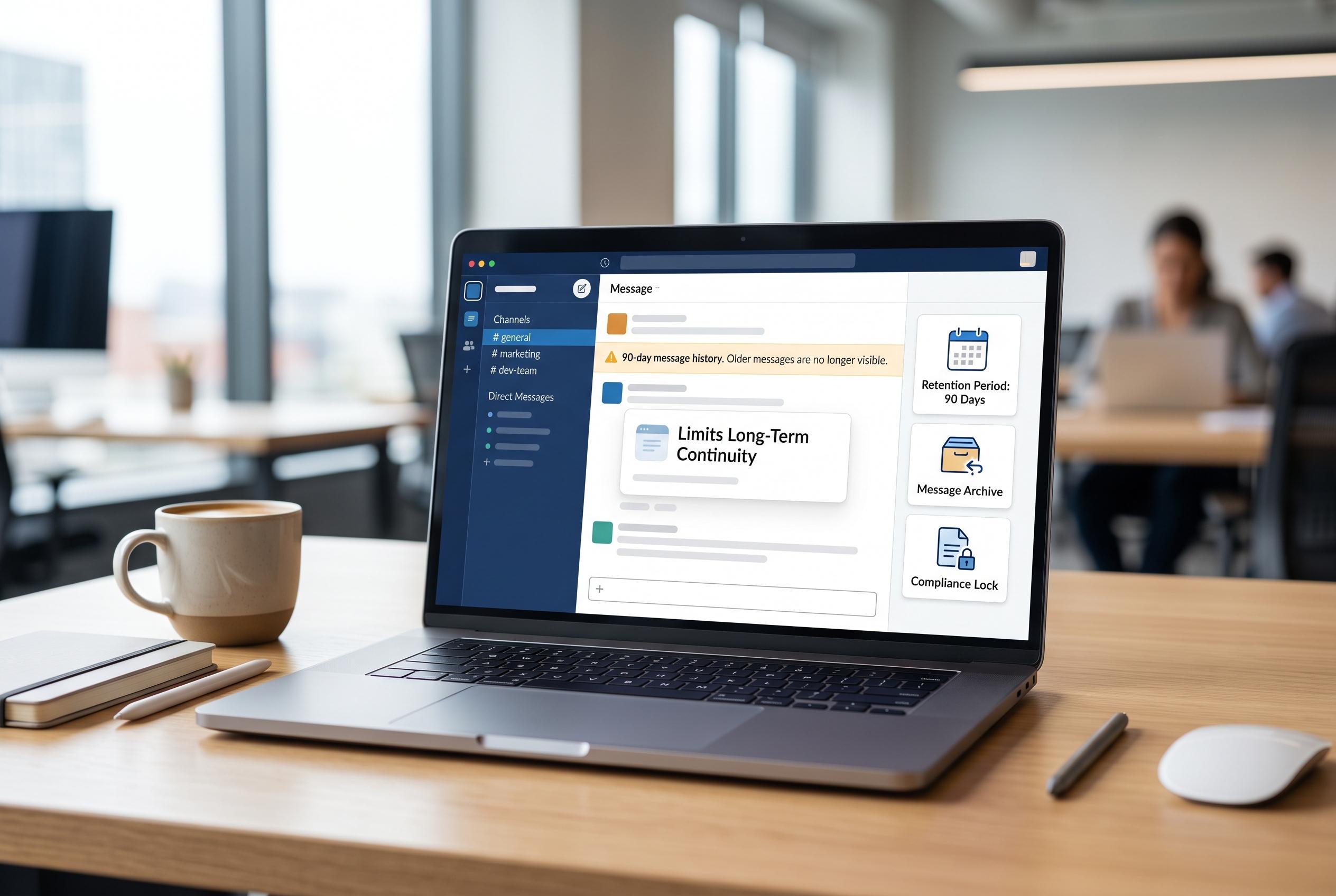

While Slack’s free tier provides essential features for small teams, its 90-day message history cap and app integration limits reveal a growing reliance on paid plans for sustained organisational memory and compliance needs.
Slack’s free plan remains a genuine entry point for small teams, but its value is easier to understand when the current limits are stated clearly. According to Slack’s pricing page, the no-cost tier includes unlimited public and private channels, 90 days of searchable message history, file sharing, personalised notifications and one-to-one audio or video calls. Slack also says the free tier supports integrations with up to three apps.
That makes the plan useful for start-ups, project groups and informal teams that need a central place for conversation without taking on subscription costs. But the 90-day visibility cap is the decisive constraint. Slack’s help pages explain that older messages and files become hidden after 90 days and are permanently deleted after one year, which means the free version is not built for long-term institutional memory.
The practical effect is straightforward: free Slack works best when conversations are short-lived, lightly regulated and relatively low in volume. Once a team depends on past decisions, file trails or onboarding through old discussions, the platform’s free tier starts to lose its appeal. Slack’s usage guidance also notes that high-volume workspaces can run into message or file sending limits, adding another reason for larger teams to treat the plan as temporary rather than permanent.
The difference between the free plan and Slack’s paid tiers is therefore less about basic chat and more about continuity. Slack says Pro removes the history limit and expands app support, while Business+ adds stronger identity controls, more storage and priority support. Enterprise plans go further with features aimed at larger organisations that need more serious governance and compliance tools.
Security is another dividing line. Slack says the free plan includes internationally recognised ISO 27001 and ISO 27018 certifications, but advanced administration, identity management and retention controls sit higher up the pricing ladder. That matters for organisations handling sensitive material or operating under stricter compliance rules, where convenience alone is rarely enough.
Historically, Slack built its brand around making workplace communication searchable and persistent. The service began as an internal tool before becoming a standalone product, and that background still explains the appeal of the free tier: it lets teams experience the workflow before committing money. But the same design philosophy also explains the paywall. Slack is effectively showing users how useful organised conversation can be, then charging when teams need that usefulness at scale.
For organisations evaluating whether to stay free, the key question is not whether Slack can be used at no cost. It can. The better question is how long a team can work within 90 days of searchable history and three app integrations before the lack of permanence becomes a business problem. For very small groups, the answer may be a long time. For most growing teams, it will arrive sooner than expected.
Disclaimer: This content is intended for informational purposes only. Readers are advised to exercise their own judgement, conduct due diligence, or consult a qualified expert before acting on any information provided.