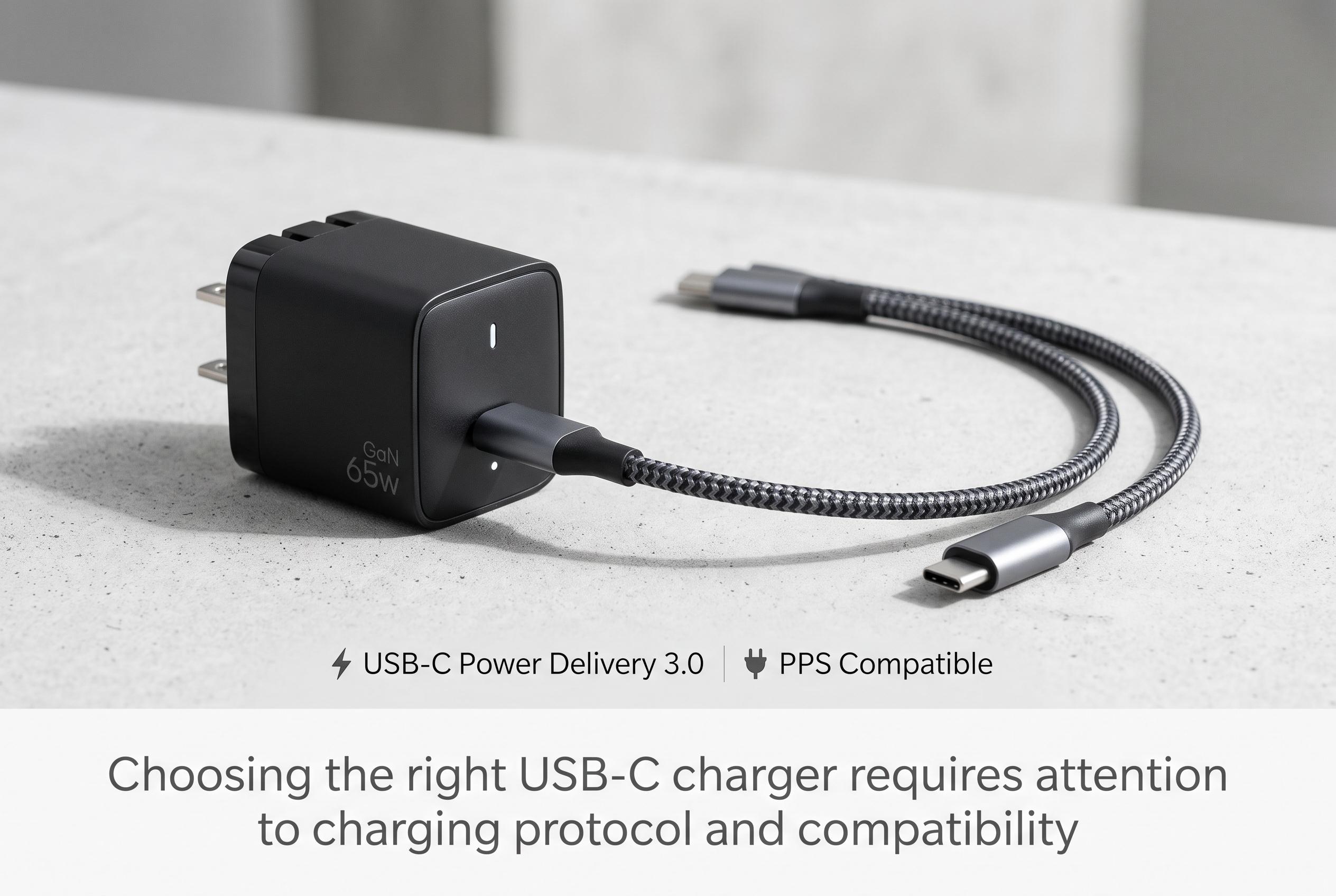

While USB-C is now common across devices, selecting a charger that supports the correct protocol, voltage, and cable rating is essential for ensuring fast and reliable charging as standards evolve.
Buying a USB-C charger can look straightforward, yet the details matter more than many shoppers expect. The promise of one universal connector has largely come true: USB-C now appears on phones, tablets, laptops and many accessories. But according to Android Authority, the difference between a charger that merely works and one that delivers full speed can still be large, because charging protocol, voltage and cable rating all affect performance.
The main complication is that USB-C is only the connector. The charging language underneath is more varied. USB Power Delivery has become the common standard for many recent phones, and its PPS, or Programmable Power Supply, extension adds finer control over voltage. Android Authority notes that major handset lines from Samsung and Google, along with brands such as Motorola, OnePlus and Xiaomi, generally support USB PD PPS, while Apple’s newest iPhones use USB PD AVS for fast charging. Tom’s Hardware likewise explains that USB PD has evolved through several versions, with PPS and Extended Power Range designed to improve efficiency and flexibility across devices.
Even so, wattage alone is not enough to identify a good charger. Android Authority points out that the same advertised power can be delivered through different voltage and current combinations, and not every charger supports the profile a phone needs. Samsung is a clear example: older Galaxy S Ultra models could use a roughly 9V, 5A profile, while newer models moved to about 12V, 3A and later, in the case of the Galaxy S26 Ultra, around 21V, 3A for about 65W. Google’s Pixel range shows a similar issue, with some newer models requiring 21V support to reach their highest speeds. In other words, a charger may have enough total wattage on paper and still fail to trigger the fastest mode on a specific handset.
For buyers, the practical answer is to look beyond the number printed on the box and check the specification list in full. Android Authority advises looking for USB PD PPS support with broad voltage coverage, ideally up to 21V, because that improves compatibility with a wider range of modern phones and leaves room for future devices. It also warns that multi-port chargers often split power between ports, and that faster charging may require a 5A-rated cable. The result is a more durable purchase: one charger that is more likely to remain useful as devices and charging standards continue to change.
Disclaimer: This content is intended for informational purposes only. Readers are advised to exercise their own judgement, conduct due diligence, or consult a qualified expert before acting on any information provided.