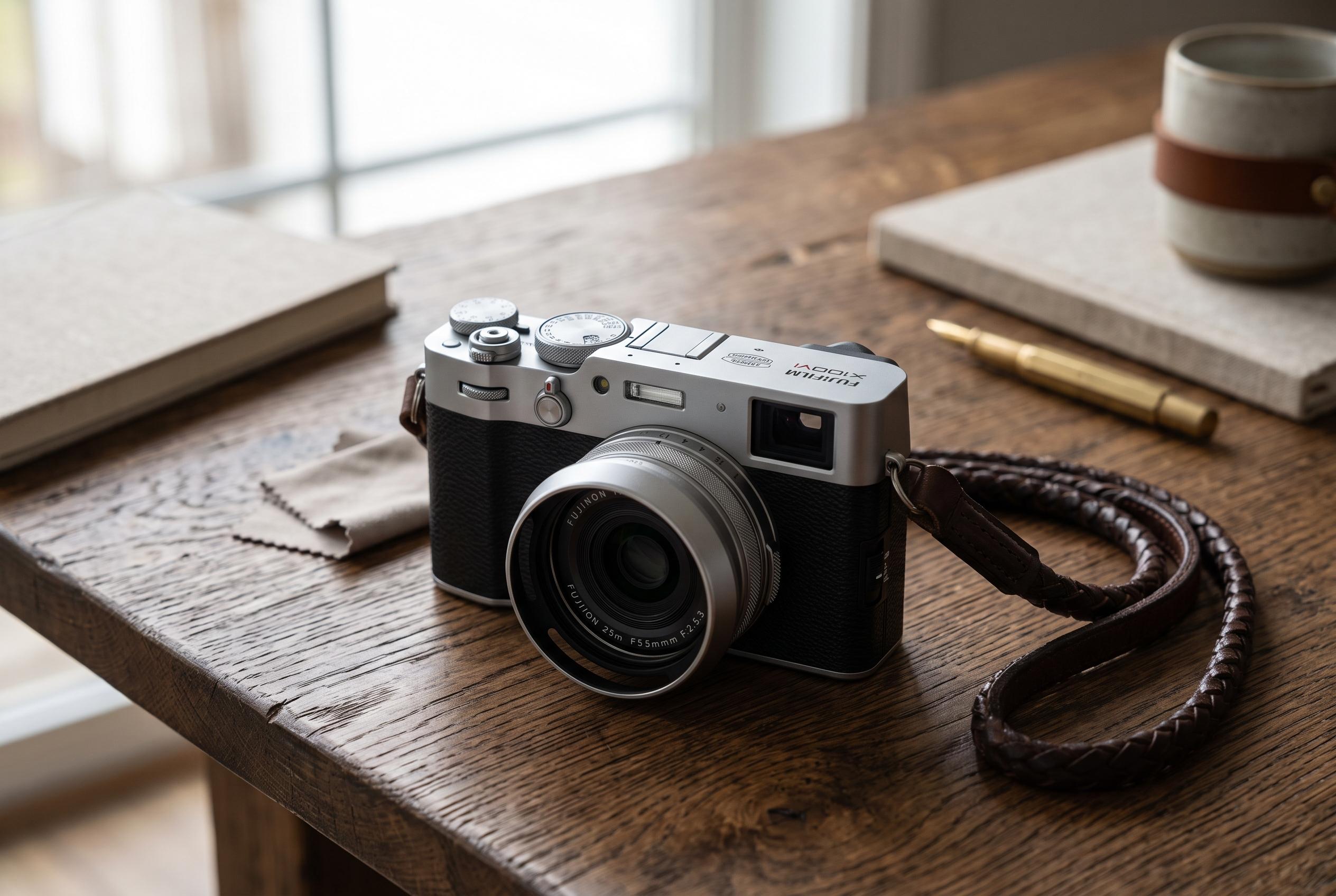

Reinvigorated by models like the Fujifilm X100VI and Ricoh GR IV, compact cameras are redefining travel photography by combining superior optics with portability, challenging smartphone dominance at the premium end.
Compact cameras have re-entered the travel conversation because they solve a problem phones still cannot: they offer better optics, larger sensors and more control without the bulk of a mirrorless kit. According to Ordinary Traveller, the category has recovered even as smartphone cameras have improved, with renewed demand for models such as the Fujifilm X100VI and Ricoh GR IV. The result is a smaller field than a decade ago, but one with far stronger performance at the top end.
Ordinary Traveller places the Fujifilm X100VI at the top of the list for good reason. Its 40.2-megapixel APS-C sensor, fixed 23mm f/2 lens and in-body stabilisation give it a rare mix of image quality, low-light flexibility and simple handling. Fujifilm’s film simulations also matter in practice: they let travellers produce polished JPEGs straight from the camera, which reduces editing time on the road. The main drawback is availability. Demand has remained high since launch, and that has made the camera difficult to find at times.
The Ricoh GR IV has become the other headline model in the compact revival. Digital Camera World reported that the GR IV helped improve Ricoh’s camera-related profitability and that the company later expanded the line with variants such as the GR IV HDF and GR IV Monochrome. Ricoh Imaging also said the camera won Best APS-C Compact Camera at the 2026 TIPA Photo & Imaging Awards, citing its APS-C sensor, 5-axis stabilisation, built-in 2EV ND filter and 1/16,000 sec maximum shutter speed. For travel and street photography, its appeal is obvious: it is genuinely pocketable yet still uses a large sensor and a sharp 28mm-equivalent lens.
For travellers who value reach over outright image quality, zoom compacts still have a place. Ordinary Traveller recommends the Sony RX100 VII for its 24-200mm lens, fast autofocus and strong 4K video in a body that can still fit in a coat pocket. The Canon G7X Mark III remains the more video-focused option, with a fast 24-100mm lens, flip screen and live-streaming support. Panasonic’s Lumix ZS99, which the site identifies as Panasonic’s first new travel zoom in six years, goes even further on range with a 24-720mm equivalent lens, but its smaller sensor makes low-light work more difficult.
The key buying decision remains sensor size versus flexibility. Larger sensors generally produce better results, especially indoors or after dark, while zoom lenses help when subjects are distant or when you cannot move closer. For most readers, the best choice will depend on how they actually travel: the X100VI suits those who want a do-everything fixed lens camera, the GR IV suits anyone who wants the smallest serious camera, and the RX100 VII or ZS99 suit travellers who need a broad zoom range. In a market that has shrunk but improved, the best compact camera is now less about compromise than about choosing which compromise matters least.
Disclaimer: This content is intended for informational purposes only. Readers are advised to exercise their own judgement, conduct due diligence, or consult a qualified expert before acting on any information provided.