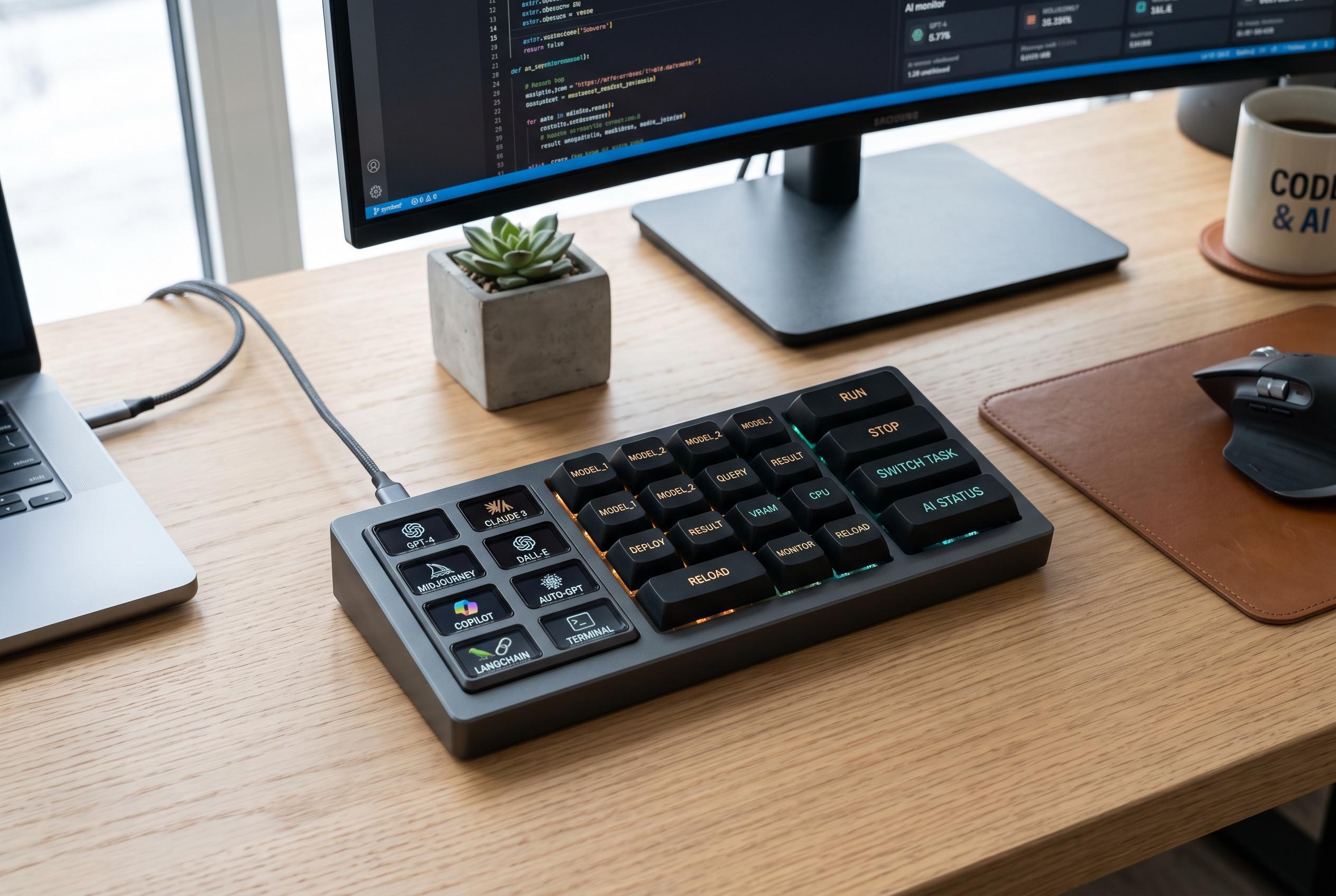

A limited-run mechanical keypad aimed at programmers managing multiple AI tasks sparks discussion about its value and future role in AI workflow management.
OpenAI’s Codex Micro is a $230 desktop keypad aimed squarely at programmers who already work with the company’s Codex coding agent. The limited-run device, built with the mechanical keyboard maker Work Louder, is less a general-purpose accessory than a specialised control surface for people juggling multiple AI-driven tasks at once. It sold out quickly, but reactions to the concept have been mixed, with some observers seeing a useful workflow tool and others viewing it as an expensive novelty.
The hardware is built around a compact set of programmable controls: mechanical keys, a rotary dial, a joystick and lighting that reflects the state of an AI task. According to TechRadar and Tom’s Hardware, the keypad uses colour cues to show whether an agent is thinking, idle, finished or in error, while the dial can be used to adjust reasoning depth on the fly. That turns the device into something closer to a command console than a simple shortcut pad, particularly for users who want to monitor several agent threads without repeatedly switching windows.
OpenAI and Work Louder have also leaned heavily into customisation. Tom’s Hardware reported that the Codex Micro ships with 32 configurable keycaps, while TechRadar said the device includes voice dictation support that simply triggers the host computer’s microphone rather than housing its own. The design is intended to help coders launch chats, move between agents and trigger common workflows with less friction, which makes sense for heavy Codex users even if the broader market is unlikely to need such a device.
The strongest criticism has been about value rather than engineering. TechRadar said online reaction has been largely negative, with sceptics questioning both the price and the need for a dedicated Codex keypad when cheaper macro pads already exist. Layer3 Labs also argued that the product only makes sense for a narrow group of users who already manage several Codex agents every day, and that most teams would get more from improving their workflow and governance than from buying additional hardware.
Even so, the Codex Micro hints at a broader shift in how AI tools may be controlled. Axios described it as part of a move from single-chat interfaces towards the management of fleets of agents, while TechSpot noted that it is distinct from the separate screen-free device OpenAI has been discussing with Jony Ive. In that sense, the keypad looks less like a mass-market gadget than an early test of whether physical controls can make agentic software more practical, and perhaps more intelligible, on the desktop.
Disclaimer: This content is intended for informational purposes only. Readers are advised to exercise their own judgement, conduct due diligence, or consult a qualified expert before acting on any information provided.