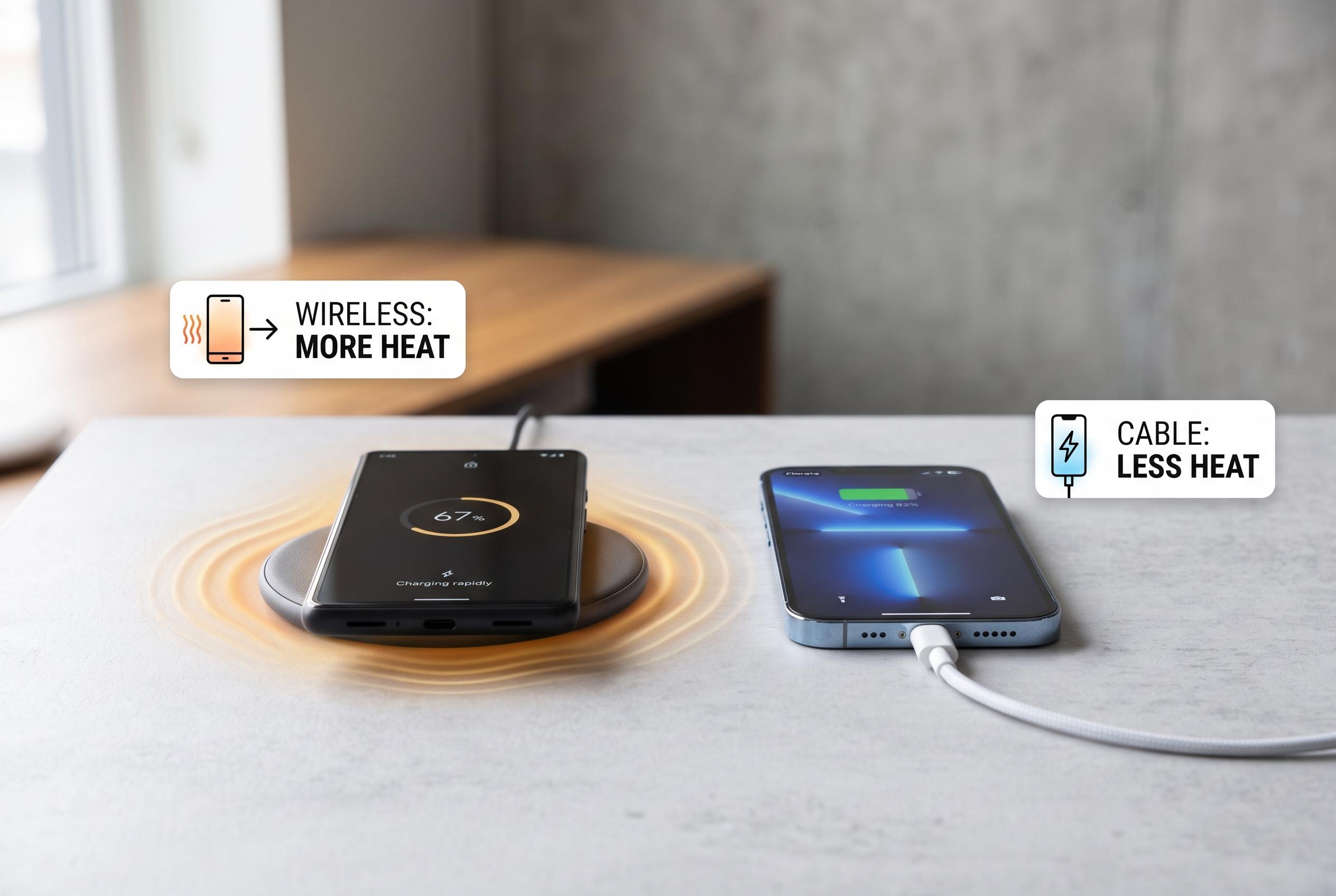

Testing shows wireless charging for iPhone 16 uses marginally more power and generates more heat than cable charging, but the additional cost to users’ electricity bills is minimal.
Testing by Android.com.pl suggests wireless charging does cost more power than a cable, but only by a modest amount. The site used an iPhone 16, a 15-watt Baseus wireless charger with a built-in wattmeter and a second meter at the wall socket to compare what went into the outlet with what reached the phone. The phone drew about 10 watts during wireless charging, while the socket reading was about 12 watts, indicating roughly 2 watts of loss in the transfer process.
Thermal imaging in the test also showed the iPhone and the surrounding area warming up more noticeably than they would with a cable. That is consistent with a basic property of inductive charging: some energy is lost as heat rather than being delivered directly to the battery. In practical terms, though, the extra cost is small. Android.com.pl estimated that if wired charging adds about 150 to 200 hryvnias a year to a user’s electricity bill, wireless charging would raise that by only about 30 to 50 hryvnias.
The broader trade-off is less about electricity bills than efficiency and speed. PhoneArena reported that iPhone 16 wired charging remains around 20 watts, while MagSafe wireless charging has been raised to 25 watts on the latest models. That means Apple’s newer wireless option can be quicker than the standard cable route in some cases, although the total energy path is still less efficient than a wired connection. Other reviews of the iPhone 16 have continued to find no major change in wired charging performance.
There are also everyday practical limits. Wireless charging usually creates more heat, works only when the handset is aligned correctly on the pad and may require removing a case if it is not designed for wireless use. Android.com.pl also noted that a powerful charging station will not make a phone charge faster unless the handset itself supports that higher wattage. In other words, the convenience is real, but so are the technical constraints.
Disclaimer: This content is intended for informational purposes only. Readers are advised to exercise their own judgement, conduct due diligence, or consult a qualified expert before acting on any information provided.