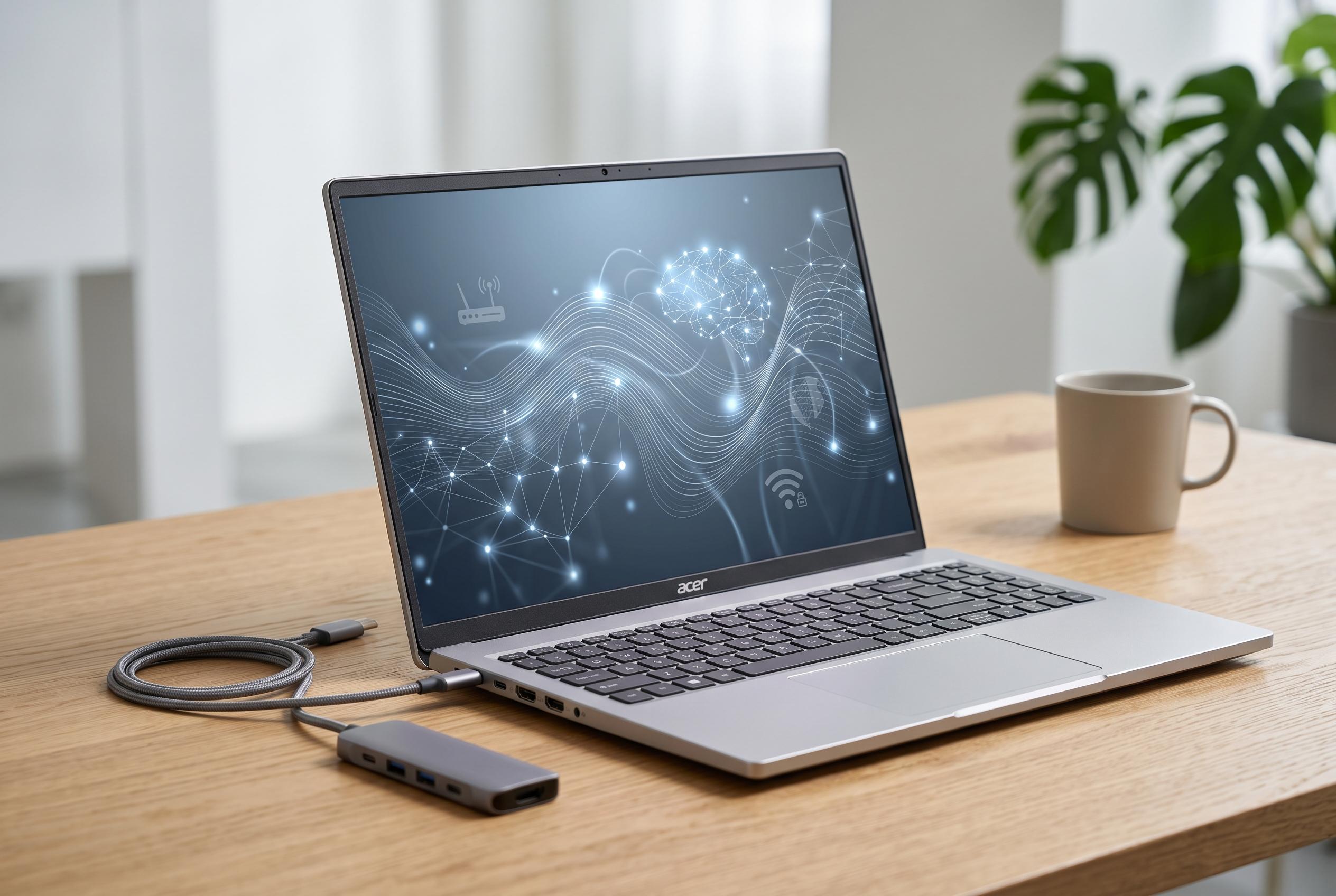

Acer’s Swift Go 16 AI features a 16-inch IPS touchscreen and strong connectivity, but its real-world value heavily depends on pricing, with the Intel version potentially offering better value through OLED displays and lower costs.
Acer’s Swift Go 16 AI is easiest to recommend when it is discounted. At full price, the equation changes quickly. Tom’s Hardware found that the AMD-based model offers a comfortable 16-inch form factor, a metal chassis, a strong port selection and a capable IPS touchscreen, but the pricing swings so widely that shoppers need to check the market before committing. The outlet also noted that Acer’s Intel version may be the sharper buy if it is cheaper, because it pairs OLED with a lower asking price.
The tested configuration uses AMD’s Ryzen AI 7 445, 16GB of LPDDR5X memory and a 1TB SSD. That puts it squarely in the mainstream productivity class rather than the premium tier, and that is reflected in its performance. Tom’s Hardware said it kept pace with more expensive laptops in some tests, especially on multi-core workloads, but fell well behind faster Arm-based rivals in tasks such as file transfers and video conversion. The integrated Radeon 840M graphics are adequate for light gaming and everyday use, but they are not meant to compete with discrete GPUs or the stronger graphics in higher-end systems.
The display is one of the machine’s better features. Acer fits the AMD model with a 16-inch, 1,920 x 1,200 IPS panel at 120Hz, and Tom’s Hardware measured solid brightness and broad colour coverage for a laptop in this class. It does not match OLED for contrast or deep blacks, but it is bright enough for office work and general media use. That matters because Acer’s Intel Swift Go 16 AI variant, according to the same review, can be the better-value option if it is available at a lower price with an OLED screen, even though it gives up some storage capacity.
The physical design is also more thoughtful than budget pricing might suggest. The Swift Go 16 AI includes two USB-C ports, two USB-A ports, HDMI, a microSD card slot and a headset jack, which gives it a practical spread of connections for a thin laptop. The chassis is relatively slim for a 16-inch model, although Tom’s Hardware did note some flex in the lid and keyboard deck. The touchpad is unusually large and supports Acer’s adaptive controls, which light up for media and meeting shortcuts in compatible apps. That idea is not new, but it is useful when it works.
There are also a few compromises. Tom’s Hardware reported noticeable software clutter at startup, including promotional shortcuts and preloaded apps that many buyers will want to remove. Battery life was decent rather than exceptional at 9.5 hours in the publication’s test, and the speakers were described as serviceable rather than impressive. One unusual quirk stood out: the laptop’s lid sensor appears sensitive to magnets, enough to trigger wake-and-lock behaviour when used near certain magnetic watch bands.
Acer’s broader Swift line suggests the company is pushing the 16-inch format in several directions. Tom’s Hardware has separately reported refreshed Swift 16 AI models with Intel Panther Lake processors, OLED panels and a large haptic touchpad with stylus support. Against that backdrop, the Swift Go 16 AI looks less like a premium showcase and more like a value play. At the right sale price, it is a credible big-screen Windows laptop with decent build quality and a good screen. At MSRP, shoppers will have stronger reasons to compare it carefully with Acer’s own Intel alternative before buying.
Disclaimer: This content is intended for informational purposes only. Readers are advised to exercise their own judgement, conduct due diligence, or consult a qualified expert before acting on any information provided.