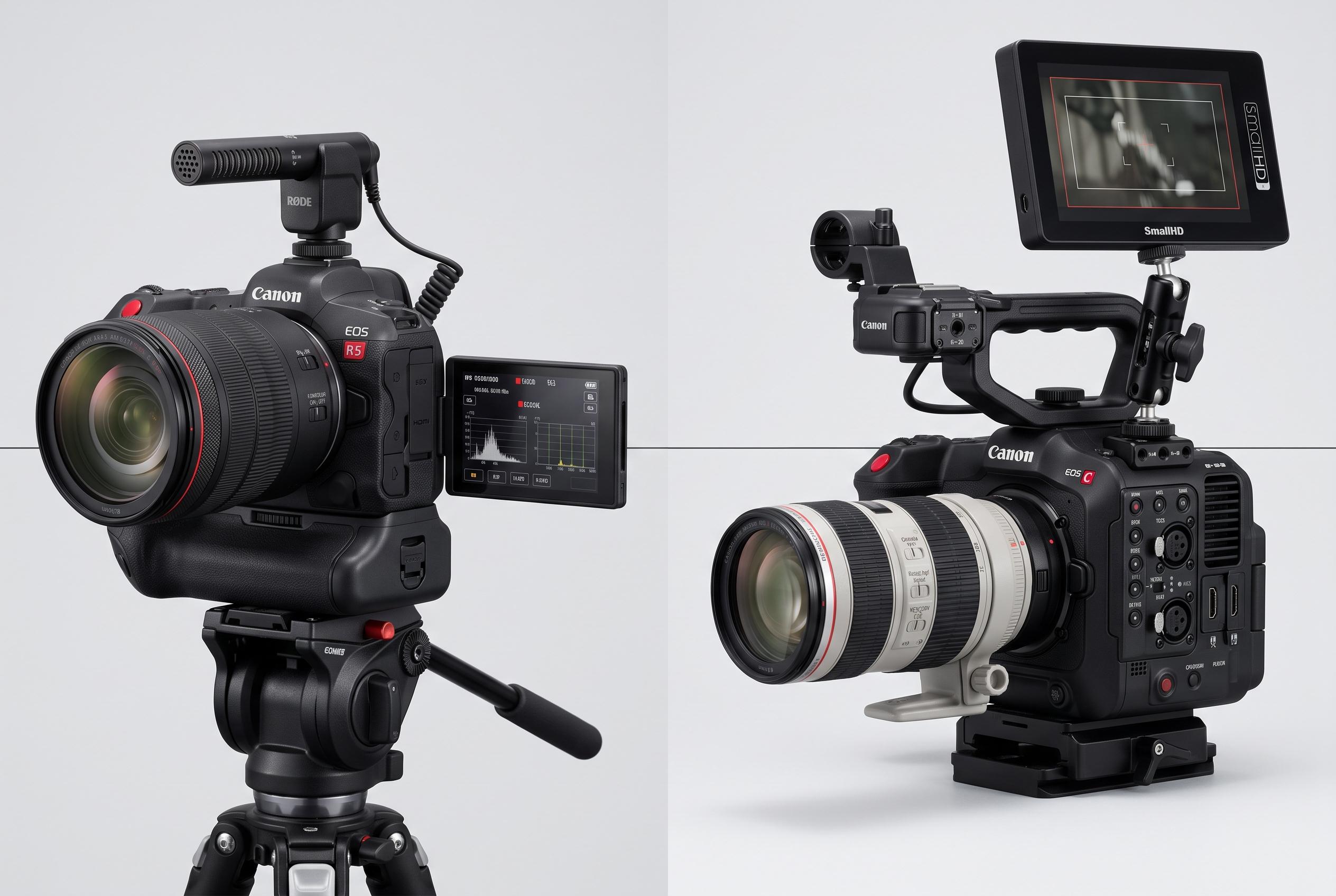

Canon’s latest video-focused camera range offers a new split between compact hybrid models for solo creators and professional cinema bodies, emphasising advanced video features and flexible connectivity for different production needs.
Canon’s video-focused line has become broad enough that choosing the right model now depends less on brand loyalty than on working style. The latest additions show a clear split between compact hybrid bodies for solo creators and more fully featured cinema cameras designed for crews, monitoring, audio and rigging. Reviews of the new EOS R6 V and EOS R6 Mark III also underline how much Canon has pushed both bodies towards serious video use, with 7K recording, open-gate capture and strong dynamic range among the main draws.
At the entry point, the EOS R6 V is the lightest and most stripped-back option, aimed squarely at filmmakers who want a small, portable body without giving up advanced video tools. Digital Camera World said its design is geared towards content creators, helped by a fully articulated screen and the absence of an electronic viewfinder, while The Digital Picture noted its 32.5-megapixel full-frame sensor and 7K 60p RAW recording. The trade-off is obvious: this is not the most natural choice for photographers who rely on a built-in viewfinder or a mechanical shutter, but it is a practical option for shooters who value mobility and a minimal rig.
The EOS R6 Mark III sits close to the R6 V on core imaging performance, but adds features that make it more comfortable as a hybrid stills-and-motion tool. CameraLabs and Digital Camera World both highlighted the 32.5-megapixel sensor, 7K open-gate capture and 40fps burst shooting, while the latter also pointed to advanced autofocus and strong in-body stabilisation. That makes the Mark III the more versatile of the two for users who divide their time between photography and video, especially those who prefer working through an electronic viewfinder.
Canon’s EOS C50 is where the line becomes more clearly cinema-oriented. It keeps the compact, modern sensibility of the smaller bodies, but adds features that matter in a production environment, including a dedicated timecode port, dual base ISO, anamorphic support and a top handle with dual XLR inputs. It also offers simultaneous crop recording, which is useful for delivering horizontal and vertical versions at the same time. The absence of in-body stabilisation may deter some run-and-gun users, but for many filmmakers that omission is less important than the cleaner rigging and workflow advantages.
Higher up the range, the EOS C80 and EOS C400 are built for increasingly demanding sets. The C80 adds triple base ISO, built-in neutral density filters, mini-XLR inputs, SDI output and a stronger mounting arrangement, making it better suited to crews that need quick deployment and flexible connectivity. The C400 goes further with a true box-style body, more mounting points, dedicated timecode, genlock and return-video ports, plus dual SDI connections for multi-device monitoring. In Canon’s own cinema hierarchy, the distinction is less about image quality than about how far each body can be integrated into a professional pipeline.
For most buyers, the right choice comes down to three practical questions: how much weight can the kit carry, how much rigging does the job require and how many devices must connect to the camera at once. The lighter R6 V and R6 Mark III suit individual shooters and hybrid users, the C50 bridges the gap for small crews and the C80 and C400 are aimed at larger productions that need robust connectivity, external audio and production-time efficiency. Canon now has a camera for nearly every tier of filmmaking, but the best one is still the one that matches the workflow.
Disclaimer: This content is intended for informational purposes only. Readers are advised to exercise their own judgement, conduct due diligence, or consult a qualified expert before acting on any information provided.