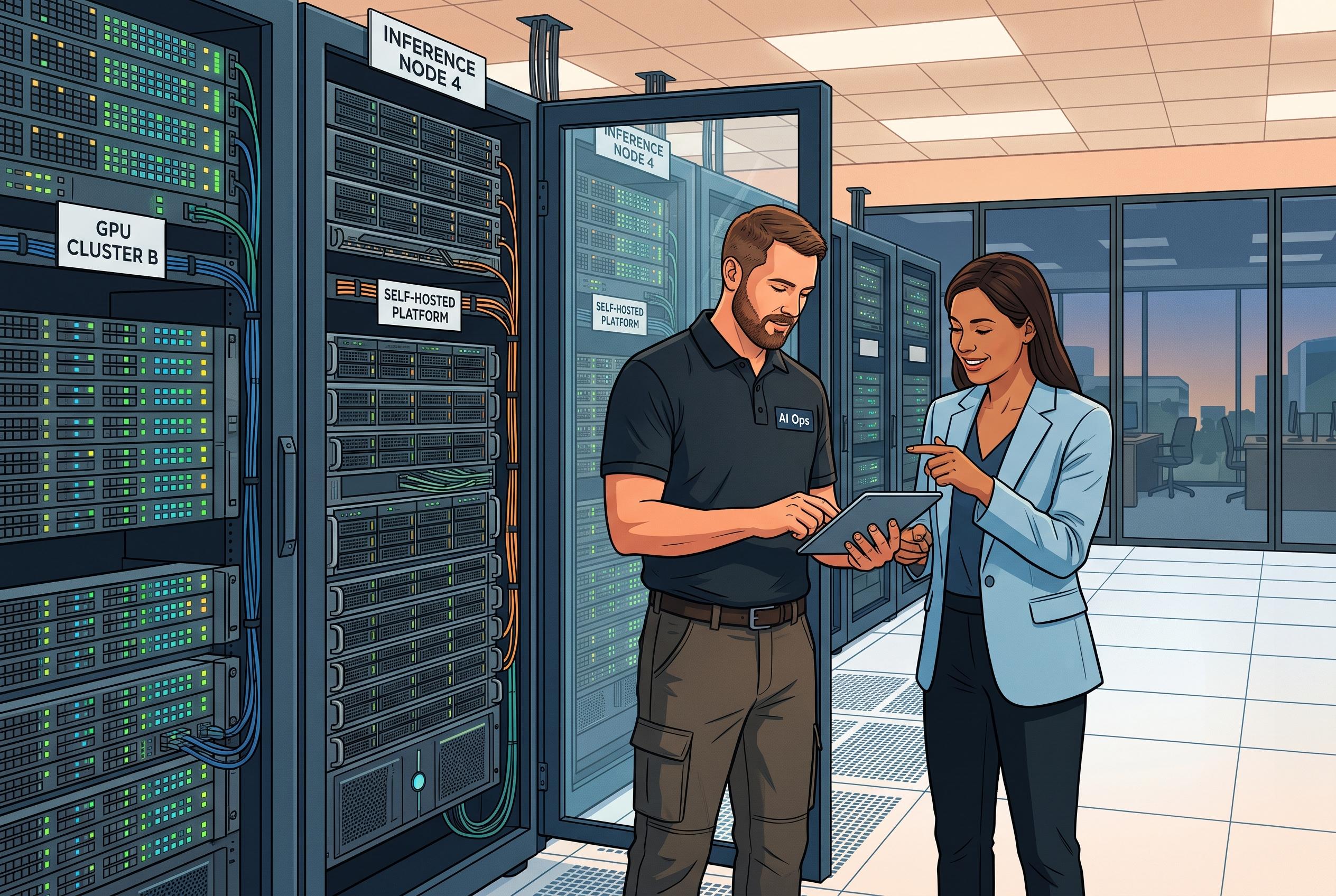

Selecting an appropriate self-hosted inference platform hinges on the specific workload, whether specialised for text embeddings or designed to manage diverse models, highlighting the importance of architectural choices in AI deployment.
Choosing a self-hosted inference server is less about chasing headline throughput and more about matching the tool to the shape of the workload. That is the central lesson of the guide: a server built for one large model behaves very differently from one meant to coordinate several smaller models. In practice, the right choice depends on whether the system is serving a primary generative model, a retrieval stack or a wider agent workflow with embeddings, reranking and extraction.
That distinction matters because the operational burden grows quickly once a project moves beyond a single model. A focused server can optimise batching, memory use and scheduling for one deployment. A broader platform may handle several model types, but usually at the cost of more configuration and more moving parts. The trade-off is simple: narrow tools are easier to tune, while general-purpose systems reduce fragmentation when an application needs many models at once.
Among the specialist options, Hugging Face’s Text Embeddings Inference, or TEI, stands out for one reason: it does a small number of jobs very well. According to Hugging Face’s documentation, TEI is designed for serving text embedding models at high speed, with dynamic batching, efficient resource use, support for Safetensors and ONNX formats, and production features such as distributed tracing and Prometheus metrics. It is also built for private and gated models, and the quick-start material shows it can run locally on CPUs, Apple Metal and GPUs.
That focus makes TEI a strong fit for search, retrieval and semantic processing pipelines. The server is particularly useful when an application needs embeddings or reranking rather than a full conversational model. The drawback is that TEI is intentionally single-model in its deployment shape, so a separate instance is usually required for each embedder or reranker. For small, clearly defined tasks, that is a reasonable compromise. For a larger fleet, the management overhead rises.
The broader lesson from the comparison is that self-hosting is not a single technical decision but an architectural one. Open models may reduce dependence on per-token billing, but they shift spending to hardware, storage, monitoring and engineering time. A server that saves compute but complicates operations can be a poor bargain. That is why the guide separates platforms that maximise one model’s performance from those that route across a model estate.
For teams building agentic systems, the best answer is often mixed. One high-throughput server may handle the main language model, while smaller specialist workers serve embeddings, reranking and safety checks. That division keeps the large model efficient without forcing it to absorb every support function. TEI fits neatly into that supporting role because its design is narrow, predictable and oriented around production embedding workloads.
The practical decision, then, is not whether one server is universally best. It is whether the system needs a specialist or a generalist. TEI is compelling when the requirement is focused text embedding and reranking with clean production controls. Broader servers remain necessary when the task is to host a diverse collection of models or a high-volume generative service. In that sense, the most useful inference stack is usually not one platform but a combination of complementary ones.
Disclaimer: This content is intended for informational purposes only. Readers are advised to exercise their own judgement, conduct due diligence, or consult a qualified expert before acting on any information provided.