
Epomaker unveils the TH108 Pro, a feature-rich, full-size mechanical keyboard designed for office work and extended use, boasting a long-lasting battery, triple connectivity, and customisation options, disrupting the usual gaming-focused design.
Mechanical keyboards have spent years shrinking, but not every user wants to give up the number pad. For anyone who spends the day in spreadsheets, jumps between cursor keys and navigation blocks, or simply prefers a full-size board, Epomaker’s TH108 Pro is aimed squarely at that audience. The company positions it as a 104-key board with a rotary knob, TFT display and triple connectivity, all in a package that still sits within the value end of the market. According to Epomaker, it also keeps weight and size typical of a large desktop keyboard while adding a 10,000 mAh battery and hot-swap support.
That combination makes the TH108 Pro more of a productivity tool than a stripped-back gaming accessory. The review sample used Sea Salt Silent V2 switches, which are intended to reduce noise rather than create the deep acoustic signature some mechanical keyboard buyers seek. In practice, that choice matters more than the cosmetic options or the extra display, because it determines whether the board can be used for long sessions in shared spaces without becoming intrusive.
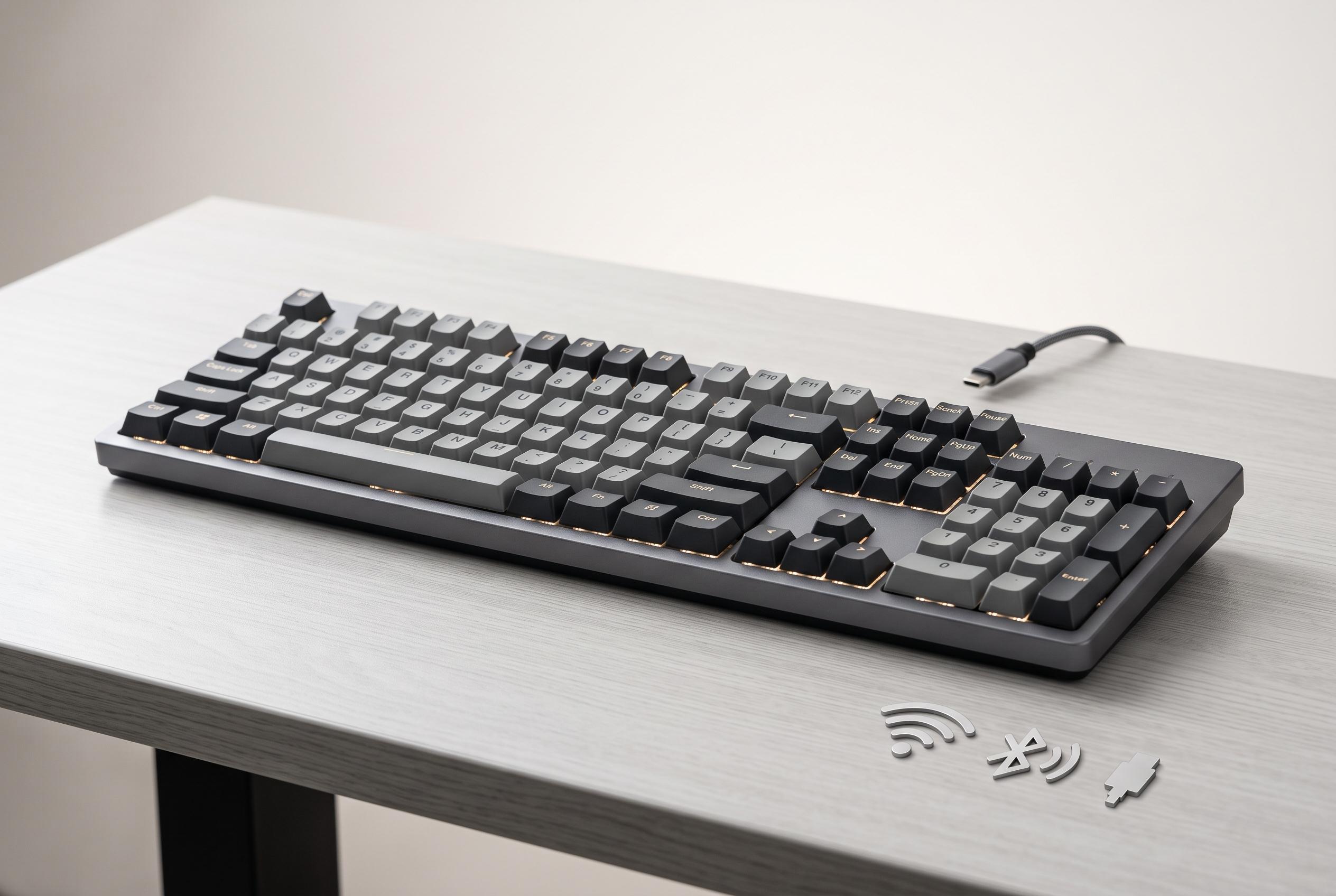
The hardware itself is straightforward but unusually feature-rich for the price tier. Epomaker lists a thick ABS case, a gasket-mounted structure, a polycarbonate plate, an FR4 PCB with flex cuts and five layers of sound dampening. The keyboard supports USB-C, Bluetooth and 2.4 GHz wireless through a dongle, with polling rated at 1,000 Hz over cable and 2.4 GHz and 125 Hz over Bluetooth. Epomaker and later reviews also agree on the 445 x 140 x 42 mm footprint and 1.12 kg weight, which help explain why the board feels stable on a desk.
The design is more restrained than many keyboards that try to look “gaming” by default. Epomaker offers several finishes, including a pink version that is the most distinctive, alongside more neutral colourways. The side-mounted knob and top-right display give the board a more desktop-centric identity, while the physical switches for connection mode and operating system layout reduce the need to memorise function-layer shortcuts. That said, the knob appears to be the least refined component, with a little lateral play and a feel that gives away the plastic construction.
The TFT display is small at 1.14 inches, but it is practical. According to Epomaker, it shows battery level, connection mode, system layout, lock status, date and time. The knob is used for volume by default, while holding FN opens the display menu for lighting, language and image settings. There is also a “Super” key on the right side that the quick manual does not clearly explain but is used for macros. The RGB implementation is deliberately understated: south-facing LEDs, side light bars and decorative rings around the display, while the included PBT double-shot keycaps do not let legends shine through.
Configuration is handled through a browser-based tool rather than a desktop app. Epomaker’s current EPOMAKER Hub and its earlier web configurator allow remapping, macro recording, profile saving, lighting control, firmware updates and display customisation, including GIF uploads. The trade-off is that setup requires either USB or the 2.4 GHz receiver, not Bluetooth, and that browser support is limited to Chromium-based browsers. The interface also looks basic, with some uneven translations, which makes it functional but not especially polished.
On battery life and daily use, the TH108 Pro is designed to disappear into routine rather than demand attention. Epomaker says the 10,000 mAh cell can last up to 200 hours with lighting off and around 42 hours with the screen and RGB active. That lines up with the board’s intended role: a full-size wireless keyboard for writing, data entry and general office work, with gaming as a secondary use case rather than the main one. The strongest case for it is simple: it delivers a full layout, hot-swap flexibility, solid wireless behaviour and unusually long battery life at a competitive price. The weaker points are equally clear: the software is barebones, the knob is not premium-feeling and the board is not built for competitive play.
Disclaimer: This content is intended for informational purposes only. Readers are advised to exercise their own judgement, conduct due diligence, or consult a qualified expert before acting on any information provided.