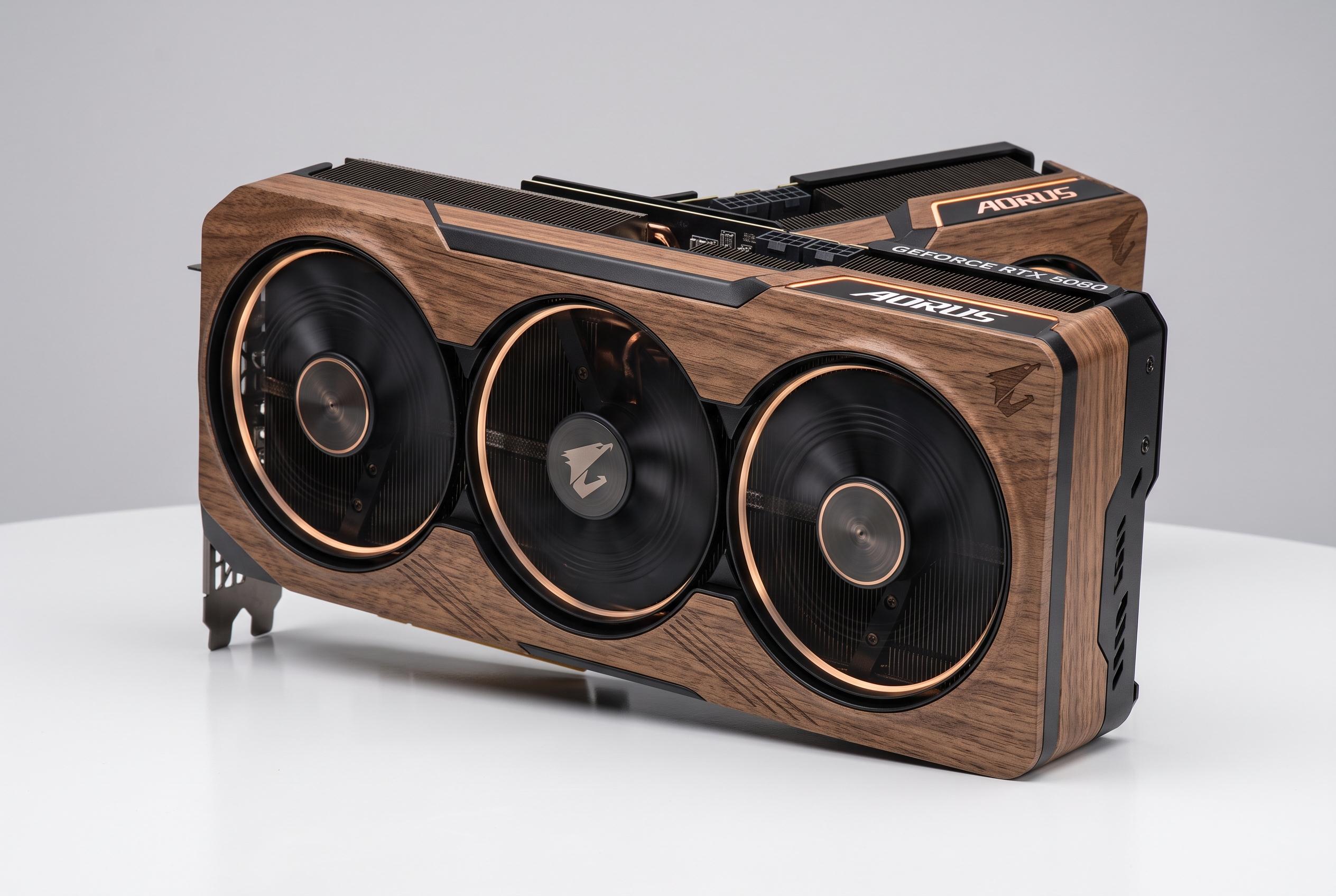

Gigabyte launches the AORUS GeForce RTX 5080 INFINITY WOOD, a flagship gaming GPU featuring a unique wood-grain design, advanced cooling, and modest performance gains over standard models amid a competitive high-end market.
Gigabyte’s AORUS GeForce RTX 5080 INFINITY WOOD 16G is a deliberate attempt to turn a high-end graphics card into both a performance product and a design object. The card sits within the new AORUS INFINITY line, which Gigabyte has positioned around its 40th anniversary, and the WOOD variant adds wood-grain detailing to the cooling shroud for a more distinctive appearance than the standard Infinity model. Despite the aesthetic focus, the hardware remains firmly in flagship territory, built around NVIDIA’s Blackwell architecture and aimed at demanding gaming and creative workloads.
The card uses the GB203 chip with 10,752 CUDA cores and 16GB of GDDR7 memory on a 256-bit bus. Gigabyte sets the boost clock at 2,805MHz, above the reference 2,617MHz specification, while the output section includes one HDMI 2.1b port and three DisplayPort 2.1 outputs. Power is supplied through a single 16-pin 12V-2×6 connector, and Gigabyte recommends an 850W power supply. The company also says the card supports DLSS 4.5, NVIDIA Reflex, ray tracing and path tracing features.
Cooling is one of the card’s main engineering points. Gigabyte’s WINDFORCE HYPERBURST system uses a dual-airflow layout that pushes air through both sides of the backplate, alongside Hawk fans, an Overdrive centre fan, direct-contact vapour chamber cooling, composite copper heatpipes and composite thermal compound. The card also has a reinforced metal backplate, a concealed power connector for cleaner cable management and RGB Halo lighting around the inner fan ring. Gigabyte says the product carries its Ultra Durable construction standards and a four-year warranty if the owner registers online within 30 days of purchase.
In testing, the AORUS card showed strong results against other custom RTX 5080 models and NVIDIA’s Founders Edition, though the margin was modest, as expected for cards based on the same GPU. Across five games, it generally led or matched the field and beat the Founders Edition by roughly 3% to 5%. Its most notable advantage came from sustaining higher operating clocks over time, with a recorded peak of 2,940MHz and an average under load of 2,860.2MHz when idle states were excluded.
Thermals and acoustics reflected a clear design trade-off. The Gigabyte card stayed quiet at idle but allowed temperatures to rise more than some rivals before stabilising at about 70C under heavy load. That left it closer to the Founders Edition than to ASUS’s Noctua-based RTX 5080, which maintained lower GPU and VRAM temperatures. Under prolonged stress, the AORUS ran about 10.9C warmer than the ASUS Noctua in Performance mode and about 5C warmer in Quiet mode, suggesting Gigabyte prioritised balance over maximum cooling headroom.
Overclocking results were respectable. In the review, the memory reached 36Gbps and the GPU gained 300MHz, with the power limit raised by 11%. Gigabyte’s own positioning, together with the review data, suggests a card aimed at buyers who want premium construction, strong sustained performance and a more individual look than a conventional gaming GPU. The main constraint remains price: the AORUS INFINITY WOOD belongs to a segment where a large premium buys refinement and style more than a dramatic jump in frame rates.
Disclaimer: This content is intended for informational purposes only. Readers are advised to exercise their own judgement, conduct due diligence, or consult a qualified expert before acting on any information provided.