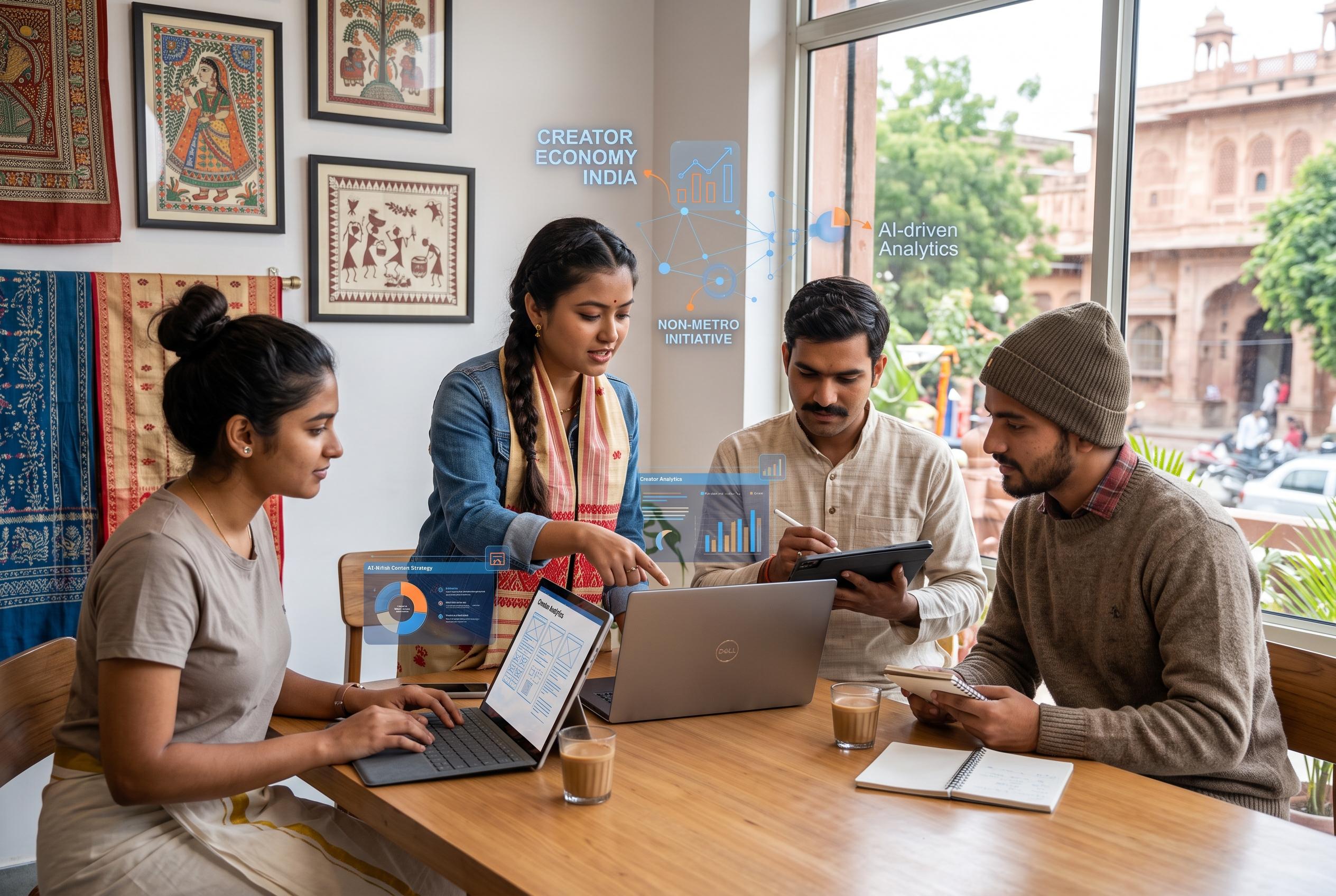

A surge in regional creators and AI integration is reshaping India’s young generation’s approach to creativity, work, and monetisation, with non-metro areas leading the charge.
Gen Z students are entering college with a different idea of what creativity means. It is no longer confined to art rooms or optional clubs. For many, it is tied to identity, community and career-building. That shift is visible in India’s fast-growing creator economy, which the Indian School of Business and Hashfame say expanded from 0.96 million creators in 2020 to 4.12 million in 2025.
The change is also geographic. The ISB-Hashfame report says 66% of creators now come from non-metro regions, with growth in those markets outpacing metro areas by a wide margin. Uttar Pradesh and Maharashtra together account for nearly a quarter of India’s creators, while states such as Tamil Nadu, Karnataka and Gujarat are over-represented relative to their populations. That points to a creator base that is broader, more regional and less dependent on India’s largest cities.
For students, this ecosystem offers more than an audience. It provides a way to learn by doing. Video editors, photographers and designers are using their own projects to build practical skills, experiment with style and develop a personal voice. As the sponsored article notes, the creative process often happens outside lectures, in hostels, cafés, on campus and on the move. That pattern reflects a wider change in how young people approach work: creation is becoming continuous, not occasional.
Technology is central to that shift. India is already a large digital market, and recent research suggests its creator economy is moving from content production towards monetisation. Boston Consulting Group estimates that 2 million to 2.5 million monetised creators are influencing more than $350 billion to $400 billion in consumer spending, with that figure potentially rising above $1 trillion by 2030. BCG also says generative AI is reshaping the sector by reducing repetitive work and opening new revenue streams such as subscriptions, virtual gifting and live commerce.
That helps explain why device makers are positioning laptops as creative tools rather than just student hardware. The Lenovo Yoga Slim 7x, powered by Qualcomm’s Snapdragon X platform, is being marketed around battery life, AI features and on-device processing. In practical terms, that means tasks such as editing, background removal and other AI-assisted functions can run without constant internet access, while leaving more room for other applications. For students juggling research, communication and content production, that kind of efficiency is part of the appeal.
The wider AI backdrop is mixed. The Indian Express previously reported that 92% of Indian employees regularly use generative AI, suggesting rapid adoption in the workplace. Yet other studies indicate the country still trails global leaders on broader AI diffusion. Even so, the direction of travel is clear: AI is becoming part of everyday creative work, and young creators are increasingly treating it as a support tool rather than a replacement for imagination. For Gen Z, the real value of technology lies in how it expands what they can make, share and refine.
Disclaimer: This content is intended for informational purposes only. Readers are advised to exercise their own judgement, conduct due diligence, or consult a qualified expert before acting on any information provided.