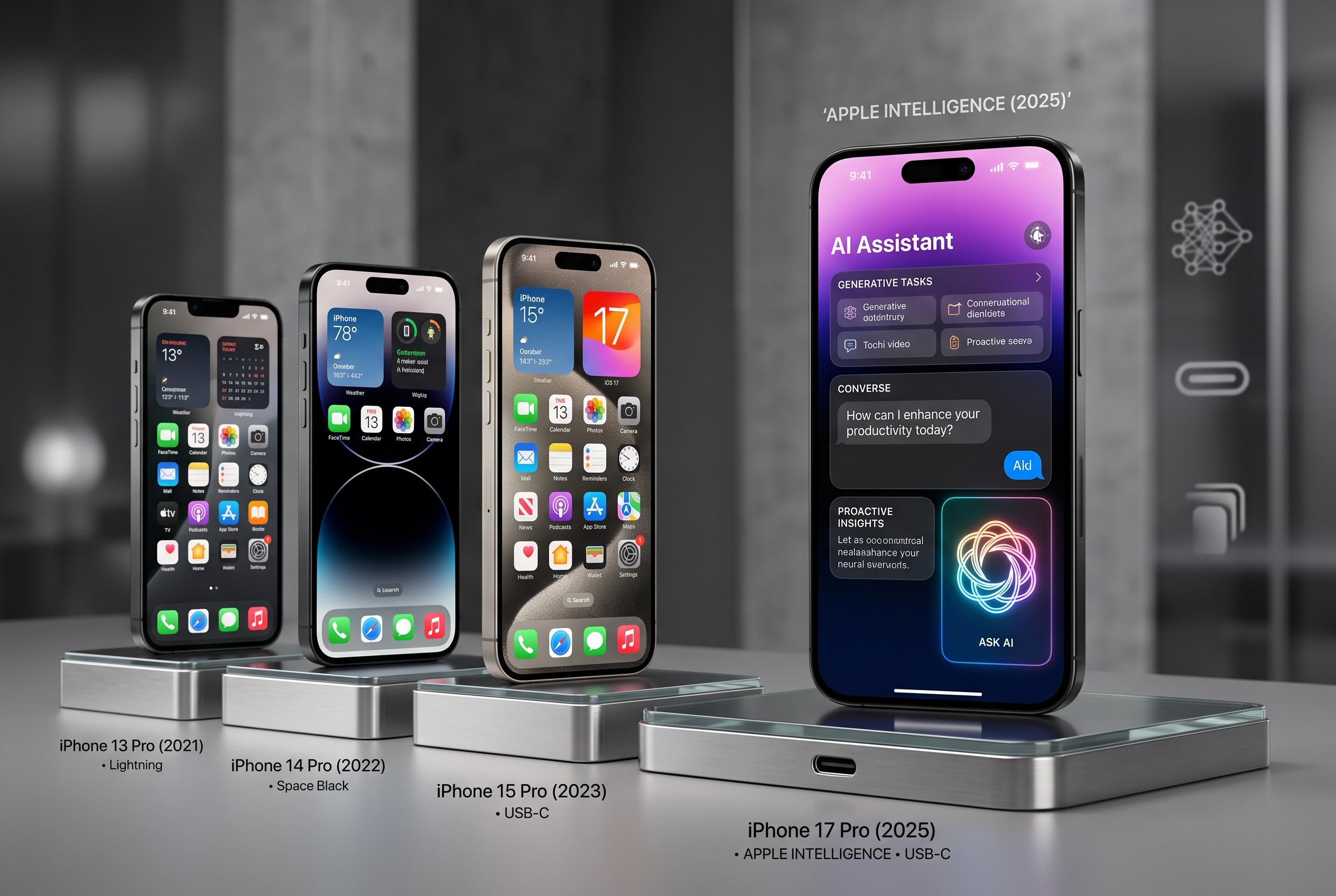

Over five years, Apple has transformed the iPhone by integrating AI-driven software, adopting USB-C, and rethinking hardware controls, making once-premium features standard across its lineup.
Over the past five years, the iPhone has changed in ways that are easier to miss than a new body shape but more important for day-to-day use. A review of the line from 2021 to the 2025 models shows Apple moving features once reserved for its highest-end devices into the mainstream, while also reshaping the way users charge, control and interact with the phone. The shift is visible in the display, the buttons, the camera system and, increasingly, in software driven by artificial intelligence.
One of the clearest turning points came with the end of Lightning. Apple replaced its long-standing proprietary connector with USB-C on the iPhone 15 line, after years in which the port had become an obstacle to speed and compatibility. Apple’s support documentation says USB-C on iPhone can be used for charging, syncing and connecting to external displays, while the Pro models also support faster data transfers. That change also made the phone easier to use with standard cables and accessories already common across laptops, tablets and other consumer electronics.
Apple also reworked the physical controls. The mute switch, a fixture since the first iPhone, gave way to the customisable Action button on the iPhone 15 Pro and Pro Max. According to MacRumors, that button can be assigned to functions such as the camera, torch, Voice Memos, Focus modes, Translate and accessibility tools. The company then added the Camera Control surface on later models, giving users a more direct way to adjust camera behaviour without digging through menus. These changes reflect a broader design trend: fewer fixed controls, more software-defined behaviour.
The display has followed a similar path. ProMotion, Apple’s adaptive refresh-rate system, expanded from Pro models into the wider line, delivering smoother motion at up to 120Hz when needed and lower rates when the screen is static to conserve power. The Dynamic Island also replaced the notched cut-out on newer Pro models and has since spread across most current iPhones. Apple later extended the always-on display beyond the top tier, another sign that features once treated as premium are becoming standard rather than exceptional.
Apple’s software story has shifted just as sharply. Apple Intelligence arrived in October 2024 on the iPhone 15 Pro and Pro Max, bringing text tools, image generation and live call translation, with Siri gaining more natural language handling and a deeper link to ChatGPT. The report also points to iOS 27 in autumn 2026 as the next major step, with more advanced Siri capabilities and some features restricted to the iPhone 17 Pro, Pro Max and iPhone Air. In parallel, the camera system has moved from 12-megapixel sensors on the iPhone 13 era to 48-megapixel main cameras and an 18-megapixel front camera on newer models, alongside stronger zoom options and higher-frame-rate video capture.
Security and connectivity have matured too. Apple introduced satellite emergency calling and crash detection with the iPhone 14, while the US-only shift to eSIM removed the physical SIM tray there even as European buyers kept it. The product line itself has been rationalised, with the mini discontinued, the Plus effectively replaced by the iPhone Air and base storage lifted from 128GB in 2021 to 256GB in 2025. The one constant, as the report notes, is the 5GB of free iCloud storage Apple has kept unchanged since 2011.
Disclaimer: This content is intended for informational purposes only. Readers are advised to exercise their own judgement, conduct due diligence, or consult a qualified expert before acting on any information provided.