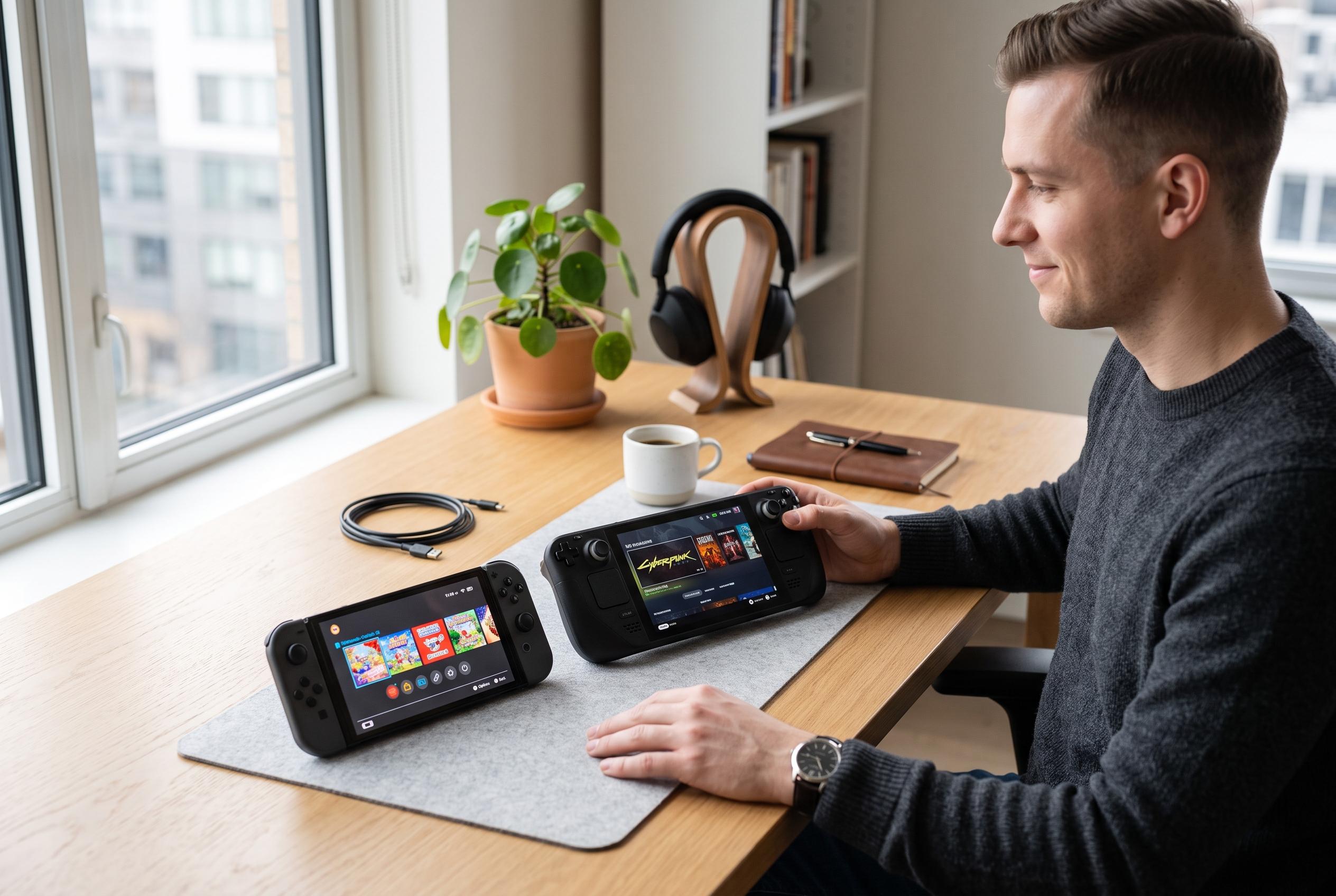

The portable gaming sector is shifting from niche to mainstream, driven by strong sales of Nintendo’s Switch 2 and growing demand for PC-based handheld consoles, redefining gaming convenience and hardware models.
Portable gaming is moving from a niche interest to a serious part of the hardware market, helped by strong sales for Nintendo’s Switch 2 and rising interest in PC-based handhelds. Nintendo said it had sold 19.86 million Switch 2 consoles worldwide by March 31, 2026, alongside 48.71 million software units, while the original Switch has now reached 155.92 million lifetime sales, a scale that underlines how durable demand remains for portable play.
The broader PC handheld segment is still far smaller, but the trajectory is clear. Research from Omdia, quoted in the article, estimates global PC gaming handheld shipments at 2.3 million units in 2025, up from 1.7 million in 2024, with annual sales projected to reach 4.7 million by 2029. That is not a direct rival to Nintendo’s volume, but it is enough to show that portable gaming now supports more than one business model.
What makes the category compelling is not raw performance alone. For many players, the appeal is access: the ability to start a game on a sofa, on a train or during a short break without committing to a desk setup. The article’s central point is that handhelds are winning on convenience, not on replacing a full gaming PC.
That distinction matters because the hardware challenge is different from a desktop’s. A handheld must balance speed with battery life, heat and weight, and that means sustained performance is more important than headline frame rates. In the article, Kaustubh K. Jadhav of ARC argues that the category is becoming credible because the whole stack, from processor to software, is finally being shaped around portable use.
Software remains the harder problem. Windows still dominates many PC handhelds, but a desktop-first operating system can feel awkward on a small touchscreen device operated mainly with controls. Jadhav says many current devices still behave like “powerful miniature PCs”, burdened by multiple launchers, driver management and controller-unfriendly menus. His view is that a good handheld should work more like an appliance: switch it on, find a game and play.
Microsoft has begun to address that friction with Windows features aimed at handhelds, including an Xbox mode designed for controller-led navigation and a compatibility programme for games that work better on smaller screens. Valve has taken a different path with SteamOS, which reduces the sense that users are wrestling with a traditional PC interface when they only want to launch a game. Together, those efforts show that the software layer is becoming as important as the chip inside the device.
Valve’s influence is especially important because the Steam Deck changed expectations for the category. The device showed that a PC handheld does not need to feel like a mini laptop, and that a more console-like front end can make a PC library much easier to use. Recent SteamOS beta work extending support to more third-party handhelds suggests Valve is widening that model beyond its own hardware.
Nintendo, meanwhile, has already proved the value of the format by building an entire business around it. The Switch 2’s sales momentum, including 2.49 million hardware units and 10.78 million software units in the quarter to March 31, 2026, shows that portable-first design still resonates with mainstream buyers. Title sales such as “Mario Kart World”, “Donkey Kong Bananza” and “Pokémon Legends: Z-A Nintendo Switch 2 Edition” also show that the hardware is being supported by strong software demand.
The next barrier is price. As the article notes, handheld PCs are creeping into the territory of gaming laptops, which offer larger screens, keyboards and broader general-purpose usefulness. Omdia has also warned that global PC shipments could fall 12% in 2026 to 245 million units, with lower-priced systems under pressure from rising component costs, a trend that could make affordable handhelds harder to build at scale.
India illustrates both the opportunity and the limit. Lumikai’s 2025 research puts the country’s gaming market above $1.5 billion, with 555 million gamers and 66% of them in non-metro cities. That is a large audience, but the article is right to note that smartphones already satisfy most casual needs. A dedicated handheld must therefore offer controls, portability and access to deeper games that a phone cannot match, while still avoiding the cost and complexity of a full PC.
For now, the best reading is that handheld gaming is becoming a complementary platform rather than a replacement for the desktop. Competitive games, strategy titles and visually demanding releases will still favour a proper PC, but portable hardware is increasingly useful for everything in between. The market’s growth suggests the winning devices will be the ones that combine efficient silicon, better software and sensible pricing, not simply the ones with the fastest chip.
Disclaimer: This content is intended for informational purposes only. Readers are advised to exercise their own judgement, conduct due diligence, or consult a qualified expert before acting on any information provided.