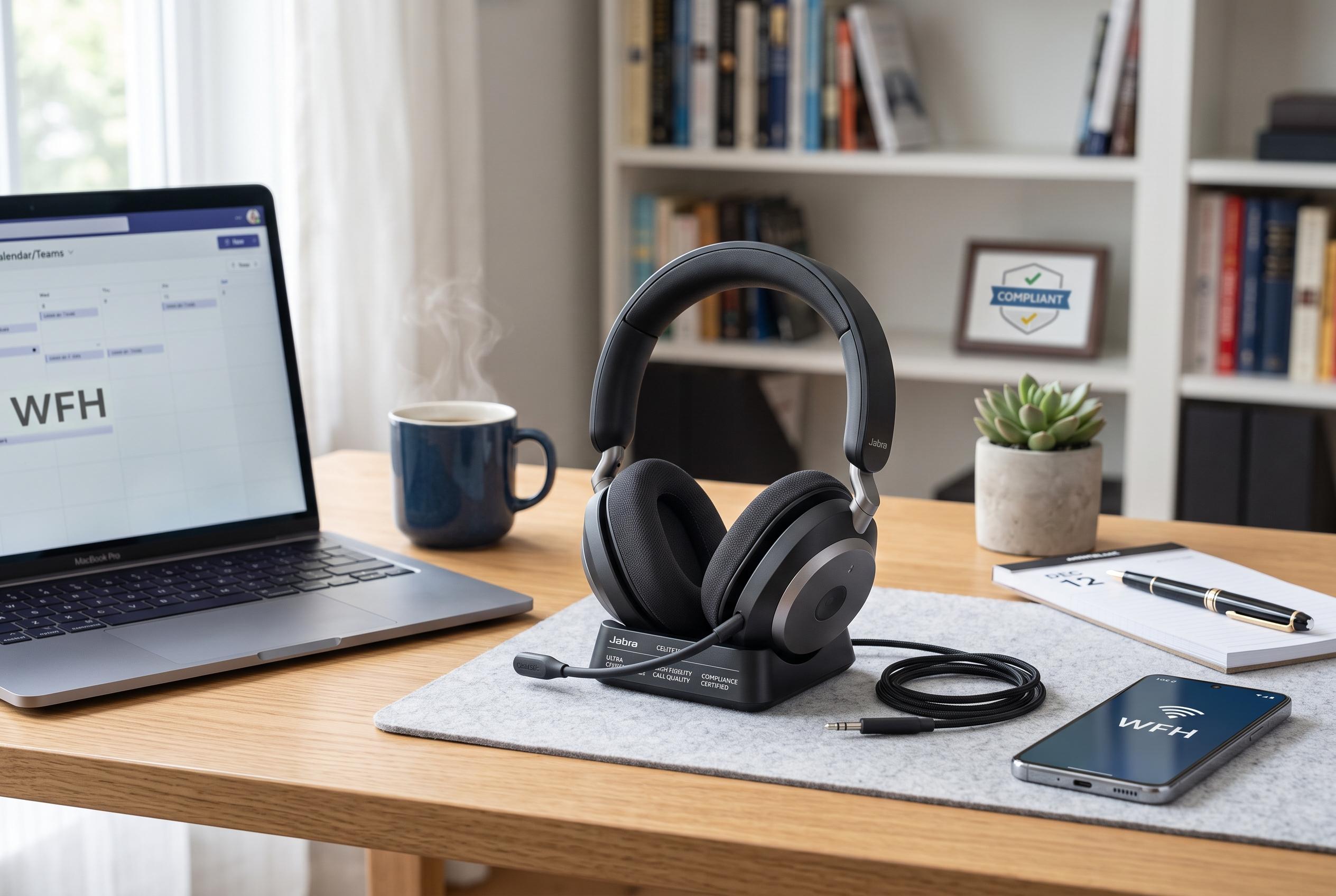

Selecting the right headset for remote work involves navigating employer rules, prioritising comfort and call clarity, and choosing between wired and wireless options that meet evolving standards in 2026.
Choosing a headset for a work-from-home phone job is less about brand preference than about compliance, comfort and call quality. The first step is to check the employer’s equipment rules, because some firms supply headsets while others insist on a specific model or connection type. That matters legally as well as practically: Nolo notes that employers may sometimes require workers to buy their own equipment, but reimbursement rules can vary. In most cases, if no exact model is named, a wired USB headset with two earpieces and a boom microphone is the safest default for call work.
The main technical question is what the headset must do. Active noise cancellation, or ANC, reduces the noise you hear, but it does not stop a caller from hearing a loud room. For that, the microphone needs its own noise-reducing design. RTINGS and other 2026 buying guides for office and work-from-home use place similar emphasis on comfort, battery life and microphone performance, especially for long sessions. That is why padded ear cups, an adjustable headband and inline mute and volume controls remain practical features rather than extras.
For higher-end buyers, current recommendations typically include business-focused models such as the HP Poly Blackwire 8225, Logitech Zone Wired 2 and Jabra Evolve2 40 SE. Wireless options such as the Jabra Evolve2 65 Flex and HP Poly Voyager Focus 2 UC are also commonly highlighted for employees whose workplaces allow them. Budget-conscious shoppers are usually directed towards wired models such as the HP Poly Blackwire 3220, Jabra Evolve 20, Logitech H570e, Jabra Evolve2 30 SE and HP Poly Blackwire 5220. Across several 2026 headset round-ups, the same pattern appears: established office brands tend to outperform generic consumer headphones for call clarity and day-long wear.
Before buying, the finer details matter. Check whether the job requires USB-A or USB-C, stereo or mono, and whether the headset must work with specific calling software. A model that “works with PC” may still be wrong for a particular employer. If wireless use is allowed, battery life and charging behaviour should be confirmed. If wired is required, cord length and a comfortable fit matter more than flashy features. In practice, the best purchase is often the one that matches the employer’s list exactly, even if it is less exciting than a premium consumer headset.
Disclaimer: This content is intended for informational purposes only. Readers are advised to exercise their own judgement, conduct due diligence, or consult a qualified expert before acting on any information provided.