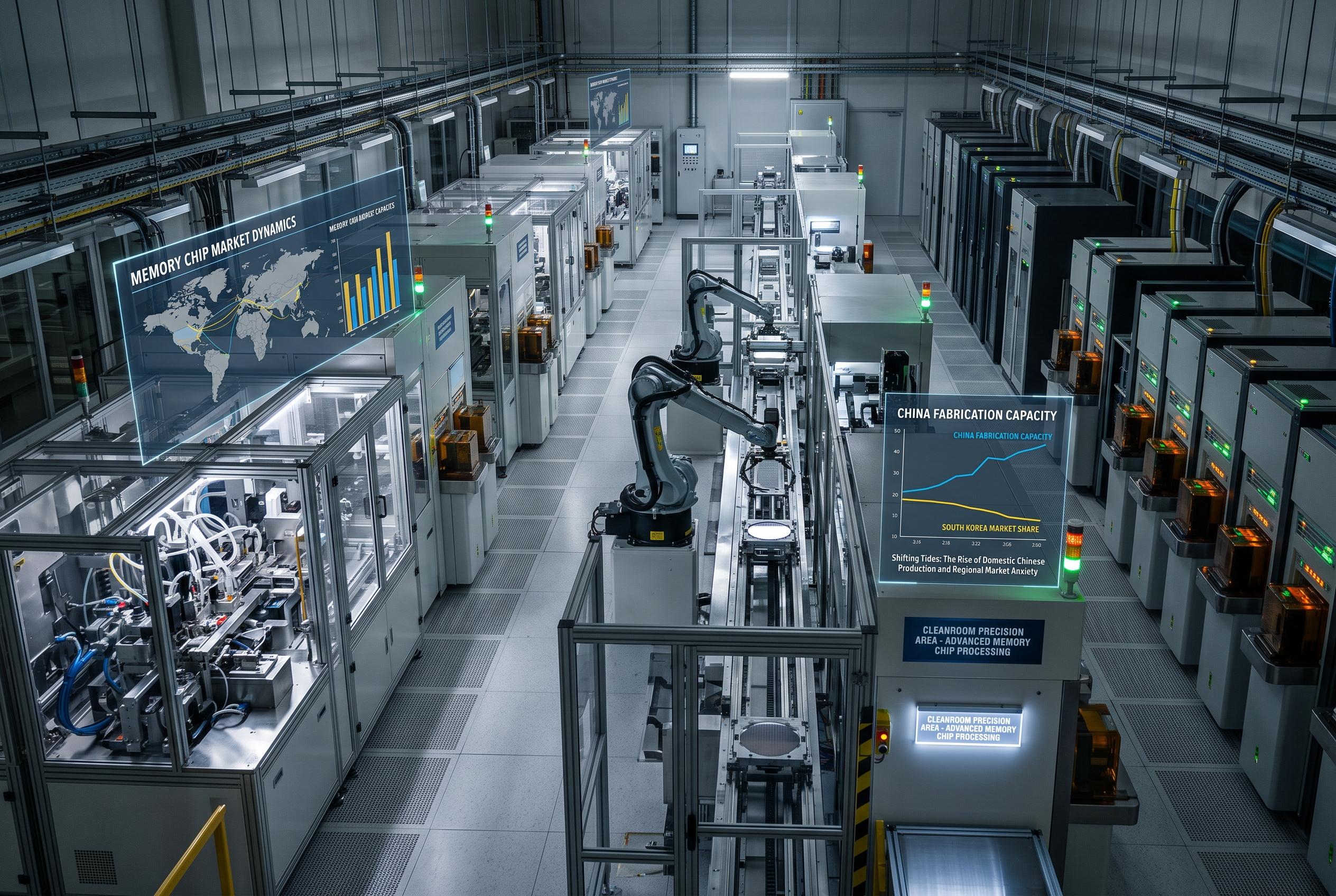

Despite tentative signs of domestic production, China’s advances in memory and lithography equipment are intensifying investor anxiety in South Korea, highlighting ongoing technological and geopolitical tensions in the global chip industry.
China’s memory-chip advances are unsettling South Korean markets, even though they are not yet strong enough to overturn the technology lead held by Samsung Electronics and SK Hynix. The latest anxiety has been driven by two developments in late July: reports that China has begun domestic production of immersion deep ultraviolet, or DUV, lithography equipment and a sharp rise in ChangXin Memory Technologies’ market value after its listing, which is expected to help fund further expansion.
Analysts in Seoul say the market reaction says as much about fragile sentiment as it does about China’s actual progress. Park Sang-jun of CMS Securities argued that the CXMT listing rattled investors because semiconductor equities were already under pressure. He also cautioned that claims of a locally made immersion DUV system remain unproven in practice. If the breakthrough were already being treated as credible by the Chinese market, related equipment shares would ordinarily have rallied, he said, rather than falling the next day.
Reuters has reported that Chinese state-linked Shanghai Aishengna Electronic Technology Group has started producing immersion DUV tools, with output expected to be about five units this year and around 20 by 2027. But industry observers say the equipment still requires extensive testing and remains behind ASML in performance, yield, throughput and reliability. For now, that means the new tools are not seen as an immediate threat to ASML or to South Korea’s chipmakers.
Even so, the strategic significance is clear. China has been blocked from the most advanced extreme ultraviolet tools and faces export controls on some high-end DUV systems. DUV is less precise than EUV, but multiple-patterning techniques can still support more advanced chip production. If Beijing succeeds in building out a domestic equipment chain, even with lower efficiency, that could gradually weaken the technology choke points created by sanctions.
The bigger concern for Seoul may be in memory, where China is already making steady gains. Samsung and SK Hynix have shifted more capacity towards high-bandwidth memory, or HBM, for artificial intelligence workloads, tightening supply in conventional DRAM and pushing prices higher. That has created space for CXMT to expand. Recent reports say the company is preparing for a faster build-out after its listing, while separate research suggests it could nearly match Micron’s DRAM production capacity in 2026 and become the world’s second-largest DRAM maker if expansion plans proceed.
There are also signs of deeper Chinese coordination in advanced memory. Reports from late 2025 said CXMT and Yangtze Memory Technologies Corp. were working together to accelerate domestic HBM development, combining DRAM capability with hybrid bonding know-how. At the same time, South Korean authorities have been pursuing industrial espionage cases involving former Samsung employees accused of passing sensitive 10-nanometre DRAM data to CXMT, underscoring how seriously Seoul views the competitive threat.
Still, the immediate picture is more nuanced than the market panic suggests. Research and industry reporting indicate that South Korea’s memory exports to China have already been under pressure, but AI-related demand remains strong and memory pricing is being shaped increasingly by long-term contracts rather than pure spot-market swings. That means the “China shock” is, for now, more a reflection of investor unease about what may come next than proof that South Korea has already lost its edge.
Disclaimer: This content is intended for informational purposes only. Readers are advised to exercise their own judgement, conduct due diligence, or consult a qualified expert before acting on any information provided.