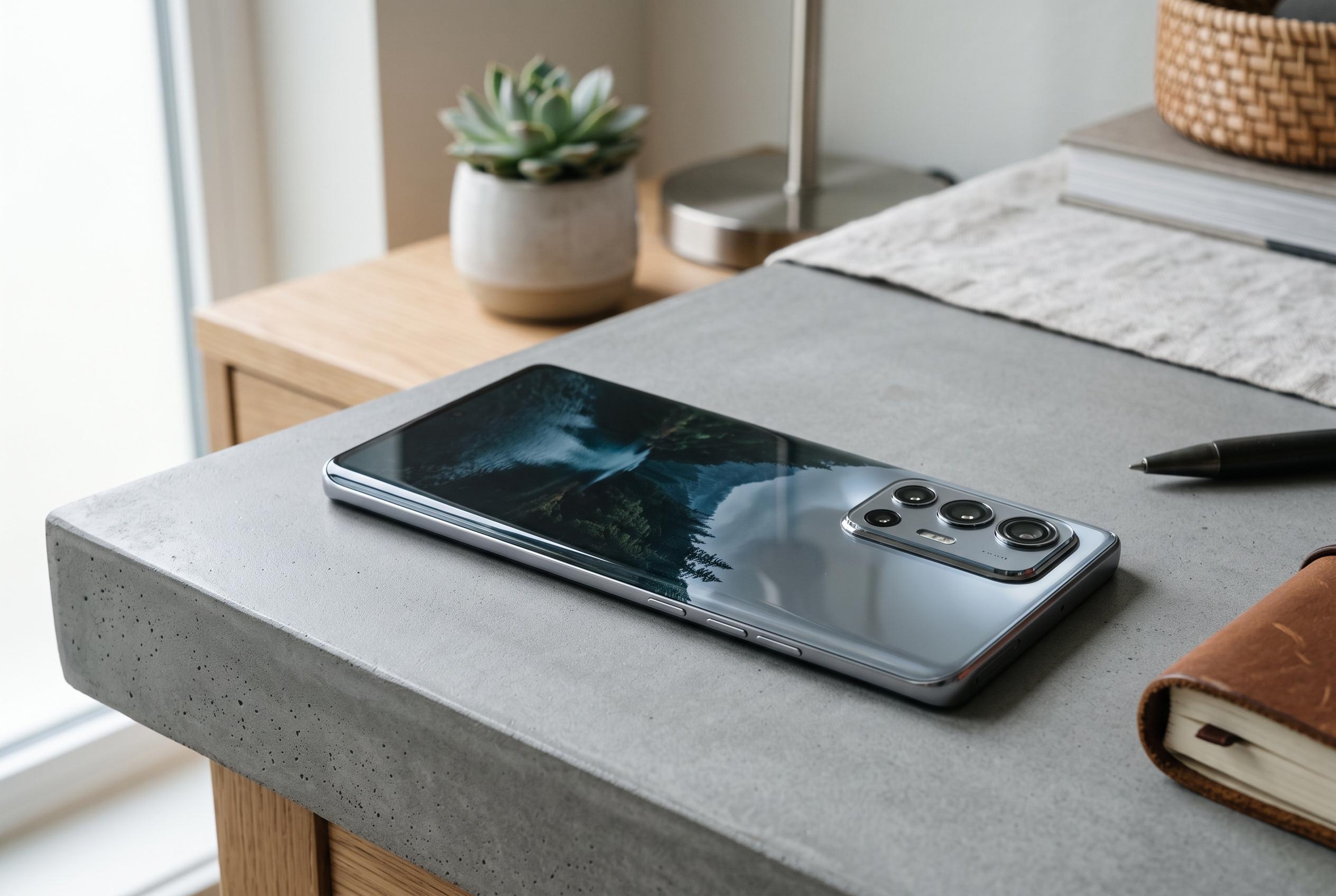

Motorola’s Edge 70 Plus offers a distinctive identity with a focus on battery life, display brightness, and photography, but adopts a more modest processor compared to its predecessor, signalling a strategic shift in its mid-range flagship lineup.
Motorola has brought the Edge 70 Plus to market as a distinct variant rather than a simple step above the Edge 70, with pre-orders now under way after its 3 September unveiling at IFA in Berlin and first sales expected from 23 September in parts of Europe. Motorola’s own announcement only says the handset will roll out in selected countries across Europe and the Middle East over the coming weeks. Stuff reported that there are currently no plans for a US release, while Gadgets 360 said India pricing and availability had still not been announced.
That positioning matters because Motorola is selling the phone on stamina, design and photography rather than outright speed. The company describes a quad-curved body and a 6.78in Extreme AMOLED panel with 2,772 x 1,272 resolution, a 144Hz refresh rate and up to 5,200 nits of peak brightness. Tech Advisor said the handset is 8.49mm thick and weighs 196g. It also noted that the protection level is only IP64, even though Motorola pairs that with MIL-STD-810H testing and Gorilla Glass 7i. Motorola’s launch material lists four Pantone finishes, including Sage, but retail-facing reports in Europe mainly mention Gray Lilac, Mountain View and Milky Blue.
The clearer upgrade is the battery. Motorola says the Edge 70 Plus carries a 6,500mAh cell and claims up to 42 hours of calls, 34 hours of video streaming or 23 hours of social-media use on one charge, based on its own testing. Wired charging tops out at 45W and the phone supports bypass charging to reduce heat while gaming. Technologist Mag noted that this is a substantial jump from the regular Edge 70’s 4,800mAh battery, but it also highlighted a trade-off: the standard model charges at 68W.
Camera hardware follows the same logic. The Plus model moves to a 200-megapixel main sensor with optical image stabilisation, while supporting coverage says Motorola is also touting 10x Super Zoom, 4K video and low-light processing. The front camera is 32 megapixels, and the remaining rear hardware appears limited to a macro camera and a light sensor. That is a notable change from the regular Edge 70, which Technologist Mag said offered a 50-megapixel main camera, a 50-megapixel ultrawide and a 50-megapixel selfie camera. In other words, the new handset adds headline resolution, but may give up some flexibility.
Performance looks more conservative. Several reports say Motorola has chosen Qualcomm’s Snapdragon 7s Gen 3, backed by 8GB of LPDDR5X memory and either 128GB or 256GB of storage. Technologist Mag contrasted that with the Edge 70’s Snapdragon 7 Gen 4, up to 12GB of RAM and up to 512GB of storage, suggesting the Plus name masks a more selective upgrade. Tech Advisor was blunter, arguing that the chip sits below what many buyers would expect at this price. Stuff cast the phone as a value play aimed at buyers who might otherwise look at devices such as Google’s Pixel 10a.
Pricing has been less tidy than the specification sheet. Motorola’s official IFA announcement gave rollout regions but did not publish a handset price, and Gadgets 360 likewise reported that the brand had not yet detailed phone pricing at that stage. Within hours, however, UK and European coverage began listing firm figures. Tech Advisor reported a £499.99 starting price for a 128GB version and £529.99 for 256GB, while 91mobiles said the European price was €599.99 for an 8GB/256GB model. That same report said pre-orders had opened and that buyers would receive a Moto Watch Fit and Moto Tag 2 bundle at no extra cost, suggesting that pricing and configurations may vary by market or channel.
The IFA launch was also meant to show a broader Motorola hardware ecosystem. Alongside the phone, the company introduced the Moto Watch Ultra, which Motorola and Gadgets 360 said starts at €429 and adds Wear OS, LTE eSIM and Polar-powered health and fitness features. Motorola also launched the Moto Snap wireless charger, priced from €39 according to Gadgets 360 and £39.99 according to Tech Advisor, with up to 25W on Qi2.2 devices and up to 30W on compatible Motorola phones. The awkward detail is that the Edge 70 Plus does not seem to be one of them: Tech Advisor said the phone lacks wireless charging, and Stuff went further, saying neither of Motorola’s new handsets at the show would support the accessory.
Taken together, the Edge 70 Plus looks less like a straightforward successor and more like Motorola’s attempt to fill another niche in an already crowded Edge 70 family. Buyers who care most about battery life, a very bright display and a high-resolution main camera may find the formula attractive, especially with the September sales push. Those comparing spec sheets more closely, however, will notice the weaker water resistance, slower charging, lower-tier processor and leaner camera assortment relative to the regular Edge 70. The result is a phone with a clear identity, but not an uncomplicated place in Motorola’s line-up.
Disclaimer: This content is intended for informational purposes only. Readers are advised to exercise their own judgement, conduct due diligence, or consult a qualified expert before acting on any information provided.