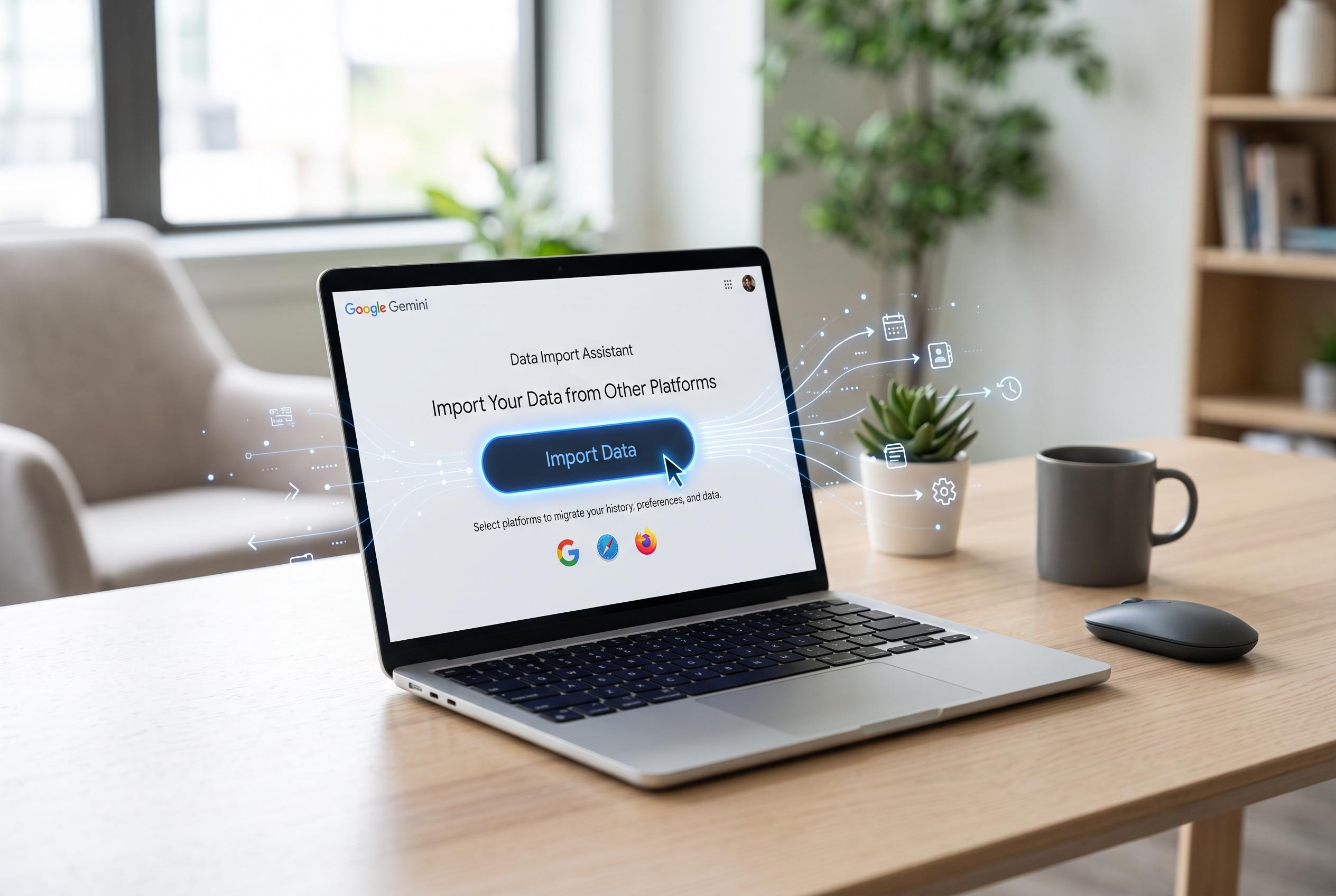

Google’s new Gemini import feature allows users to bring preferences and history from rival AI platforms, easing service switching but revealing the complexity of maintaining true AI continuity across systems.
Google’s new Gemini import feature marks a meaningful shift in consumer AI. According to Google’s support documentation, eligible users can bring in preferences, remembered facts and chat history from other AI platforms, including ChatGPT and Claude, so a new assistant can start with some sense of who the user is and how they work. That is an important step, but Google also says the feature is not available in the UK, the European Economic Area or Switzerland.
OpenAI has long offered a different kind of mobility. Its help pages explain that users can export ChatGPT history and account data for backup or transfer, but the company is explicit that export is not the same as migration. The downloaded record can be reused, yet it does not recreate the original account environment, settings or workspace access. That distinction goes to the heart of the debate over what AI portability really means.
The stronger case for Gemini’s new importer is not that it solves the problem, but that it lowers the cost of switching. Reporting from MacRumors and TechRadar says the tool can pull in summaries of user behaviour, preferences and personal context from rival assistants, helping users avoid starting from scratch when they move services. Tom’s Guide adds that the process can involve generating a structured summary from a prompt in the old assistant, then feeding that material into Gemini.
Still, a chat archive is not the same as a live work environment. A transcript can show what was said, but it does not automatically preserve which issue is current, which decision is final, which draft has been superseded or which task is still open. That matters for anyone using AI to support long-running projects, because continuity is about current state as much as historical memory.
The article’s broader point is that AI systems hold several different kinds of state, and they should not be confused. Open pages, files, tabs, repositories and external tools can all be part of the task, but they sit outside the conversation log. Even browser products illustrate the problem: when OpenAI wound down Atlas, users were told to save important data because bookmarks, tabs and history would not simply follow them elsewhere.
That is why portable memory is only part of the answer. Preferences such as “keep answers concise” are useful, but they are not enough to capture project authority, provenance or unresolved work. A durable AI layer would need to track not just what a user likes, but what has been decided, what evidence supports it and what should happen next.
The architectural implication is clear: the user’s continuity data should ideally live outside any single model provider. In that arrangement, the provider becomes a replaceable capability layer, while the durable record remains under user control. The article frames that as the difference between owning continuity and renting capability, a model that would make it easier to switch between OpenAI, Anthropic, Google and future systems without losing the underlying work.
For now, the industry is only part of the way there. Google has made cross-platform import more practical, OpenAI allows exports and reference-based reuse between personal accounts, and Claude also supports data export. Together, those moves suggest that major providers are beginning to treat user history as something with value beyond a single account. The harder question, and the one that remains unresolved, is whether the next generation of tools will let users resume an AI relationship rather than merely recover its past.
Disclaimer: This content is intended for informational purposes only. Readers are advised to exercise their own judgement, conduct due diligence, or consult a qualified expert before acting on any information provided.