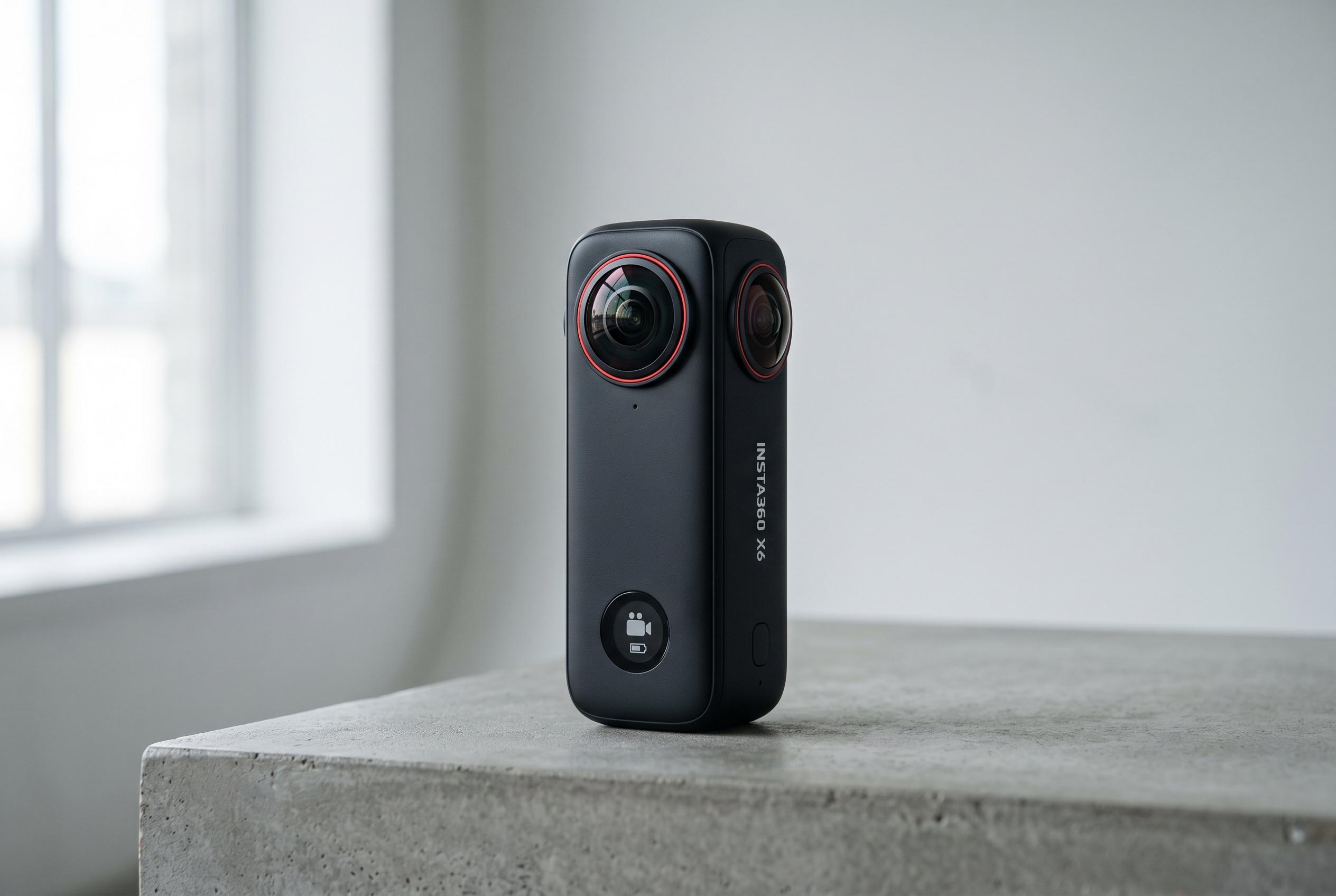

Insta360’s new X6 camera claims to be the company’s most advanced consumer 360-degree device yet, featuring larger sensors and improved low-light performance, though the upgrade may not justify its price for all users.
Insta360’s X6 arrives as the company’s strongest consumer 360-degree camera to date, but it is best understood as a refinement rather than a reinvention. CNET’s Geoffrey Morrison said the device is the most capable model he has tested from the category, yet he also argued that the gains over the X5 are modest for many buyers. The new camera pairs a smaller body with larger sensors, faster processing and a higher-resolution imaging pipeline aimed at improving detail and low-light performance.
The hardware changes are meaningful. According to CNET’s review, the X6 uses dual custom 1.1-inch square Sony sensors, records 8K 360-degree video at up to 50 frames per second and captures stills at 120 megapixels. Insta360 has also added a larger battery, improved microphones with wind protection, 10-bit colour and Dolby Vision HDR support, alongside waterproofing to 20 metres without a case. Earlier leak reports from Digital Camera World, Gadgets 360 and Gizmochina pointed in the same direction, suggesting that the company was preparing a more compact camera with a bigger battery and 1,200-nit display.
The design is also more practical. Morrison noted that Insta360 has shortened the body, making the X6 feel less awkward in hand and easier to carry than previous models. The camera keeps the large touchscreen but replaces the physical buttons below it with pressure-sensitive on-screen controls, supplemented by haptic feedback. That approach saves space and supports the smaller form factor, although it is still less intuitive than traditional buttons.
Image quality appears to be the headline reason to buy it. CNET found that the X6 performs better in low light than the X5 and much better than older models, though the improvement is not as dramatic as the marketing suggests. In daylight, footage is detailed, colourful and relatively clean, while the Pro mode gives more control over exposure and colour balance. The trade-off is workflow: 8K files are demanding, and many phones still cannot comfortably edit the highest-resolution footage or make full use of 120-megapixel stills.
The software ecosystem remains central to the appeal. Insta360’s app is broad and occasionally cluttered, but it offers a capable editor, guided tutorials and AI-assisted tools such as Auto Edit and AI Director, which can assemble a shareable video automatically after the camera is recharged. That sort of automation may help newcomers cope with the complexity of 360-degree shooting, even if manual editing still delivers better results. CNET also highlighted the importance of user-replaceable lenses, which it described as a decisive advantage over rival products such as DJI’s Osmo 360, whose similar hardware is offset by a more awkward app strategy and non-replaceable glass.
The broader verdict is clear. The X6 is an excellent camera for enthusiasts, especially those shooting indoors, at night or in mixed light, and for users who want a 360 device that can also serve as a competent wide-angle camera. But for many buyers, the X5 remains close enough in capability to make the upgrade hard to justify at the launch price of about $700. The result is a familiar Insta360 pattern: the company still leads the category, but the newest model is most compelling for people who need the best rather than simply something very good.
Disclaimer: This content is intended for informational purposes only. Readers are advised to exercise their own judgement, conduct due diligence, or consult a qualified expert before acting on any information provided.