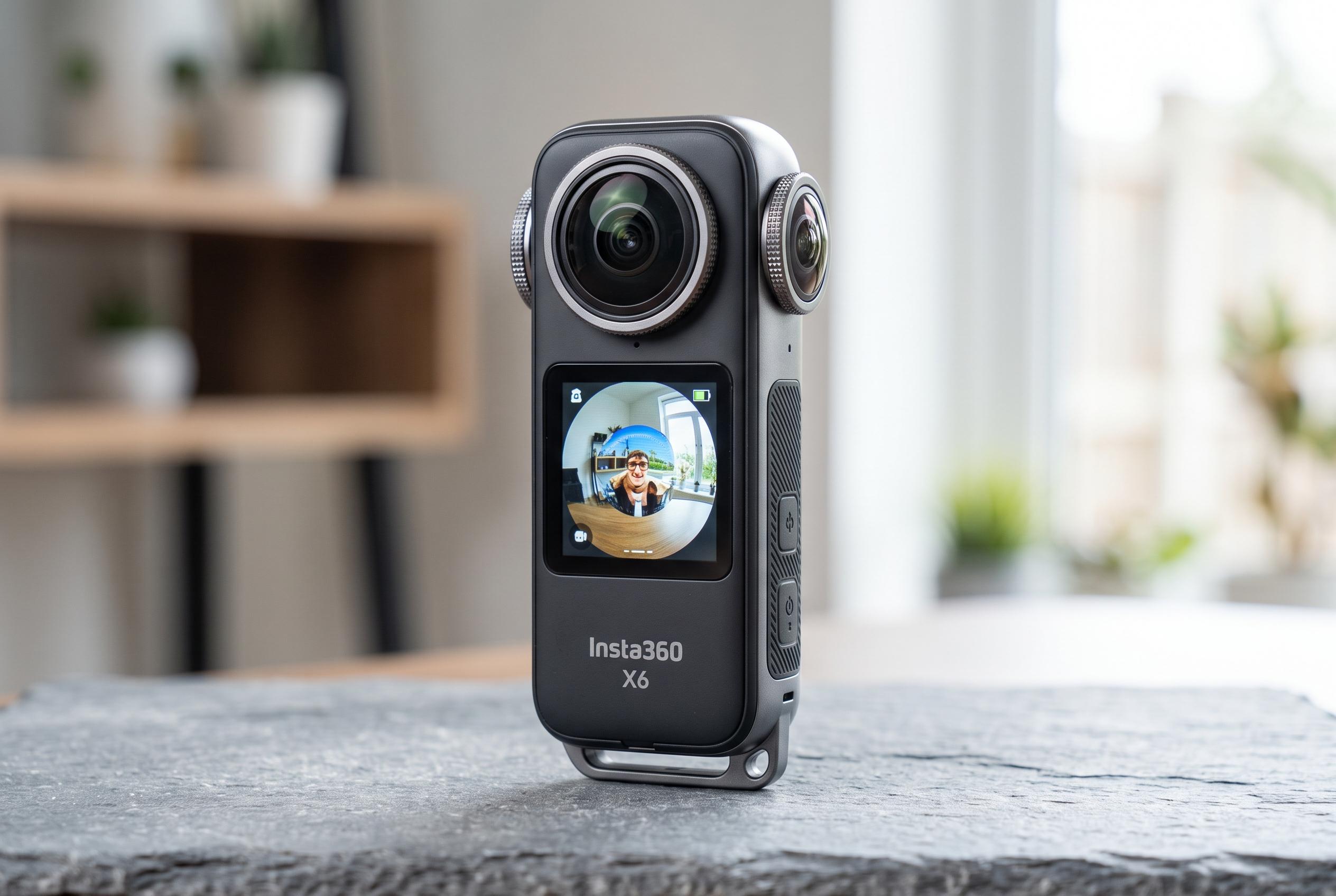

The Insta360 X6, the company’s latest flagship 360-degree camera, introduces larger sensors, higher resolution, and greater durability, positioning itself as the top all-round compact 360 camera amid increasing competition, despite software challenges.
The Insta360 X6 arrives as the company’s latest flagship 360-degree camera at a time when the category is far more crowded than it was even a year ago. TechRadar says it is competing not only with previous Insta360 models such as the X5 and X4, but also with newer rivals from DJI and GoPro. That matters because the X6 is not simply a routine refresh. It is a bid to remain the benchmark for compact 360 cameras, and on the evidence of the review it does so with confidence.
At the hardware level, the X6 is the most impressive version of Insta360’s formula yet. TechRadar reports that it uses larger dual 1/1.1-inch sensors, supports 8K video at up to 50 frames per second and raises still-image capture to 120 megapixels for 360 shots. The camera also keeps the features that have made the X-series popular, including replaceable lenses, strong stabilisation, built-in storage and a design that remains compact enough for travel, sport and mounted shooting. Tom’s Guide’s earlier reviews of the X5, X4 and X3 show how Insta360 has steadily pushed the line forward, from the One X’s 5.7K footage to the X4’s 4K single-lens mode and the X5’s stronger low-light performance and lens protection system.
Durability is another area where the X6 stands out. TechRadar says it is IP68-rated, waterproof to 20 metres without a case and to 60 metres with Insta360’s dive housing, which is deeper than the limits reported for the DJI Osmo 360 and GoPro Max 2. The review also notes that the lenses are claimed to be more scratch-resistant than before and remain easy to replace if damaged. That combination makes the X6 unusually practical for users who want one camera that can move from dry land to underwater work without much compromise.
Battery life and imaging performance also appear to justify the premium. TechRadar found that the X6 came close to Insta360’s claim of 140 minutes of 8K recording, while also avoiding overheating in extended testing. Image quality, meanwhile, is where the camera pulls away from the field. The review says the X6 delivers excellent daylight detail and, more importantly, class-leading low-light performance through its PureVideo mode and wider 10-bit colour support. Tom’s Guide’s review of the X5 had already highlighted the benefits of larger sensors for night shooting, but TechRadar says the X6 pushes that strength further and removes the old trade-off between daytime sharpness and nighttime usability.
The main caution is software. TechRadar describes the mobile app as unstable during testing, with repeated crashes during editing and export, even though the camera itself is robust and capable. That matters because Insta360 is leaning heavily on features such as AI Director, InstaFrame 2.0 and native Dolby Vision support, all of which are aimed at serious creators who want a more complete workflow. The desktop software was more reliable, but the overall conclusion is clear: the X6 is expensive, and its app ecosystem still lags behind the hardware. Even so, for buyers who want the strongest all-round small 360 camera currently available, TechRadar’s verdict is that the X6 makes a compelling case.
Disclaimer: This content is intended for informational purposes only. Readers are advised to exercise their own judgement, conduct due diligence, or consult a qualified expert before acting on any information provided.