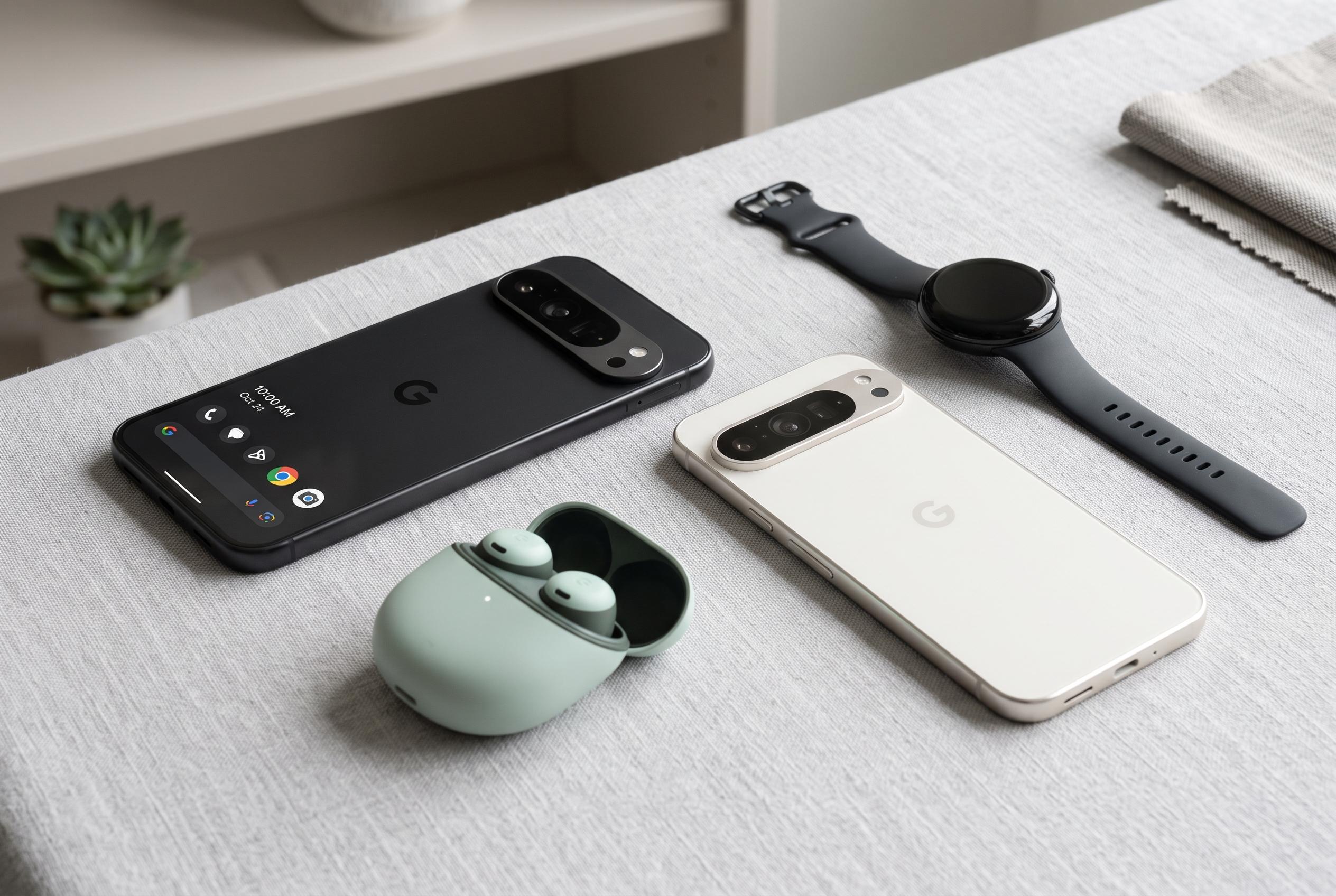

Google unveils its latest Pixel smartphones featuring slimmer camera designs, advanced AI tools, and new accessories, signalling a strategic push to bolster its ecosystem amidst stiff competition from Apple and Samsung.
Google has refreshed its Pixel line with thinner camera housings, new artificial intelligence tools and a sharper push to persuade buyers that its software is worth upgrading for. The latest handsets, unveiled on Wednesday, are designed to make routine tasks faster and to widen the use of Google’s Gemini AI features across the company’s hardware ecosystem.
According to Google’s presentation and reporting by Axios, the new range is built around the Tensor G6 processor, which the company says improves power efficiency and speeds up browsing and app loading. Google has also removed the 128 gigabyte entry model, with the base storage now doubling to 256 gigabytes. The move comes as component costs rise and as Google tries to strengthen its position in a market still dominated by Apple and Samsung.
Pricing has moved up accordingly. In the United States, the Pixel 11 starts at $900, the Pixel 11 Pro at $1,100 and the Pixel 11 Pro XL at $1,300, while the Pixel Pro Fold begins at $1,900. Google is also offering six months of its AI Pro subscription with the Pro models, a clear sign that it wants buyers to use more of its Gemini toolkit rather than treat AI as an optional extra.
The software additions are aimed at making the phones feel more capable in everyday use. Google has added live translation for videos, podcasts and voice messages, as well as features such as photo extraction from video, a teleprompter, improved speech-to-text and better video stabilisation, according to Forrester analyst Andrew Cornwall. On the Pro models, a new HiLight feature lets users assign colours to contacts so the phone can light up in that colour when it is face down, extending Pixel’s existing “Flip to Shhh” function.
Camera improvements remain central to the pitch. Google says the new Magic Capture mode can take a burst of photos and video with one shutter press, while improved light sensitivity and a faster Instant Night Sight mode are meant to help in darker settings without requiring users to hold the phone steady for as long. The company also introduced Pixel Tag, its first tracking accessory, priced at $30 for one or $100 for four and compatible with Android 9 or later. Analysts quoted by Android Central said the launch underscores a broader strategy: using incremental hardware changes, AI features and accessory tie-ins to make Pixel a more complete ecosystem, even if it still trails the iPhone in mainstream popularity.
Disclaimer: This content is intended for informational purposes only. Readers are advised to exercise their own judgement, conduct due diligence, or consult a qualified expert before acting on any information provided.