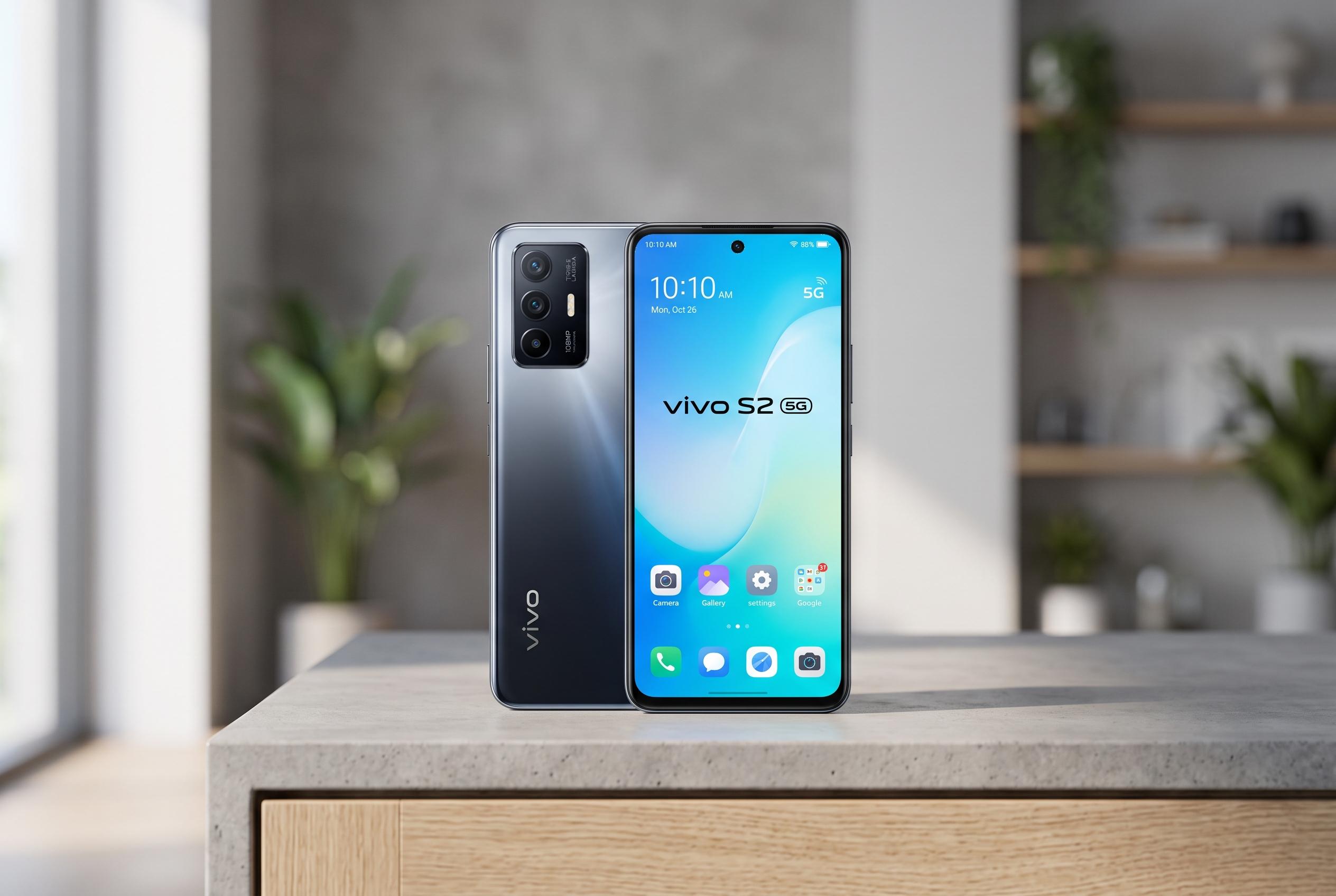

Vivo’s new S2 5G enters the Indian market as a more powerful alternative to Oppo’s F33 5G, offering advanced display, processing, and battery tech , but at a higher price point.
Vivo’s newly launched S2 5G is being positioned as a direct challenger to Oppo’s F33 5G, a handset that arrived in India in April and has already established itself in the mid-range segment. The comparison is straightforward: Vivo is asking buyers to pay more for a newer device with a larger battery, a more advanced chipset and a higher-resolution curved screen, while Oppo counters with faster charging and a lower entry price. According to the details released by the two brands and the device listing published by TelecomTalk, both phones are aimed at buyers who want strong specifications without moving into flagship territory.
On design, both phones use plastic frames and carry MIL-STD-810H durability claims, but they take different approaches to the back panel and overall silhouette. Vivo has gone for a slimmer body with a curved glass front and a circular flash beside the rear cameras, while Oppo uses a flatter, more conventional layout with a square camera housing. Vivo is offering Sapphire Blue, Regal Bronze and Silk White, whereas Oppo’s colour range is Pearl White and Forest Green. The display story is more clearly in Vivo’s favour: TelecomTalk says the S2 5G has a 3D curved AMOLED panel with up to 1.5K resolution, a 120Hz refresh rate and peak brightness of 3,000 nits. Oppo’s F33 5G, meanwhile, has a 6.57-inch flat AMOLED screen with a 120Hz refresh rate, 240Hz touch sampling and 1,400 nits of typical brightness, according to Gadgets 360.
The bigger gap comes in processing hardware. TelecomTalk says the Vivo S2 5G uses MediaTek’s Dimensity 7360, a 4nm chip paired with a Mali-G615 graphics unit, up to 8GB of LPDDR4X RAM and as much as 256GB of UFS 3.1 storage. The Oppo F33 5G, by contrast, runs on the Dimensity 6360 Max, a 6nm processor with a Mali-G57 MC2 GPU, up to 8GB of RAM and UFS 2.2 storage. Based on the benchmark figures cited in the TelecomTalk comparison, Vivo’s phone has the stronger raw-performance headroom and better sustained output, while Oppo appears more modest but still adequate for mainstream use.
Camera hardware is similar on paper but not identical in execution. Vivo’s S2 5G uses a 50-megapixel Sony IMX852 main camera with an f/1.8 lens, plus a 2-megapixel bokeh sensor, and a 32-megapixel front camera. Oppo’s F33 5G also has a 50-megapixel main rear sensor with an f/1.8 aperture, alongside a 2-megapixel monochrome lens, while its selfie camera is 16 megapixels. Oppo’s launch materials emphasised a 50-megapixel ultra-wide selfie camera on the F33 series as a whole, but the F33 5G itself is listed with the lower-resolution front camera in the product details cited by Gadgets 360, so buyers should check the exact model before relying on the broader series marketing.
Battery and software help define the trade-off. Vivo has fitted a 7,050mAh battery with 44W wired charging, reverse wireless charging and bypass charging, a feature that can reduce heat by powering the handset directly during intensive use. Oppo responds with a 7,000mAh silicon-carbon battery and 80W wired charging, plus 10W wired reverse charging, but without bypass support. Both phones run Android 16 from launch, with Vivo’s OriginOS 6 promising three years of OS upgrades and five years of security patches, while Oppo says ColorOS 16 will receive three years of OS updates and four years of security support.
Price is where the choice becomes most practical. TelecomTalk says the Vivo S2 5G starts at Rs 39,999 for the 8GB/128GB version and rises to Rs 44,999 for the 8GB/256GB model, with sales beginning on August 11 and a student discount available on Vivo’s site. Oppo’s F33 5G is cheaper, starting at Rs 34,999 for the 6GB/128GB variant, Rs 36,999 for the 8GB/128GB version and Rs 39,999 for the top 8GB/256GB model. For buyers who want the strongest overall hardware, Vivo looks like the more capable phone. For anyone watching the budget closely, Oppo remains the easier recommendation.
Disclaimer: This content is intended for informational purposes only. Readers are advised to exercise their own judgement, conduct due diligence, or consult a qualified expert before acting on any information provided.