
Lenovo’s Legion Go 2 demonstrates significant upgrades with an OLED screen, a more ergonomic design, and enhanced hardware, positioning it as a notable contender in premium handheld gaming devices despite its higher price point.
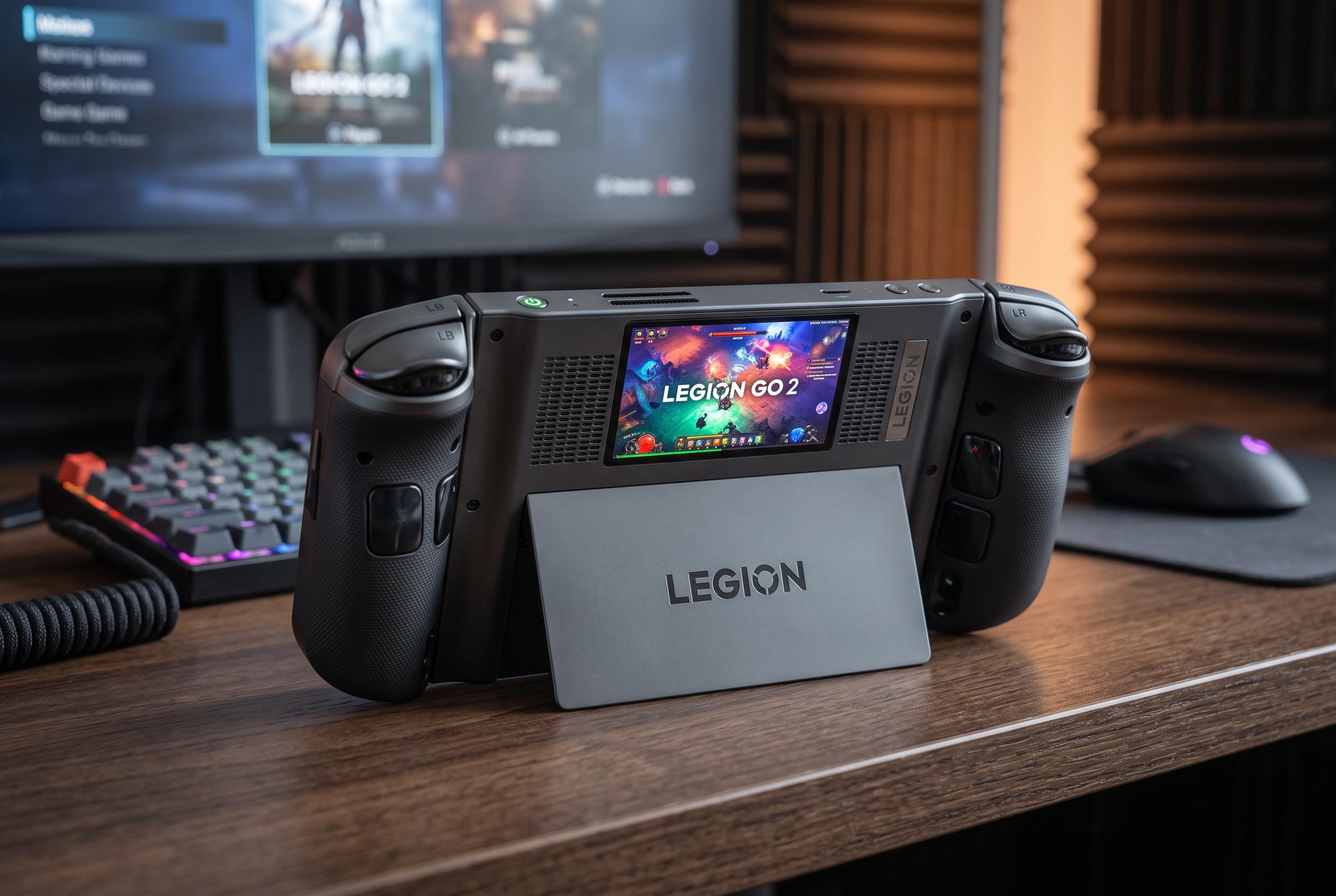
Almost a year after Lenovo’s second-generation Legion Go arrived, it remains one of the more distinctive Windows handhelds on the market. The basic formula is familiar: a large 8.8-inch device with detachable controllers, a kickstand and enough flexibility to double as a compact PC. Yet the Legion Go 2 is not just a repetition of the original model. It brings a faster Ryzen Z2 Extreme chip, a larger battery, an OLED display and a number of ergonomic revisions that make it easier to live with day to day.
The most obvious trade-off is the screen. Lenovo has reduced the resolution from 2560 x 1600 to 1920 x 1200, but that decision appears to have been made in service of battery life and gaming smoothness. The gain is an OLED panel with 144Hz refresh, VRR and HDR support, which gives the handheld better contrast, deeper blacks and richer colour than the IPS display used before. Tom’s Hardware and Tom’s Guide both describe the panel as a major strength, although they note that brightness and reflections can still be limiting in some environments.
Lenovo has also improved the physical design in ways that matter in use. The unit is shorter, the grips are better shaped and the buttons have been rearranged to feel more natural. The detached controllers still support mouse-like operation in FPS mode, but the right controller’s touchpad and rear scroll wheel are the features that most clearly help with Windows 11 navigation. PCWorld and Windows Central both singled out the build quality, secure controller attachment and built-in kickstand as standout elements of the design.
A fingerprint reader built into the power button is another practical improvement. It speeds up sign-in and suits a device that is likely to be picked up and put down frequently. Lenovo has also moved the microSD slot and ports around to improve usability and heat management, while the larger rear vents help the system stay cooler under load. Windows Central said thermals and fan noise are well controlled, even when the handheld is pushed hard.
On the software side, Legion Space remains functional rather than transformative. It is useful as a central hub for game libraries, performance profiles and driver updates, and its overlay makes quick tweaks possible during play. That said, Windows 11 is still Windows 11, and the operating system is not as naturally suited to a handheld form factor as a dedicated console-style interface. Tom’s Guide noted that navigation can still be awkward, even if Lenovo’s own software helps reduce the friction.
Performance is the other major attraction. Reviewers broadly agree that the Ryzen Z2 Extreme gives the Legion Go 2 enough headroom for modern games at sensible settings, especially when paired with the lower-resolution OLED panel. Tom’s Hardware reported strong colour coverage and the kind of display quality that makes games look especially sharp at the handheld’s native resolution. The same combination of hardware improvements has also enabled Lenovo to offer SteamOS support on the device, which Tom’s Hardware said should improve efficiency compared with Windows 11.
Battery life is better than before, though still far from class-leading. Lenovo’s larger 74Wh battery is a clear upgrade over the original Legion Go, and TechRadar said it was designed to deliver meaningfully longer sessions. Even so, practical results still depend heavily on the game and power settings. Tom’s Guide found gaming endurance to be a little over 2 hours in demanding titles, while lighter use can stretch far longer. That places the Legion Go 2 in the same broad compromise zone as other high-end handheld PCs: good portability, but not all-day gaming at full power.
That leaves price, which is the hardest part of the equation. The Legion Go 2 launched as a premium device, and recent market conditions have pushed it even higher in some regions, making it a difficult buy for anyone expecting mainstream handheld pricing. Tom’s Guide and Windows Central both argued that the device’s strengths justify it only for buyers who value the larger OLED display, flexible controls and strong performance enough to accept the cost. For everyone else, more affordable alternatives remain easier to recommend.
Disclaimer: This content is intended for informational purposes only. Readers are advised to exercise their own judgement, conduct due diligence, or consult a qualified expert before acting on any information provided.