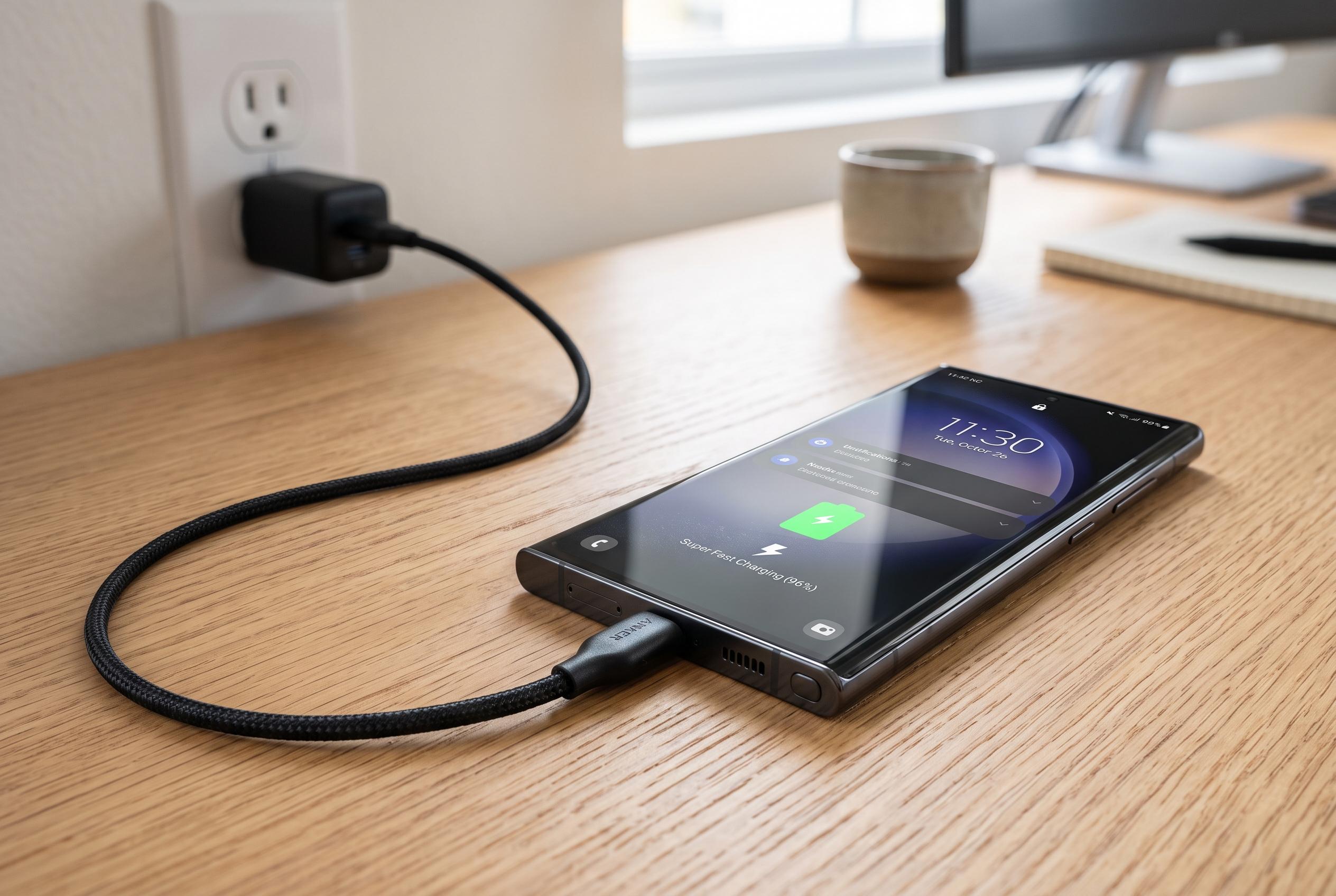

Selecting a USB-C charger involves more than wattage. Compatibility with device-specific voltage and current profiles, especially for Samsung Galaxy phones, affects charging speed and long-term flexibility. Buyers should prioritise chargers supporting USB PD and PPS with a broad voltage range.
Choosing a USB-C charger looks straightforward, but the details matter more than many buyers expect. A charger can advertise a high wattage and still fail to deliver the best possible speed if its voltage and current profiles do not match the device. Industry guides on USB charging standards note that the move from simple fixed-output adapters to USB Power Delivery and Programmable Power Supply has made compatibility more precise, not less. That is why two chargers with the same headline power figure can perform very differently in real use.
According to Samsung’s support materials, many recent Galaxy phones support USB-C charging with USB Power Delivery, while some models also work with Quick Charge 2.0. The company says faster results come from higher-rated adapters such as 25W and 45W units, but that only helps when the charger supports the right charging profile. Independent advice for Galaxy owners also notes that some phones now ship with only a USB-C cable in the box, which means buyers must choose an adapter separately.
The main point is that wattage alone does not tell the full story. A phone that supports 45W charging may still charge more slowly if the charger cannot supply the correct combination of voltage and current. That is especially relevant for Samsung devices, where charging behaviour has changed across generations. Reports on the Galaxy S21 Ultra, for example, show that its supported charging configuration differs from earlier assumptions, which means a charger that seems powerful on paper may still miss the device’s preferred settings.
For most buyers, the safest approach is to look for a USB-C charger that supports USB PD and PPS with a broad voltage range. A 100W adapter with PPS support up to 21V should cover most smartphones, tablets and many laptops, though the highest-power gaming notebooks may still need a more specialised unit. Buyers should check the specification sheet, packaging or manufacturer website for the supported voltage range, not just the maximum wattage. That extra step can avoid slow charging, improve long-term flexibility and make one charger usable across several devices.
Disclaimer: This content is intended for informational purposes only. Readers are advised to exercise their own judgement, conduct due diligence, or consult a qualified expert before acting on any information provided.