
A slight change in router placement and smarter bandwidth management can make the crucial milliseconds count for live sports bettors, highlighting common home network pitfalls and practical solutions.
For anyone trying to place a live bet as a match unfolds, the weak link is often not the app but the home network. The difference between a successful in-play wager and a missed price is usually measured in milliseconds, not megabits, because latency and jitter matter far more than headline download speed. In practice, that means a fast broadband package can still feel slow if traffic is being queued elsewhere in the house or if the connection is unstable at the wrong moment.
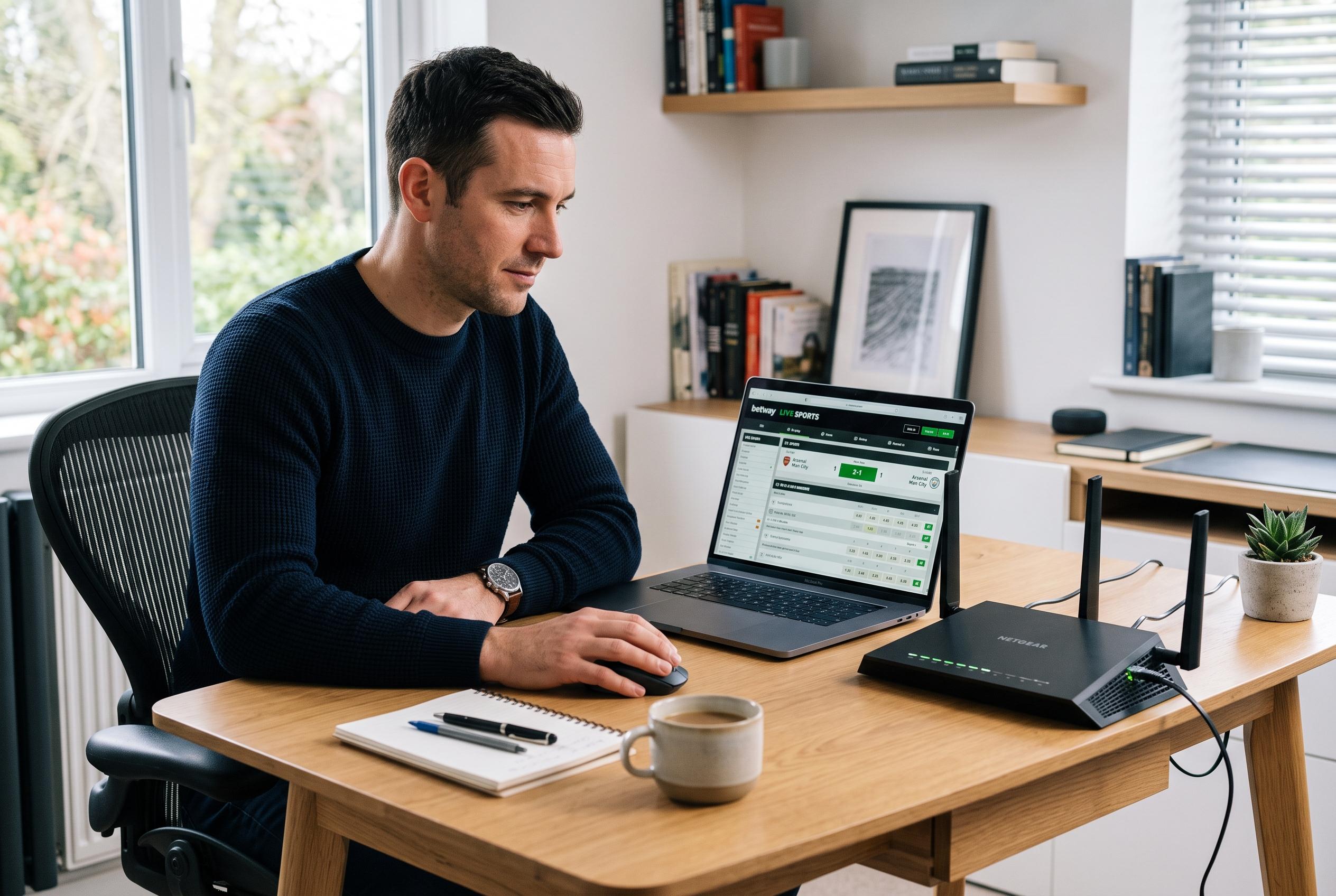
One of the simplest fixes is also one of the most overlooked: move the router. TP-Link says the best results usually come from placing it centrally, off the floor and in the open, rather than hiding it in a cupboard or behind furniture. Its support guidance and related placement advice from other networking specialists also warn against putting routers near large metal objects, thick walls, microwaves or cordless phones, all of which can weaken or distort the signal.
A second issue is band selection. Many homes rely on a single Wi-Fi name for both 2.4 GHz and 5 GHz traffic, but that can cause devices to cling to the wrong band. The 2.4 GHz band reaches further but is more congested, while 5 GHz is faster at short range but loses strength more quickly through walls. Newer routers may also offer 6 GHz, which is cleaner but works best only close to the access point. Splitting the bands in the router settings can help a betting phone stay on the connection that best suits the room.
Uploads can also quietly ruin the experience. Cloud backups, console updates and background syncing may consume the upstream capacity that live betting depends on, even when the download side appears fine. Networking specialists call the resulting delay bufferbloat, and it is often better addressed with smart queue management or basic quality-of-service settings than with a larger broadband package. In other words, reducing congestion can matter more than adding speed.
For households where the television or streaming box is the main source of the match, a wired ethernet connection can free up wireless bandwidth for the phone in hand. Powerline adapters can help where running a cable is impractical, although their performance depends heavily on the age and quality of the wiring. Even then, one limitation remains outside the home: most live streams are delayed behind the action, so pictures are almost always slower than the market itself. That is why serious in-play bettors often keep a text feed or live statistics page open alongside the video and use the stream as a secondary source rather than the main one.
Disclaimer: This content is intended for informational purposes only. Readers are advised to exercise their own judgement, conduct due diligence, or consult a qualified expert before acting on any information provided.