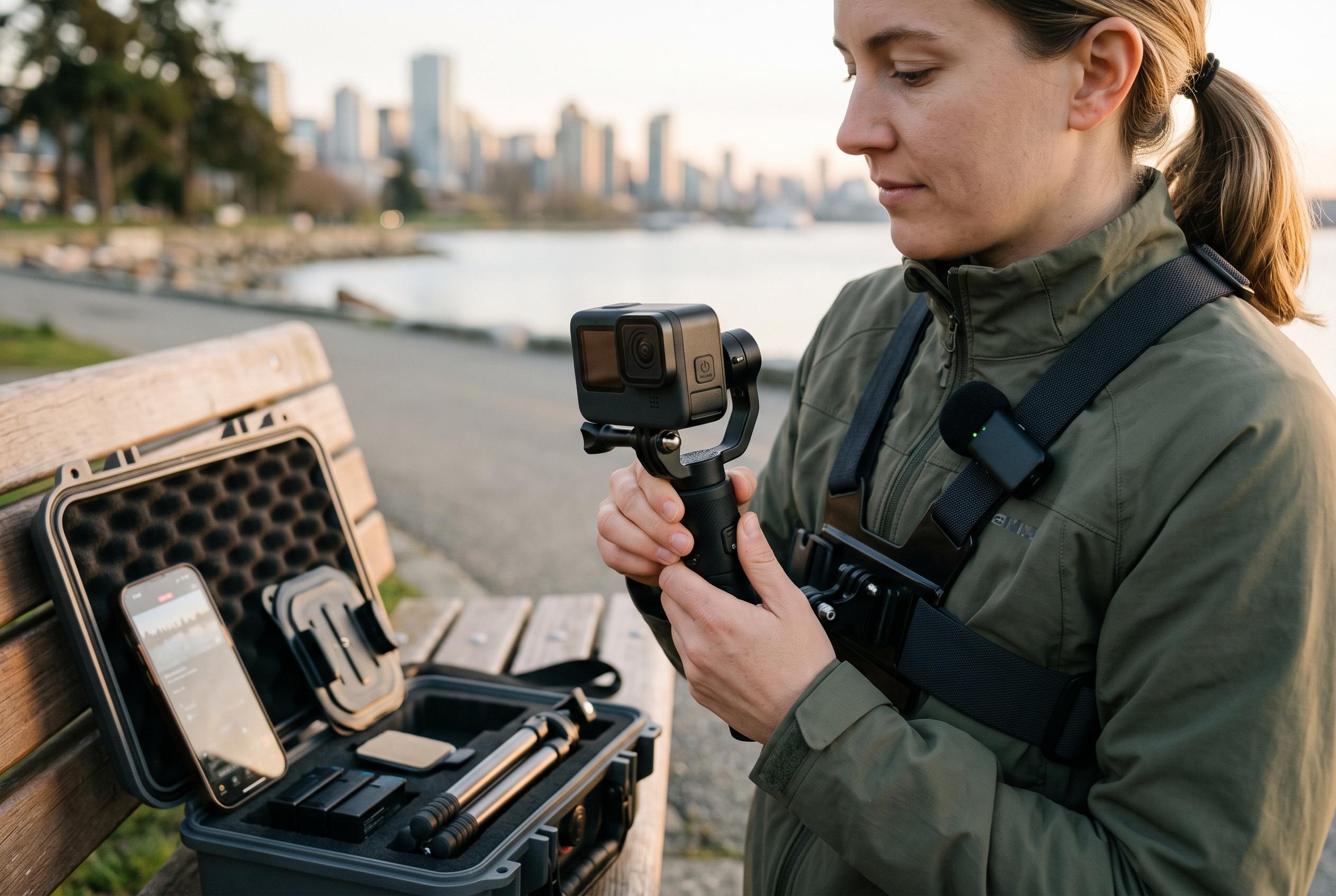

The evolving landscape of action cameras in 2026 reveals a shift from basic rugged devices to versatile tools tailored for solo creators, highlighting new models, features, and industry directions.
Action cameras have moved well beyond their original role as rugged point-of-view tools. For vloggers, they now fill a clear niche: compact cameras that handle movement, weather and awkward angles far better than a traditional mirrorless setup. The lead review from Short Film Central argues that the DJI Osmo Action 5 Pro remains the strongest all-round choice for solo creators because of its larger sensor, front and rear screens, long battery life and reliable stabilisation. That conclusion still makes sense, even as newer 2026 buying guides from Digital Camera World and iTechGuides say the DJI Osmo Action 6 is now the best overall action camera for many buyers. The distinction matters: the newer model may lead on raw specification, but the Action 5 Pro still combines the features vloggers use most consistently in daily shooting.
What separates a good vlogging action camera from a merely tough one is not just resolution. It is the ability to frame yourself quickly, keep footage steady while walking or running, and capture usable dialogue without turning the workflow into a technical exercise. On that measure, the strongest options in the current market remain easy to identify. GoPro’s HERO12 Black and HERO13 Black still set a high bar for sharpness and stabilisation, while Insta360’s X3 remains appealing for creators who want 360-degree reframing rather than a fixed field of view. Digital Camera World also notes that alternatives such as the Insta360 Ace Pro 2 and DJI Osmo Nano have widened the field further, which means buyers now choose by shooting style rather than brand loyalty.
The best choice depends on how the camera will be used. For travel and adventure vlogging, DJI’s Action series offers a practical balance of image quality and endurance, with the Action 4 and Action 5 Pro sharing the same 1/1.3-inch sensor class that gives better low-light results than many older action cameras. For creators who value the cleanest footage above all else, GoPro’s HERO12 and HERO13 still offer the sharpest-looking 5.3K capture in the category, although they are more demanding on battery and storage. For unpredictable scenes, Insta360’s 360 cameras keep the whole environment in frame and allow the edit to be chosen afterwards, which is useful when the creator cannot know in advance where the key moment will happen.
Audio remains the weakest part of most action cameras, and that has not changed. The safest upgrade is still a wireless microphone, especially for solo vloggers who need speech to remain clear over traffic, wind or crowd noise. DJI’s native support for its Mic 2 and Mic Mini systems gives the Action 5 Pro and Action 4 a real advantage in this respect. GoPro users can lean on Bluetooth audio and the Media Mod ecosystem, while Insta360 has made respectable progress on built-in microphone performance. Even so, the core rule holds: action cameras are now good enough for vlogging, but built-in microphones are usually best treated as backup rather than primary audio.
Battery life and heat management are equally important. This is where the more recent models separate themselves from cheaper alternatives. Short Film Central’s testing found the Action 5 Pro capable of running much longer than most rivals, which makes a practical difference during day-long shoots or travel days when charging opportunities are limited. By contrast, premium GoPros can still lose battery quickly at their highest resolutions, and budget cameras such as the AKASO Brave 4 and EK7000 remain attractive mainly because they lower the entry cost rather than because they match flagship endurance. For readers who want to shoot with confidence rather than constantly manage power, the mid- and upper-tier cameras are easier to live with.
For buyers trying to spend sensibly, the market now offers a clearer hierarchy than it did a year ago. The AKASO models remain useful as entry points, especially for beginners, children or risky mounting situations where loss or damage would be painful. The GoPro LIT Hero adds a built-in light that can help in restaurants, indoors or at night, though it is still a compromise product compared with fuller-featured flagships. Meanwhile, broader compact-camera buying guides from TechRadar continue to remind readers that not every creator needs an action camera at all: some vloggers will be better served by a compact camera with optical zoom, while others may prefer a DJI Pocket-style gimbal camera for more polished handheld movement. The right tool depends on whether the priority is resilience, image quality, zoom, or ease of use.
The deeper trend in 2026 is that action cameras are becoming less specialised and more adaptable. Insta360’s latest firmware and accessory announcements show a push towards software-driven expansion, while GoPro’s move into interchangeable-lens and Micro Four Thirds territory signals that even the best-known action brand is looking beyond its traditional category. For vloggers, that means the decision is no longer simply about picking the smallest rugged camera on the shelf. It is about choosing between fixed-lens action cameras for simplicity, 360 cameras for flexibility, and hybrid compact systems for more controlled production. In that context, the DJI Osmo Action 5 Pro remains a sensible recommendation for most everyday vloggers, but it is no longer the only serious option.
Disclaimer: This content is intended for informational purposes only. Readers are advised to exercise their own judgement, conduct due diligence, or consult a qualified expert before acting on any information provided.