
Acer unveils the Vero 16 at IFA, featuring a tool-free chassis, replaceable components, and support for processor upgrades, marking a significant shift towards repairable, eco-friendly laptops in the premium market.
Acer has used IFA in Berlin to push its Vero line in a more ambitious direction, unveiling a 16-inch laptop that is meant to be repaired and upgraded rather than replaced. The Vero 16 was announced on 2 September 2026 and is scheduled to reach Europe, the Middle East and Africa in the first quarter of 2027. Tom’s Guide reported a UK starting price of £1,599, placing it well above the budget end of the market and turning repairability into a premium selling point.
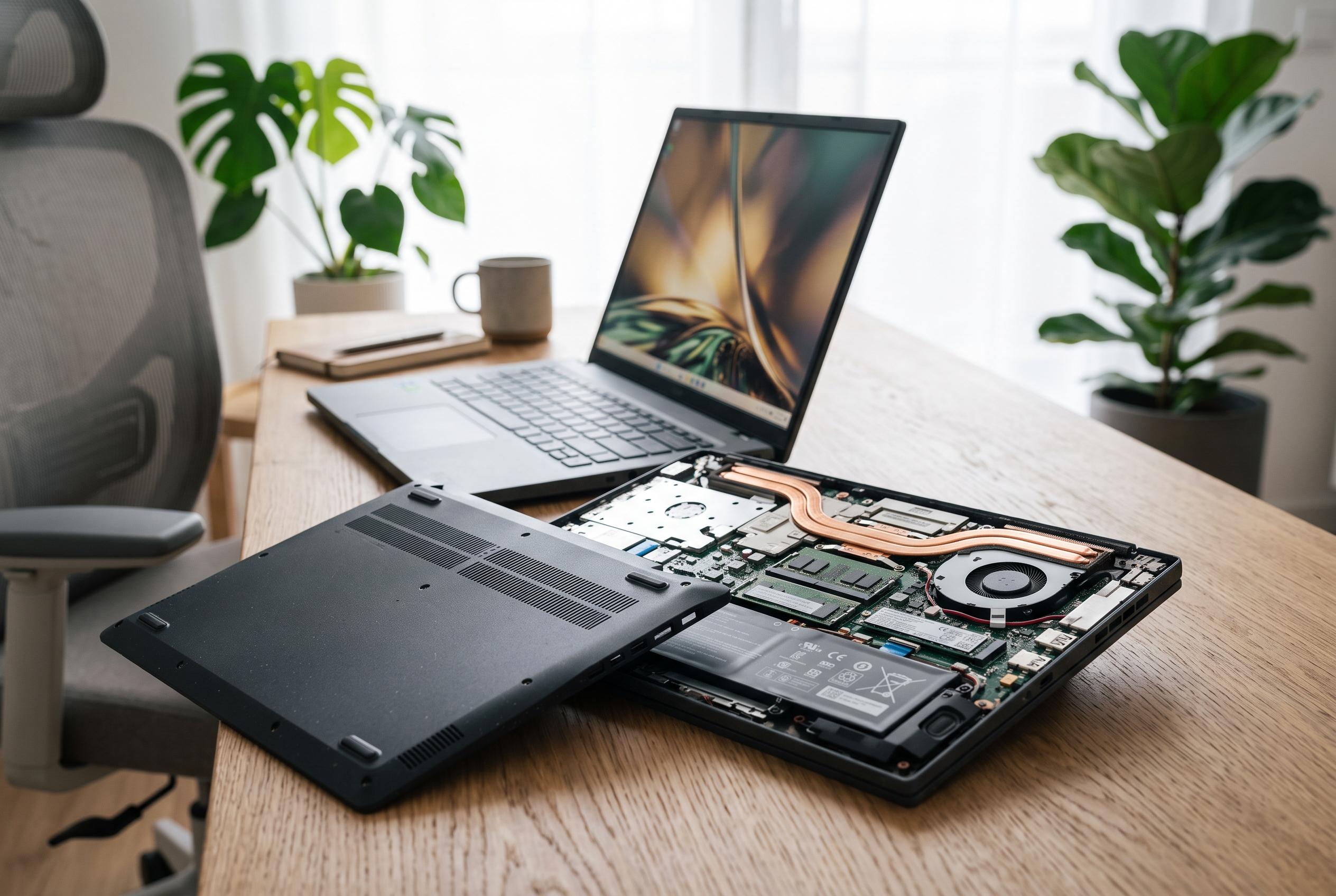
The most unusual part of the machine is not the screen or processor but the way Acer has laid out the hardware for access. The company says the underside opens via a tool-free latch rather than screws, with an engraved guide on the chassis showing users where major components sit and how they can be removed. Acer says owners will be able to replace the battery and SSD themselves, detach the external hinge to simplify display work, and remove the covers over the side ports for easier servicing. Lowyat noted that earlier Vero models still needed a screwdriver to get inside, so this version marks a more decisive shift towards user access.
Acer is also making a larger promise that deserves scrutiny: it says the Vero 16 is designed to support processor upgrades across at least two generations. That would be a striking departure from most conventional laptops, where the processor is usually soldered to the motherboard. Notebookcheck highlighted that problem directly, pointing out that do-it-yourself CPU upgrades in notebooks are normally awkward or impractical, which leaves an important unanswered question about whether Acer intends the processor to be replaced on its own or as part of a broader board-level module. Tom’s Guide, which handled the laptop at IFA, cast the system as a mainstream alternative to Framework, but also noted that Framework still offers a wider degree of component-level modularity.
On specifications, Acer is not treating the Vero 16 as a low-end sustainability exercise. The official specification sheet lists Intel Core Ultra Series 3 chips from a base Core Ultra 5 322 up to a Core Ultra X9 388H, alongside Intel Arc B390 graphics on higher configurations. Acer says the top specification reaches 180 platform TOPS, a measure of AI processing throughput, and pairs that with a 16-inch OLED panel that goes up to 2,880 x 1,800 at 120Hz. Other published specifications include up to 32GB of LPDDR5x memory, up to 512GB of SSD storage, a 71Wh battery, a 5MP infrared webcam with privacy shutter, Wi-Fi 7, an SD card reader, HDMI 2.1, two Thunderbolt 4 ports and two USB-A ports.
The sustainability pitch is more detailed than the usual use of recycled plastic in a casing. Acer says the top cover and palm rest are made from a mix of 50% post-industrial recycled aluminium and 50% low-carbon aluminium, while the bottom cover uses 60% post-consumer recycled plastic and the display bezels use 30% post-consumer recycled plastic. The chassis is rated to MIL-STD-810H durability standards, the finish is a solvent-free powder coating intended to reduce volatile organic compound emissions, and the packaging is described as 100% recyclable. There is, however, a discrepancy in the wider coverage: TechRadar’s IFA awards write-up said 70% of the chassis was made from a mix of recycled plastic and bio-based oyster shell material, whereas Acer’s own materials specification breaks the construction down differently and centres the new model on aluminium and recycled plastics.
That matters because Acer is trying to reposition Vero as more than an eco-branded sideline. In the company’s language, the line is moving from “3R” to “4R”, adding repairability to reduce, reuse and recycle. James Lin, general manager of notebooks at Acer, said: “Sustainability should be built into every stage of a product’s lifecycle, from raw materials all the way to packaging.” The company also says EPEAT Silver registration begins on 1 January 2027, which suggests it is seeking a recognised environmental label to support the broader message.
Early reaction from technology publications has been positive, if not uncritical. TechRadar called the Vero 16 “a breath of fresh air” in a market where thin designs often make maintenance harder. Tom’s Guide argued that Acer had managed to bring a Framework-style idea into a more conventional premium notebook and said the higher initial outlay could prove worthwhile if it extends the machine’s useful life. PCWorld took a more restrained view, describing it as a plausible “mid-range, all-rounder laptop” while questioning how much the extra engineering for serviceability would add to the final cost.
For now, the Vero 16 remains a promise rather than a finished test case. Acer has confirmed only an EMEA launch window in Q1 2027 and says final specifications and prices will vary by market. Even so, the significance of this announcement lies beyond one model. If Acer can provide the parts, documentation and upgrade path implied by its launch claims, the Vero 16 could become an important measure of whether repairable design can move from niche specialists into ordinary, shop-shelf Windows laptops.
Disclaimer: This content is intended for informational purposes only. Readers are advised to exercise their own judgement, conduct due diligence, or consult a qualified expert before acting on any information provided.