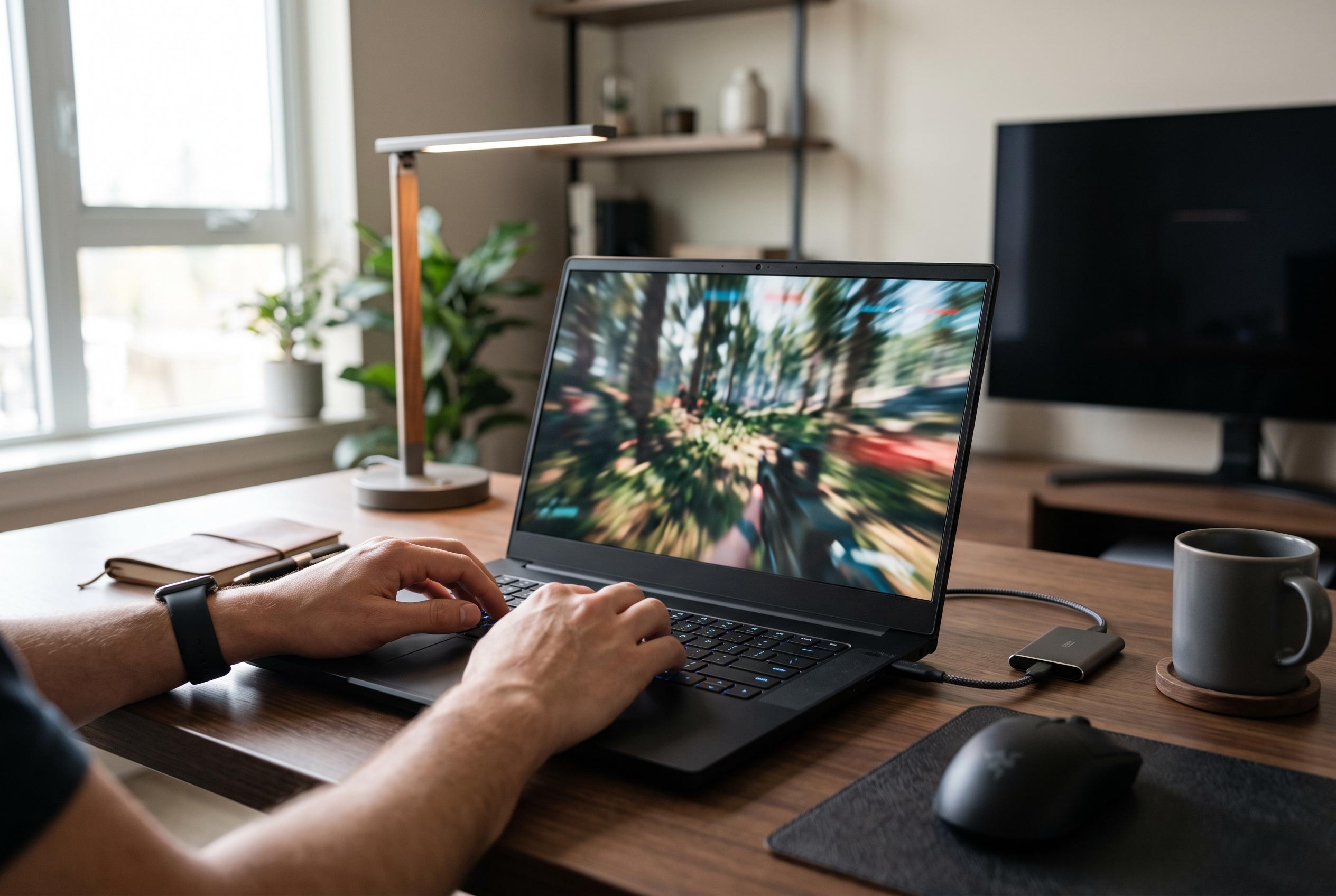

The new Alienware 16X Aurora introduces a sleek, minimalist design and a high-refresh OLED display, setting a fresh benchmark in premium gaming and productivity laptops. While it excels visually and in performance, some trade-offs in portability and battery life remain.
Alienware’s 16X Aurora marks a notable shift in the brand’s design language. According to Tom’s Hardware, the laptop ditches the usual flash for a cleaner, more restrained look, pairing a near-inch-thick chassis with aluminium panels, a magnesium internal frame and no external lighting. At 5.66 pounds, it is not light, but its build quality is solid and the rear-mounted ports help keep desk space clear for a mouse.
The hardware is squarely aimed at high-end gaming and general performance. Tom’s Hardware tested an entry-level configuration with Intel’s Core Ultra 7 270HX Plus, Nvidia’s GeForce RTX 5060 and 16GB of DDR5 memory, while other coverage noted higher-spec variants with an RTX 5070 or RTX 5070 Ti and up to 64GB of RAM. Dell’s pricing spans from an entry model at $1,529.99 to more expensive builds above $3,000, placing the Aurora in direct competition with similarly equipped gaming laptops from Acer, Asus and Gigabyte.
In gaming, the Aurora is strong rather than exceptional. Tom’s Hardware found it handled demanding titles smoothly at 2560 x 1600, with frame rates that were competitive against rival RTX 5060 and RTX 5070 machines, though results varied by game. The machine also completed stress testing with consistent clock speeds and stable thermals, suggesting it can sustain long gaming sessions without obvious throttling. TechRadar’s review of a higher-spec configuration reached a similar conclusion, describing the system as well suited to modern AAA games at 1080p and 1440p, especially when paired with DLSS.
Where the Aurora stands out most is the display. Tom’s Hardware praised the 16-inch OLED panel for its 2560 x 1600 resolution, 240Hz refresh rate and G-Sync support, calling it the laptop’s best feature. Lab results showed bright OLED output, wide DCI-P3 colour coverage and strong contrast, while Tom’s Guide also singled out the screen as vivid and well suited to both games and media. Some other reviewers described the panel as IPS rather than OLED, but the shared view is that Alienware is offering a premium, high-refresh display across the range.
Productivity performance is another strength. Tom’s Hardware reported that the Core Ultra 7 270HX Plus delivered class-leading benchmark results in Geekbench and Handbrake, while also posting the fastest file-transfer score in its test group. That makes the Aurora more than a gaming machine; it is also a capable work system for users who need strong CPU performance and fast storage.
The compromises are familiar ones. Battery life was middling in Tom’s Hardware testing at just under eight hours, and other reviews recorded substantially shorter runtimes. Speakers were judged serviceable but not memorable, with limited bass, and the keyboard and touchpad were described as competent rather than distinctive. Upgrade access is better than average, with two SO-DIMM slots and two M.2 SSD slots, but the laptop’s weight means it is best viewed as a desktop replacement rather than a machine for frequent commuting.
Disclaimer: This content is intended for informational purposes only. Readers are advised to exercise their own judgement, conduct due diligence, or consult a qualified expert before acting on any information provided.