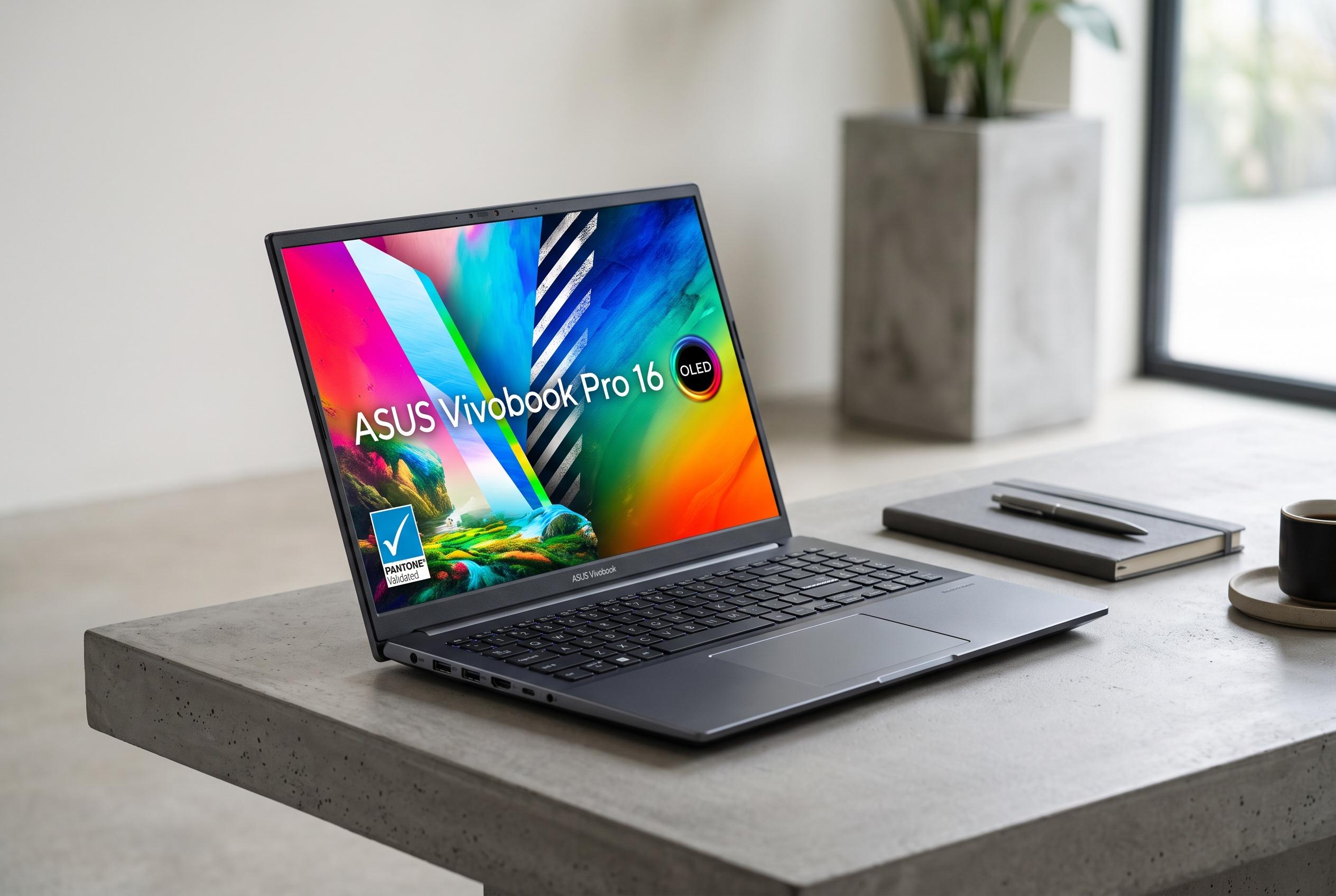

Asus unveils a lower-specification version of its Vivobook Pro 16, featuring AMD Ryzen AI 9, a 16-inch OLED screen, and a more affordable price point, expanding accessibility for creative and AI workloads.
Asus has added a lower-specification version of its Vivobook Pro 16, trimming memory and storage while keeping the core design aimed at creative and AI-focused workloads. According to Notebookcheck, the new model pairs AMD’s Ryzen AI 9 H 465 with the same 16-inch OLED screen, 80Wh battery and 1.65kg chassis used by the earlier Intel-based configuration, but cuts the RAM to 16GB and the SSD to 512GB. The company is effectively positioning it as a cheaper entry point rather than a redesigned machine.
The display remains the main selling point. Asus is retaining a 16-inch OLED panel with a 2,560 x 1,600 resolution, a 165Hz refresh rate, peak brightness of up to 1,100 nits and full DCI-P3 coverage, according to Notebookcheck. That places the laptop above the more mainstream Vivobook 16 OLED family, which Asus has described in its own materials as a 3.2K OLED product with a 120Hz panel and 550 nits peak brightness, aimed at a broader consumer audience.
Other hardware also stays largely unchanged. Asus is still offering two M.2-2280 slots for storage expansion, a 7.1-inch touchpad, an IR camera with Windows Hello support, a backlit keyboard, twin microphones and a 180-degree hinge. On the ports side, the Ryzen version swaps Thunderbolt 4 for USB4, while keeping one additional USB-C port, two USB-A ports and HDMI 2.1. Asus says USB4 and Thunderbolt 4 both support up to 40Gbit/s transfer speeds, so the practical difference is mainly in branding and platform support rather than raw throughput.
The new configuration is due to go on sale in China on August 11 under the Fearless Pro 16 name, at an equivalent price of about €990, Notebookcheck reported. Asus has not yet said whether the AMD model will reach other markets. That makes the launch more of a regional refresh for now, although it fits a wider pattern in Asus’s Vivobook line, where similar Pro and non-Pro models have previously been split by display speed, graphics hardware and memory ceilings rather than by chassis design.
Disclaimer: This content is intended for informational purposes only. Readers are advised to exercise their own judgement, conduct due diligence, or consult a qualified expert before acting on any information provided.