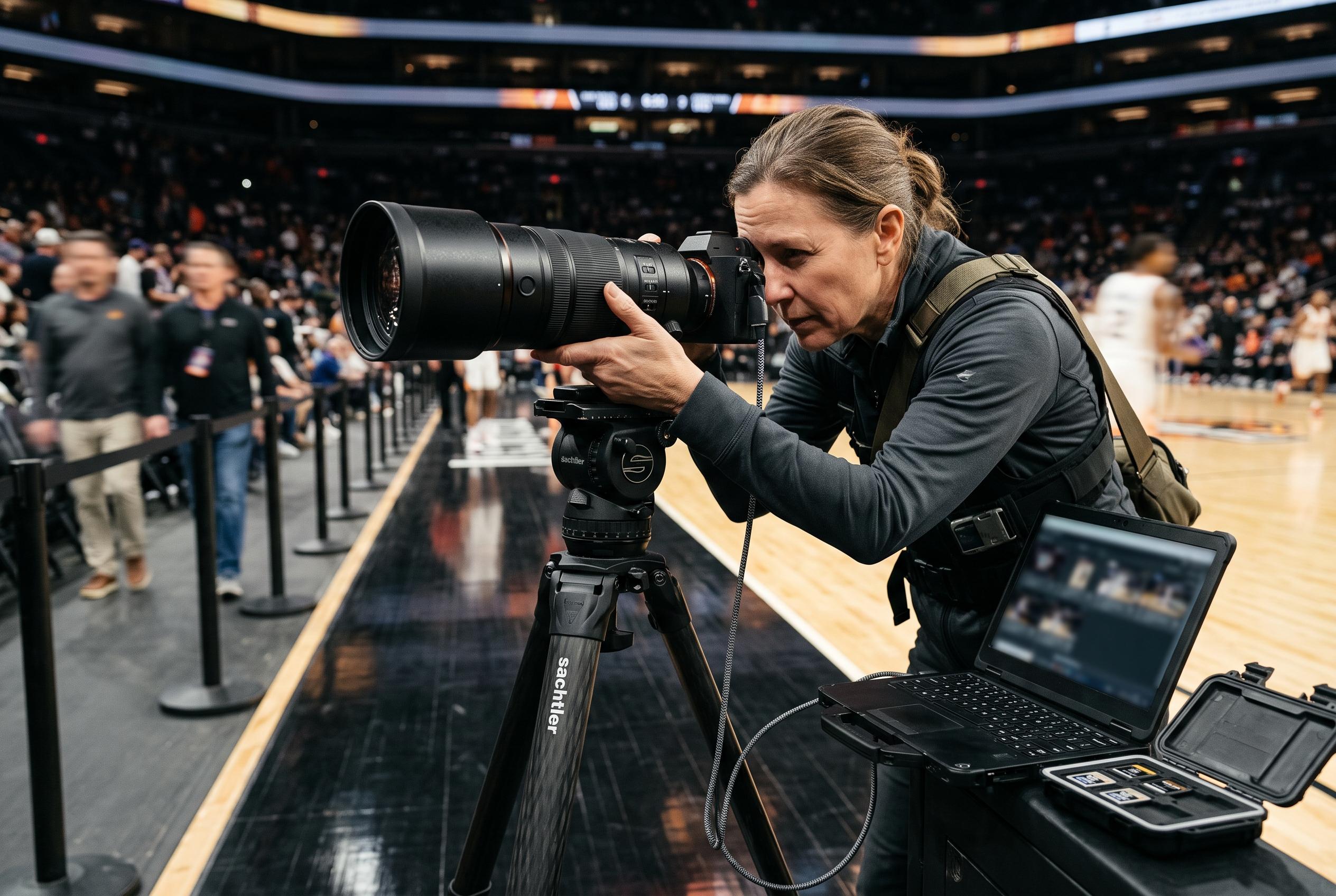

Canon’s EOS R6 Mark III moves beyond simple frame-rate improvements, illustrating a new paradigm in mirrorless camera performance characterised by enhanced data handling, larger files, and refined buffering , making it a decisive tool for action and sports photography.
Canon’s EOS R6 Mark III is not just a faster version of the EOS R6. It represents a broader change in how high-speed mirrorless cameras should be understood: less as simple frame-rate machines, more as data-processing systems built to capture, hold and move large volumes of image information quickly and reliably.
The headline numbers set out the scale of the shift. According to Canon’s specifications, the original EOS R6 uses a 20.1-megapixel full-frame sensor and can shoot at up to 20 frames a second electronically, while the EOS R6 Mark III moves to a 32.5-megapixel sensor and doubles that top electronic rate to 40 frames a second. The Mark III also retains 12 frames a second with its mechanical shutter, matching the broad shooting cadence of the earlier model in that respect.
That higher burst rate matters because each frame now contains far more data. The original R6’s lower-resolution files are smaller and easier to manage, whereas the Mark III creates substantially larger RAW files and a heavier workload for the sensor, processor and internal buffer. In practical terms, the newer camera is handling more than three times as many pixels per second at its top electronic rate, which helps explain why a simple comparison of frames a second does not capture the full picture.
Storage and buffering are central to that story. The R6 relies on UHS-II SD cards, but the R6 Mark III adds CFexpress Type B alongside SD, with Canon specifying CFexpress 2.0 support and VPG400 in the faster slot. That gives the newer body a much stronger path for clearing its buffer during sustained bursts. Reviewers have noted that the Mark III’s buffer is markedly improved, with one review describing a very deep sequence at reduced frame rates and others pointing to hundreds of frames of high-speed shooting before slowdown becomes likely.
The difference is especially relevant for action, sports and birds in flight. At 20 frames a second, the camera samples motion every 50 milliseconds. At 40 frames a second, that interval falls to around 25 milliseconds. For rapidly changing wing positions, head angles and body posture, that finer sampling can increase the chance of catching a decisive moment. GearBase and other reviewers have therefore framed the Mark III as the more capable choice for demanding action work, while still recognising the original R6 as a strong value option for photographers who do not need the extra speed or resolution.
Canon’s own specification sheet also makes clear that the top burst figure is only one part of performance. Continuous shooting can vary with autofocus mode, lens behaviour, battery condition, temperature and lighting conditions. In other words, the 40 frames a second figure should be read as a peak capability, not a guarantee that every shooting scenario will behave identically. The same applies to workflow after capture: more frames and larger files mean more demand on cards, computers, storage and editing software.
The comparison between the EOS R6 and EOS R6 Mark III therefore shows how mirrorless performance has evolved. The question is no longer only how fast a camera can fire frames. It is how effectively it can read the sensor, process the data, manage the buffer and write the results to storage without interrupting the sequence. On that measure, the Mark III is a more complete high-speed imaging system.
Disclaimer: This content is intended for informational purposes only. Readers are advised to exercise their own judgement, conduct due diligence, or consult a qualified expert before acting on any information provided.