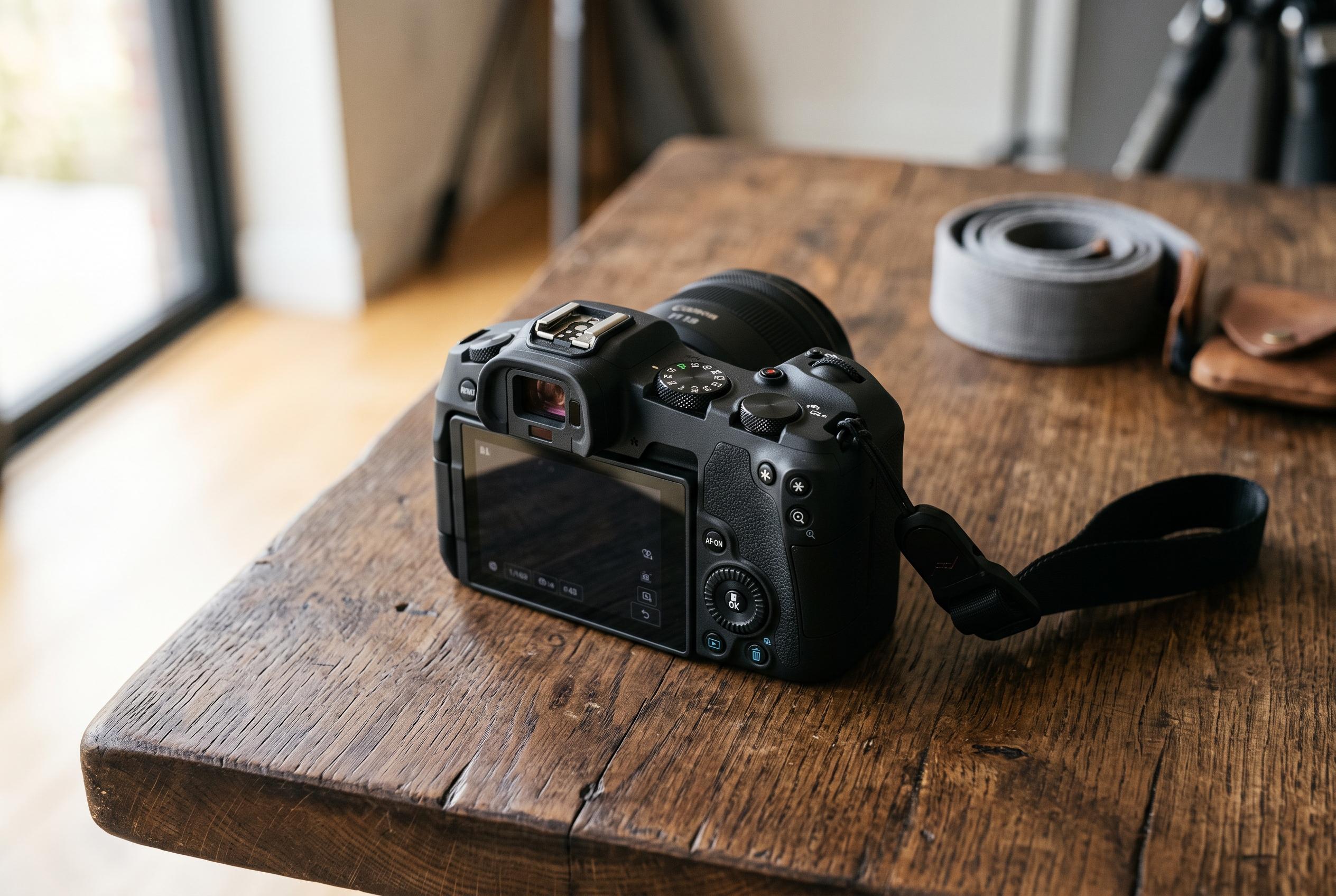

Canon’s EOS R8 Mark II introduces in-body image stabilisation and a dedicated autofocus joystick while maintaining its lightweight design, aiming for enhanced usability in a competitive full-frame mirrorless market.
Canon’s EOS R8 Mark II is a careful update rather than a radical redesign. The new body keeps the original camera’s 24.2-megapixel full-frame sensor and DIGIC X processor, but it closes two of the most obvious gaps in the first R8 by adding in-body image stabilisation and a dedicated autofocus joystick, while keeping the model’s light footprint intact. Reuters-style reporting from the launch and hands-on coverage make clear that Canon is aiming at usability and handling, not higher resolution.
The headline addition is 5-axis IBIS, which Canon rates at up to 7.5 stops under specific test conditions when used with compatible stabilised lenses. The body still weighs about 546g with battery and card, making it Canon’s lightest EOS camera with IBIS, according to the company. That matters because the R8 line has always been about portability, and Canon appears determined to keep that advantage while making the camera more practical for hand-held stills and video.
Canon has also refined the shooting experience around the sensor. The R8 Mark II retains the 40fps electronic-shutter burst mode, but Canon says the camera now delivers a deeper buffer, with roughly 73 RAW frames or 190 large/fine JPEGs at maximum speed. That makes the specification more usable in real shooting, especially for action, wildlife and other unpredictable subjects where sustained burst depth matters as much as the top frame rate itself.
Video has been broadened in a more meaningful way than a routine refresh. The camera supports uncropped 6K-oversampled 4K up to 60p, Full HD up to 180p, Canon Log 3, and Canon’s Look File system for applying LUTs in-camera and over HDMI. Canon has also added livestreaming support and UVC/UAC compatibility, placing the R8 Mark II squarely in the hybrid creator category rather than treating video as a secondary feature.
Even so, the camera does not erase all the compromises of the compact full-frame class. The LP-E17 battery remains small, and CIPA-style figures cited by Canon are modest, with endurance varying according to display mode and power settings. Reviewers have also noted that the body still feels entry-level in some respects, with dated display hardware and a build that does not chase the more robust weather-sealed approach seen in some rivals.
At $1,899 abroad and ₹1.79 lakh in India, the R8 Mark II enters a crowded part of the market. TechRadar and other reviewers have pointed to the Nikon Z5 II as a stronger value proposition for many buyers, thanks to dual card slots, a more premium handling package, and lower pricing, while Sony’s A7C II remains a lighter alternative with a higher-resolution 33-megapixel sensor. Canon’s case is narrower but clear: a very light full-frame body with IBIS, fast burst shooting, improved controls and a strong RF lens ecosystem.
Disclaimer: This content is intended for informational purposes only. Readers are advised to exercise their own judgement, conduct due diligence, or consult a qualified expert before acting on any information provided.