
DJI’s latest Osmo Pocket 4 balances subtle hardware enhancements and automation features to elevate mobile filmmaking, aiming squarely at serious creators with its pocket-sized design.
DJI’s latest pocket camera is a careful but substantial refinement of a format it helped define. The Osmo Pocket 4 keeps the appeal of a stabilised camera that can disappear into a jacket pocket, but adds enough polish to feel closer to a mature creator tool than a novelty. Reviewers from Shotkit, Tom’s Guide and TechRadar all point to the same core idea: this is still a compact device first, but one now aimed squarely at serious mobile video work.
At its heart is a 1-inch CMOS sensor, paired with 10-bit colour, D-Log capture and video recording at up to 4K/240fps. Tom’s Guide and TechRadar both highlight the camera’s improved handling of motion, dynamic range and autofocus, while Shotkit notes that DJI has also pushed the built-in stabilisation, tracking and general responsiveness further than before. The result is footage that looks more natural than software-stabilised alternatives, especially when the camera is moving through busy or unpredictable environments.
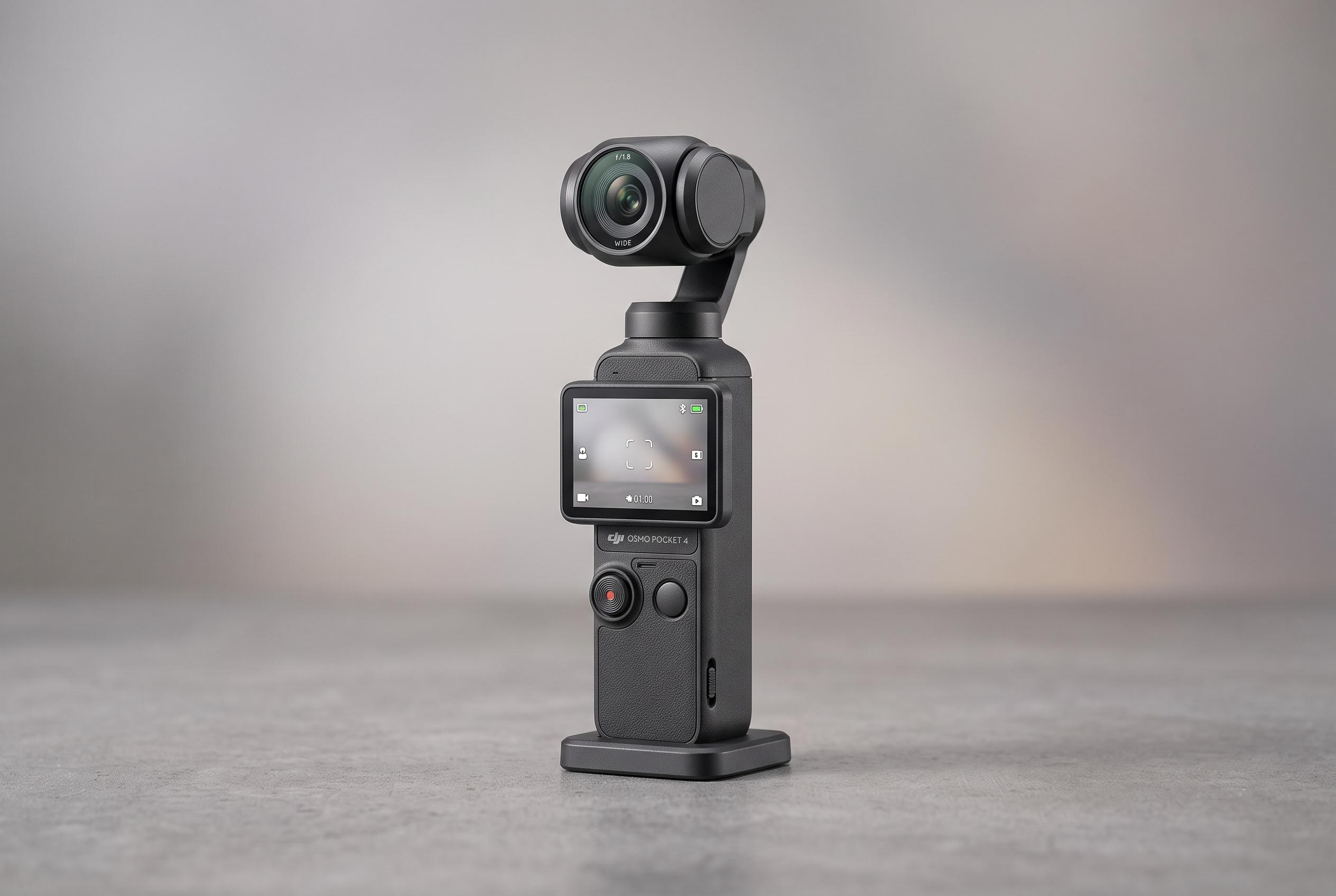
The hardware changes are modest in size but meaningful in use. The 2-inch rotating touchscreen is brighter and more practical than before, and the body gains extra shortcut buttons that make quick zooming and custom functions easier to reach. According to Shotkit, the camera also feels sturdier in the hand, with a more confident gimbal mechanism and better grip than earlier generations. TechRadar and Tom’s Guide both note the inclusion of 107GB of internal storage, which reduces immediate reliance on cards and helps the camera fit a faster solo-shooting workflow.
DJI has also leaned harder into automation. ActiveTrack 7.0, subject lock, gesture control and registered subject priority are designed to make the camera easier to use without a second operator. Shotkit found these tools especially useful in crowded scenes, where the Pocket 4 can be set to keep a chosen person in frame rather than drifting towards passers-by. That kind of subject management, combined with the quick launch modes and custom buttons, makes the camera feel unusually well suited to vlogging, travel and casual documentary work.
Audio remains an area where the Pocket 4 is competent rather than exceptional on its own, but the broader ecosystem helps. Reviews from Tom’s Guide and T3 say pairing it with DJI’s wireless microphones produces a clear step up in quality and unlocks more flexible recording options. TechRadar also points to improved accessory support, including a magnetic fill light, while Shotkit highlights the usefulness of the optional battery handle for longer sessions and easier handheld shooting.
Battery life is now one of the stronger parts of the package. DJI claims up to four hours in ideal conditions, while T3 and Shotkit both describe the charging speed as notably fast, with a large top-up possible in minutes rather than hours. That said, real-world endurance will vary once higher frame rates, tracking and bright screen use are involved. Availability is still complicated in the United States, where Tom’s Guide and TechRadar say regulatory issues continue to limit the model’s presence, even as it is sold in other markets.
Taken together, the reviews suggest a camera that is less a reinvention than a disciplined improvement. For existing Pocket 3 owners, the upgrade may not be essential. For newcomers, however, the Osmo Pocket 4 looks like one of the most complete pocket-sized video systems now available: small, fast to deploy, and capable of delivering far more polished results than its size would suggest.
Disclaimer: This content is intended for informational purposes only. Readers are advised to exercise their own judgement, conduct due diligence, or consult a qualified expert before acting on any information provided.