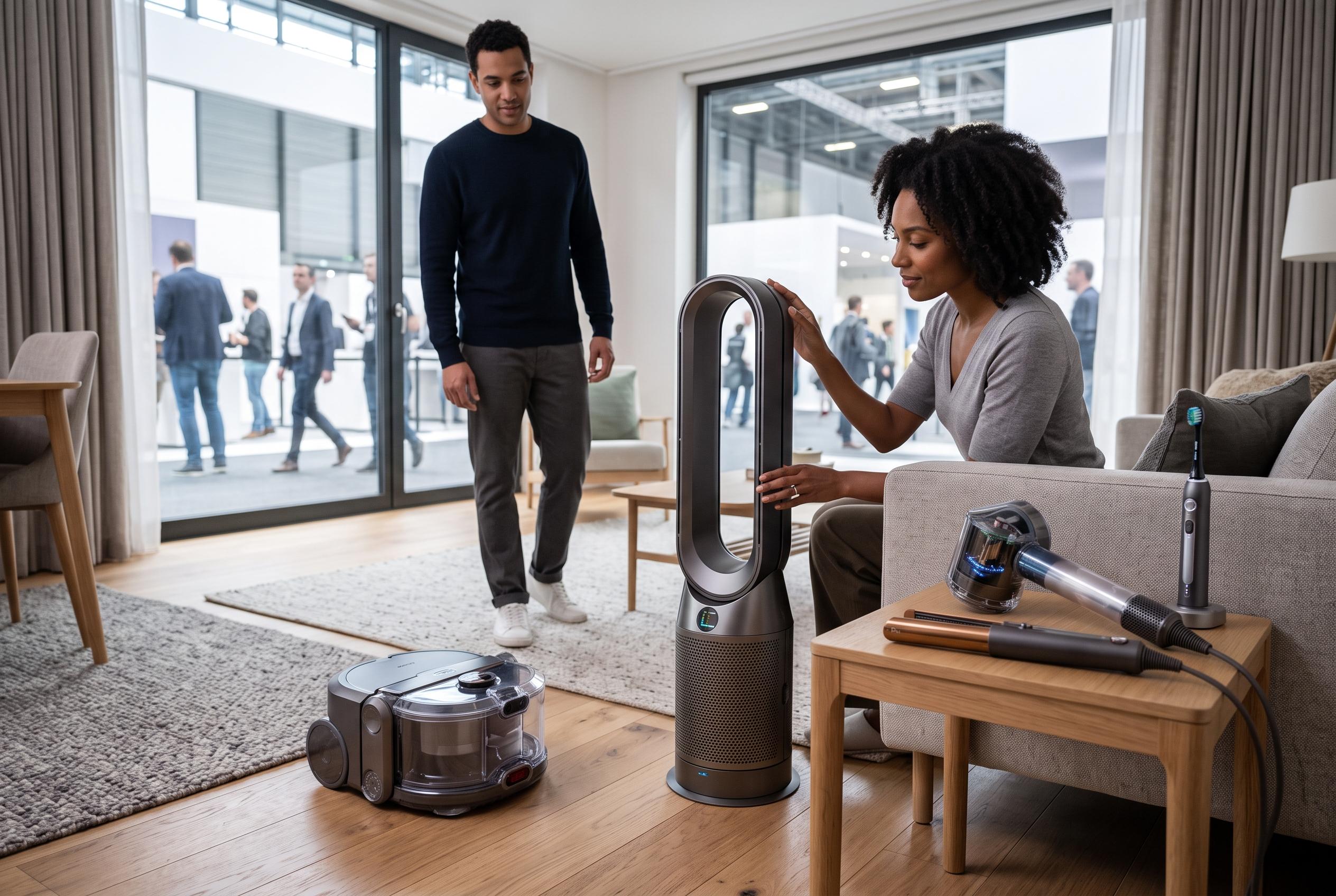

Dyson unveils a wide-ranging product expansion at IFA 2026, featuring connected sensors, computer vision, and software-led automation across oral care, floor cleaning, air treatment, and hair styling, signalling a strategic move beyond traditional hardware to intelligent, responsive household machines.
Dyson has used the days around IFA 2026 to roll out a much broader product push than a conventional appliance refresh, putting connected sensors, computer vision and software-led automation at the centre of categories that range from oral care to robot cleaning and hair styling. The launch is already arriving in phases: the CameraJet toothbrush went on sale on 1 September, the R1 and R2 Nurovi robots followed on 3 September, the Airsmooth styling brush is now available, and the Corrale CoolShine is due next week, while several larger machines have been pushed into early 2027. (dyson.co.uk)
The strategic message is that Dyson no longer wants to be seen primarily as a maker of mechanically refined hardware. At Dyson Unveiled, Jake Dyson said the company had moved towards “intelligent machines that can see, think, and respond”, using “artificial intelligence, vision systems and machine learning” across products for “your mouth, your hair or around your home”. Even the scale of the reveal is not described consistently. Wallpaper* counted 12 new offerings, while other coverage put the number at 13. The main showcase was staged in Berlin on 3 September, but The Guardian reported the CameraJet launch from Paris on 1 September, and The Independent said it saw the Airsmooth at Dyson’s Paris salon the same day, suggesting a multi-city launch sequence rather than a single reveal. (wallpaper.com)
The most unusual product remains the CameraJet, Dyson’s first move into oral care and one of its clearest attempts to justify a premium price through sensors and software. In the UK it is listed at £419.99, or about £420, and Dyson says it is the result of six years of work by 661 engineers. The brush combines a 100k-pixel macro lens camera, machine learning, an anti-gravity mouthrinse tank and app connectivity so users can view the inside of their mouth live and direct liquid jets into gaps between teeth while brushing. Dyson says no images are stored on the device or in the cloud. James Dyson told The Guardian that flossing was an “awkward and time-consuming chore” and that “few of us do it even though we know we should”. But Eddie Crouch, chair of the British Dental Association, warned in the same report that patients should not think “the latest gizmos will solve all their oral health problems”. The Guardian also noted that the matching toothpaste and mouth rinse cost £8.50 each. (dyson.co.uk)
Floorcare is where Dyson’s software-heavy pitch looks most commercially grounded. The new Nurovi family spans the £499.99 R1 Nurovi Dry, the £749.99 R2 Nurovi Wash+Dry and the flagship R3 Nurovi Spot+Scrub UV, due in early 2027. Wallpaper* said the name refers to Neural Intelligence networks and a new Vision sensor system, while Ideal Home highlighted that the R1 is Dyson’s first robot vacuum below £500, a notable shift for a brand whose own robots have typically sold in the £700 to £1,000 range. Jake Dyson told Ideal Home: “With the Dyson Nurovi robots, we’ve rethought things from the ground up – from how debris is captured, to how edges and corners are cleaned, and how the machine senses and adapts to its environment.” At the top of the range, the R3 combines UV light, AI vision and green laser-like illumination to identify nearly 200 household substances and objects, then repeatedly scrubs a patch until a stain has gone. Dyson says it also uses 30,000Pa suction, 70°C heated water, a 12-point hydration system and a 40mm extending microfibre roller. (t3.com)
That emphasis on floors runs beyond the robots. T3 also noted the debut of the W1 PencilWash, an updated version of the wet cleaner Dyson launched earlier in 2026, while Ideal Home said the company showed a new Big Ball Konical vacuum as part of the same event. Taken together, that suggests the launch was less a diversion into novelty categories than an attempt to broaden Dyson’s cleaning range at several price points and formats, from an entry robot to more specialist wet-cleaning machines. (t3.com)
Air treatment formed another large part of the Berlin showcase, even if it drew less attention than the toothbrush. Dyson has been extending its HushJet airflow system since the compact purifier in 2025 and the Mini Cool Fan in April 2026, and the new line-up expands that architecture into larger purifier, cooler and heater products. Dyson’s event material says the biggest HushJet Big+Quiet Cool Pure+ Formaldehyde model can project purified air up to 20 metres and capture 99.999% of particles down to 0.01 microns, while T3 later reported UK October availability for the Big+Quiet at £899.99 and the smaller Pure Cool+ Formaldehyde at £549.99. The heater-cooler version, HushJet Hot Cool Pure+, is being positioned as the most powerful 3-in-1 model in the range. (dyson.com)
The hair tools are, however, the clearest example of Dyson trying to widen its audience without abandoning premium pricing. T3 said both new devices have universal voltage. The Airsmooth, available now for £199.99 through Dyson’s online store and selected retailers, is Dyson’s first dedicated hot air brush and its lowest-priced hair styler so far. The Independent framed that as a direct affordability play, noting that it is £380 cheaper than the Airwrap. Lucy Smith wrote that the brush’s “pear-shaped” head is larger than any Dyson bristle attachment she had previously used, and said the product checks temperature 100 times a second, compared with 40 times a second for the Supersonic Nural hair dryer. That gives Dyson a simpler, cheaper entry point for customers who want drying and smoothing without the Airwrap’s multi-tool format. (t3.com)
The Corrale CoolShine follows a similar logic: familiar format, but with a new technical twist. T3 said it arrives next week at £249.99, again with universal voltage, while Dyson says the straightener combines its flexing plates with a cooling attachment that uses sealed, heat-extracting copper pipes containing distilled water to pull excess heat away from the hair during styling. Dyson is claiming up to 29% less heat damage and up to 154% more shine. Whether shoppers accept those claims across categories as different as toothbrushing, air cleaning and hair styling is the central question behind this launch. Dyson has made its case that sensors, cameras and machine learning can improve ordinary household tasks. The early scepticism around CameraJet shows that, at these prices, engineering ambition alone will not be enough. (dyson.com)
Disclaimer: This content is intended for informational purposes only. Readers are advised to exercise their own judgement, conduct due diligence, or consult a qualified expert before acting on any information provided.