

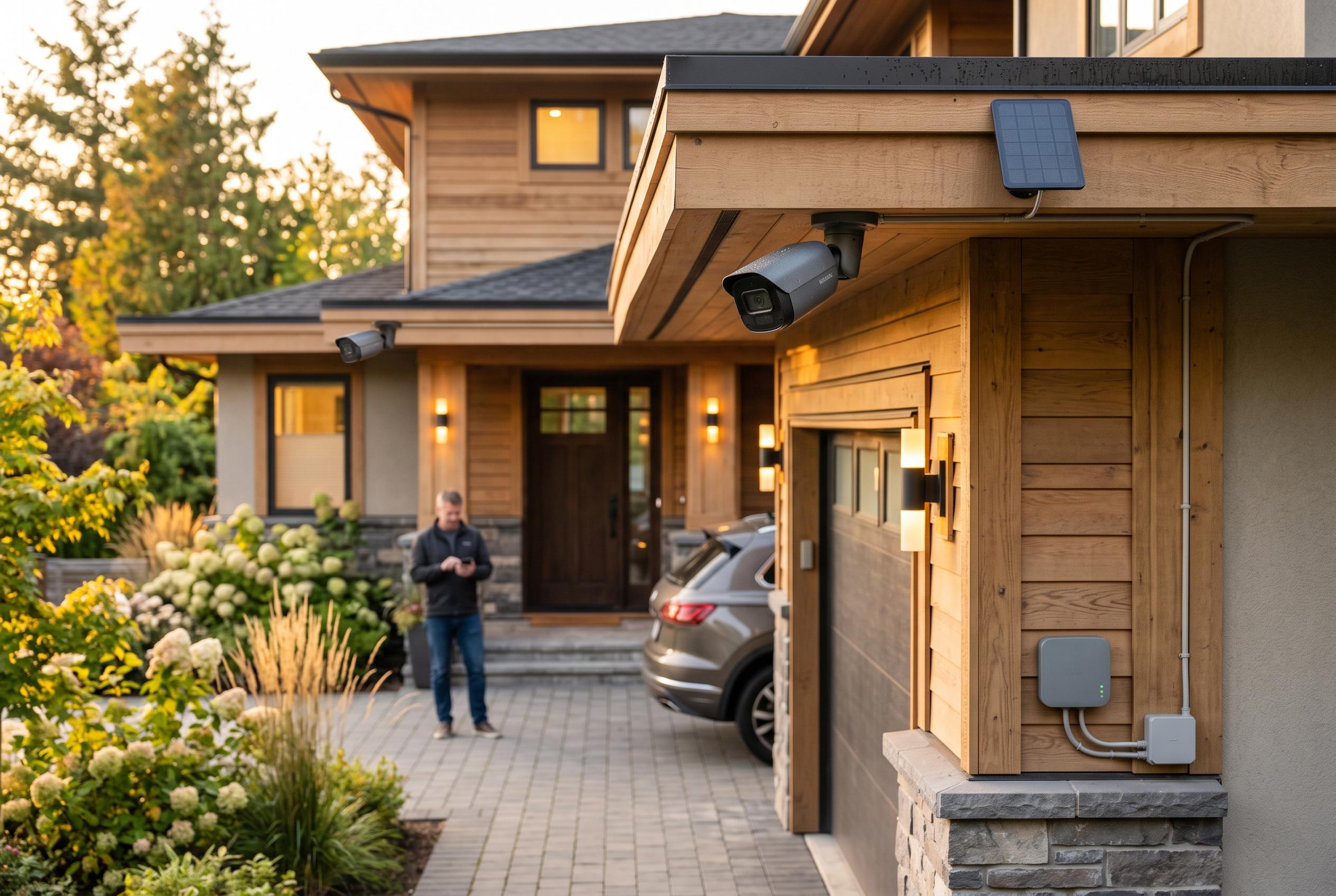

Eufy’s latest outdoor cameras, the S4 and E42, combine advanced features like 4K recording, local storage, and solar power, aiming to disrupt the home security market with lower costs and greater flexibility.
Eufy’s latest outdoor cameras are pitched as a way to avoid two familiar home-security compromises: the cost and disruption of hardwired installs, and the inconvenience of constantly recharging battery-powered models. In practice, the eufyCam S4 and SoloCam E42 combine solar assistance, local storage and app-based control in a form factor aimed squarely at households that want serious coverage without a recurring subscription. That positioning matters because it places the products between traditional alarm-style systems and the cheaper, but often more limited, DIY camera market.
The stronger of the two is the eufyCam S4, which third-party reviews describe as a particularly ambitious model. Senses.se calls it a tri-lens camera with a fixed overview unit and a motorised pan-tilt-zoom module, while Expert Reviews says it is among the most feature-rich security cameras it has tested. Both outlets note that image quality is sharp and motion tracking is highly effective, although setup can be fiddly and the camera is expensive. T3 also highlights the S4’s 4K capture, 3x zoom, local storage and strong full-colour night vision, reinforcing its position as the premium option for front-of-house surveillance.
By contrast, the SoloCam E42 is the more compact and flexible choice. Notebookcheck reports that the model offers 4K recording, pan-and-tilt movement, local AI processing and optional solar power, with bundles starting at a lower price point than the S4. TechAU’s hands-on impressions align with that broader picture, describing the E42 as easier to place around eaves, side paths and rear boundaries, where a smaller footprint is preferable. The company’s broader product direction appears to be moving towards local processing, solar-assisted operation and event-triggered recording rather than cloud-dependent monitoring.
There are, however, practical caveats. Senses.se notes that live view access on the S4 can be slower than expected, and Expert Reviews points to awkward motion-zone configuration. TechAU’s installation advice also underlines an important operational detail: these cameras are best paired and tested before mounting, because signal strength, angle and solar exposure all affect day-to-day performance. That is especially relevant for users trying to maximise battery life, as solar charging only works properly when the panel receives enough direct light during the day.
Pricing remains a major part of the appeal. TechAU says the S4 can be bought as a standalone camera or in multi-pack bundles that still undercut many professional installations, while the E42 is positioned as the cheaper of the two. The wider market context is also moving quickly: Notebookcheck says Eufy is extending the same design language into newer models with higher-resolution lenses, while T3 reports that Anker’s newer Eufy products are adding dual-lens systems, larger batteries and more advanced motion sensing. Taken together, the message is clear: Eufy is building a camera range intended to deliver broad coverage, local control and lower running costs, with the S4 aimed at maximum capability and the E42 at practical everyday use.
Disclaimer: This content is intended for informational purposes only. Readers are advised to exercise their own judgement, conduct due diligence, or consult a qualified expert before acting on any information provided.


