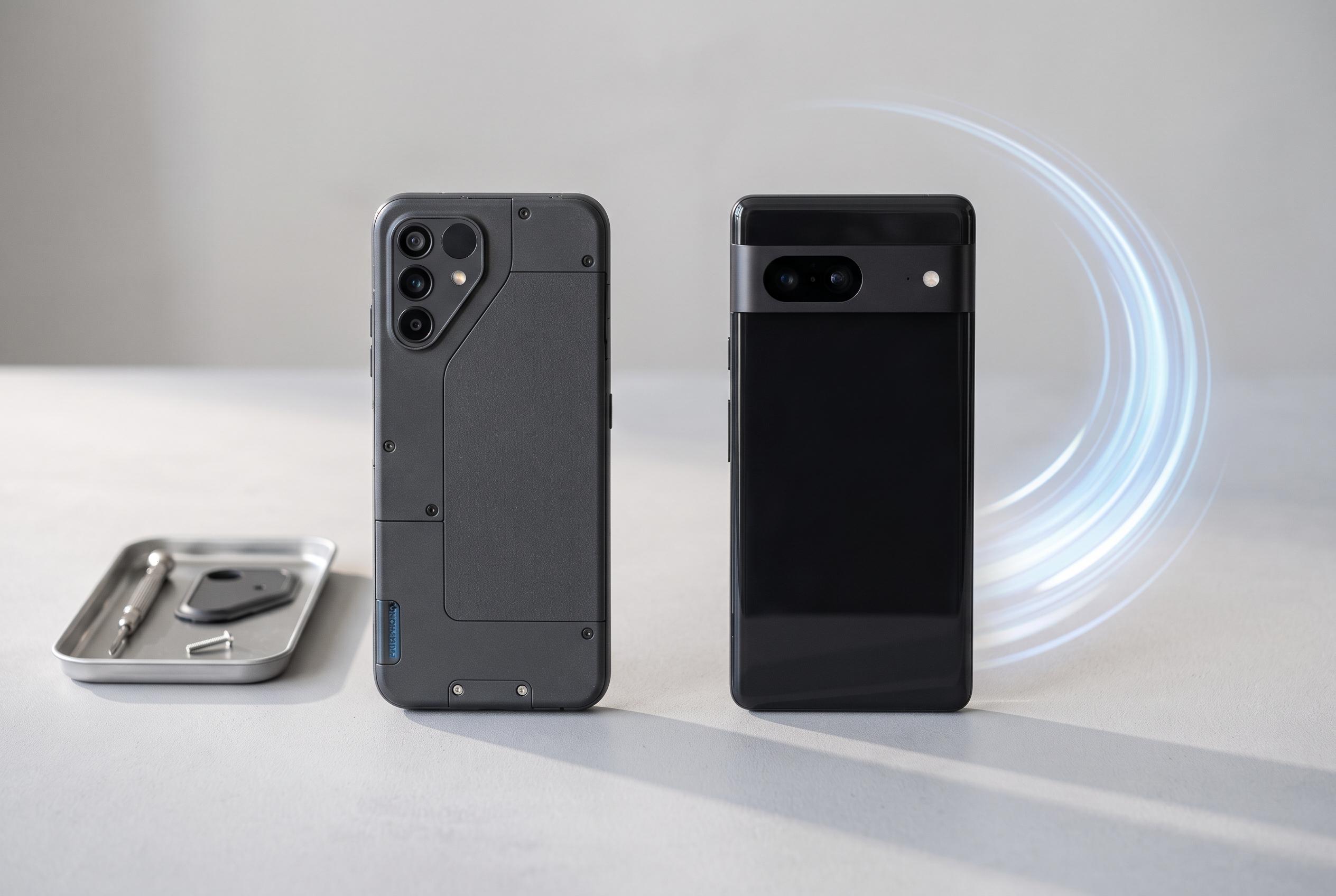

The Fairphone 6 and Google Pixel 10a, priced similarly in the UK, cater to differing priorities: one champions longevity and repairability, while the other offers flagship-like speed and camera quality, reflecting a broader debate on smartphone sustainability versus performance.
The Fairphone 6 and Google Pixel 10a arrive at much the same price point in the UK, but they are built for very different buyers. Fairphone’s pitch is rooted in longevity, ethical sourcing and easy self-repair, while Google’s mid-range Pixel is designed to deliver flagship-style speed, camera processing and software support at a lower cost than its top-tier phones. In the US, the gap is wider, with the Fairphone priced above the Pixel, which changes the value argument considerably.
Repairability is where the Fairphone pulls ahead most clearly. iFixit gives the Fairphone 6 a perfect repairability score and notes that core parts such as the battery, screen, ports and camera modules are designed to be replaced with relative ease. Google’s Pixel 10a is also serviceable, and iFixit has published repair guides for it, but the phone scores lower and some components are more complex to change. For buyers who plan to keep a handset for years, that difference matters.
Performance is likely to favour the Pixel 10a. Google’s handset uses a Tensor chipset and pairs it with 8GB of RAM, whereas the Fairphone 6 uses a Snapdragon 7s Gen 4 and ships with 12GB of RAM. That suggests the Pixel will be the quicker phone for general use and the stronger option for Google’s software features, while the Fairphone may benefit from extra memory in heavier multitasking. On paper, the Fairphone has enough headroom for everyday use, but it is not chasing the same class of silicon.
Camera hardware also leans towards Google. The Pixel 10a has a 48MP main camera and a 13MP ultrawide, supported by Google’s established image processing tools such as Best Take. The Fairphone 6 offers a 50MP main camera and a 13MP ultrawide, but with a smaller sensor and less ambitious software. For buyers who want more flexible photography and more polished results straight out of the camera, Google appears to hold the edge.
Long-term support is strong on both sides. Fairphone says the Fairphone 6 will receive software updates until 2033, including six Android version upgrades. Google promises seven years of OS updates for the Pixel 10a, which would extend support to 2034. In practical terms, either phone should outlast the typical upgrade cycle, but Google offers one extra year. The choice therefore comes down to priorities: the Pixel 10a for speed, cameras and software polish; the Fairphone 6 for repairability, modular design and a more circular approach to ownership.
Disclaimer: This content is intended for informational purposes only. Readers are advised to exercise their own judgement, conduct due diligence, or consult a qualified expert before acting on any information provided.