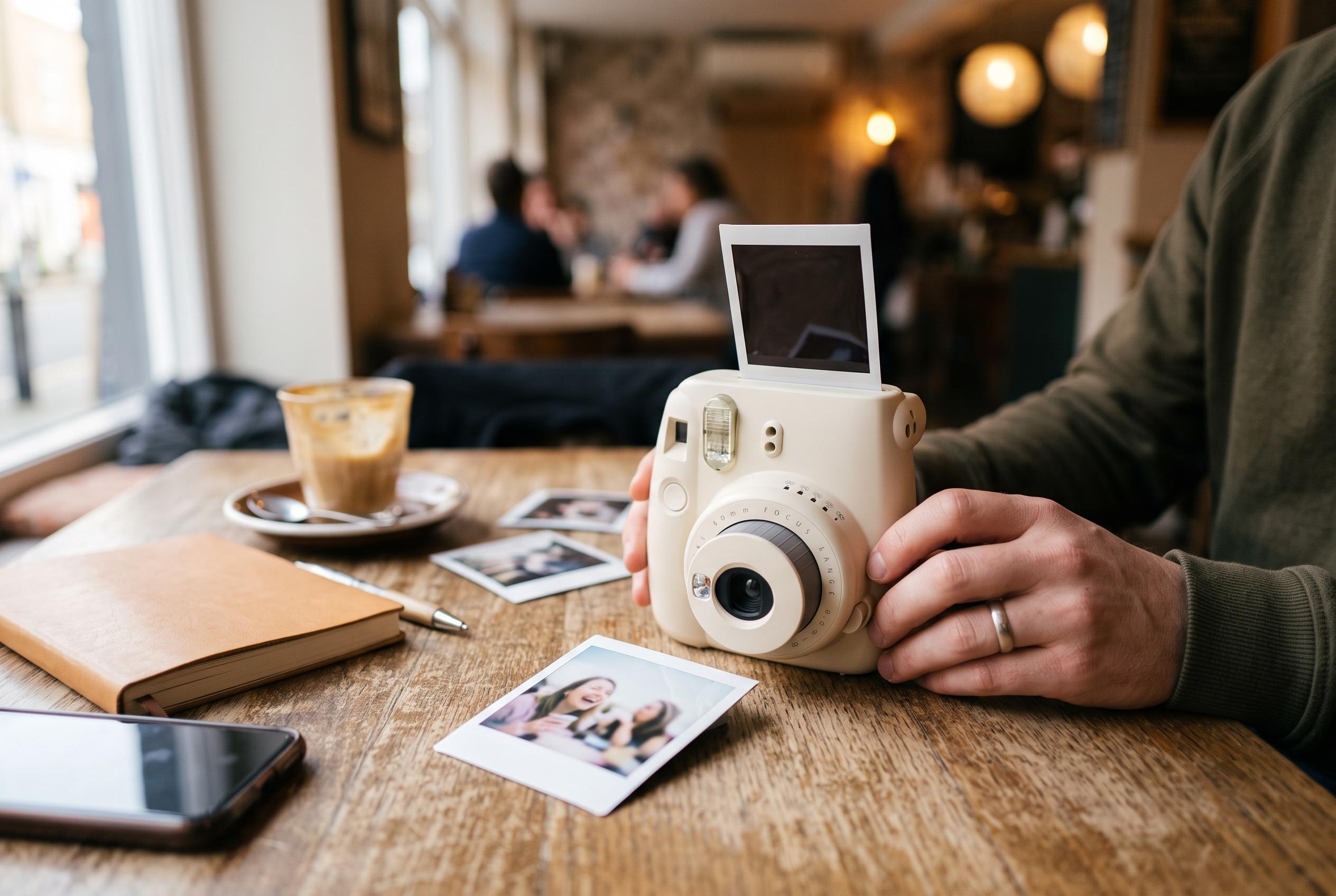

Fujifilm’s new Instax Mini 13 introduces modest refinements, including a mechanical self-timer, aiming to appeal to casual users and first-time buyers, while maintaining the simplicity that defines instant photography.
Fujifilm’s Instax Mini 13 is a careful update rather than a reinvention. According to the Indian Express review, it keeps the format simple and accessible, with a body that is easy to pick up and use, while adding only modest refinements over the Mini 12. The most notable change is a mechanical self-timer, which gives the camera a little more flexibility without compromising the point of the Instax experience: taking a picture, waiting for the print and accepting the charm of the result.
That approach is reflected in the design. The camera has a soft, rounded shape that suits casual use more than deliberate photography, and it is offered in a range of playful finishes, including Dreamy Purple, Frost Blue, Candy Pink, Lagoon Green and Clay White. Reviewers at TechRadar and DPReview noted the more balloon-like body styling and the metallic front logo, while Expert Reviews said the shape is less comfortable for long periods than some users might prefer. Even so, the Mini 13 remains light enough at roughly 306 grams to carry easily, and its controls are deliberately limited: lens barrel, shutter button, selfie mirror and flash.
The new timer is the clearest functional improvement. TechRadar and the Indian Express both point to its 2-second and 10-second settings as a useful addition for selfies and small group shots. That said, the lack of a tripod socket weakens the usefulness of the longer timer, especially if a user wants a more stable, staged composition. The camera also retains Instax’s close-up mode, which improves framing for nearer subjects through parallax correction. Tom’s Guide and Digital Trends both found the overall operation reassuringly straightforward, with automatic exposure and no menu system to slow things down.
Image quality is best judged on the camera’s own terms. The Mini 13 uses a 60mm f/12.7 lens and Instax Mini film rated at ISO 800, and the built-in flash fires automatically on every shot. That combination, as the reviews from Expert Reviews, Tom’s Guide and Digital Camera World all observed, produces bright, vivid prints that are especially effective indoors, at parties and in other social settings where the flash helps to balance the scene. In stronger light, however, the same simplicity becomes a limitation. Overexposure, blown highlights and a lack of manual control remain common complaints, and Digital Trends noted that it is not an ideal camera for landscapes or other situations that demand precision.
The larger question is whether the Mini 13 gives existing Instax users enough reason to upgrade. On that point, the answer is probably no. The Indian Express concluded that anyone already using a Mini 12 will find the changes too slight to justify an immediate replacement. But for first-time buyers, the Mini 13 lands in the right place. It is inexpensive by instant-camera standards, runs on two AA batteries rather than a rechargeable pack, and focuses on what many people want from this format: a simple process, a physical print and the small surprise of seeing how the image turns out. It is not a tool for technical control, but it does a credible job of making instant photography feel enjoyable.
Disclaimer: This content is intended for informational purposes only. Readers are advised to exercise their own judgement, conduct due diligence, or consult a qualified expert before acting on any information provided.