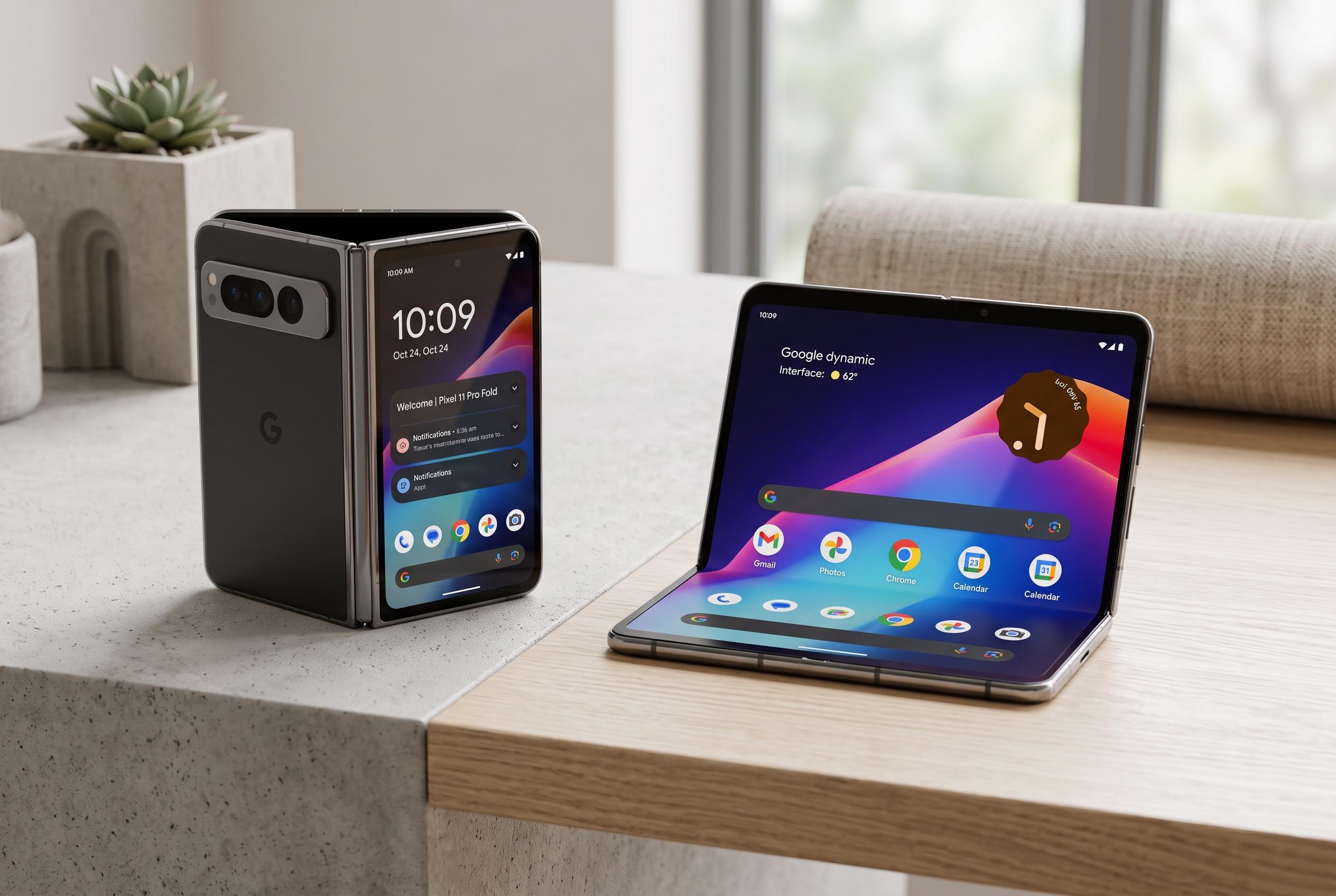

Google launches its most expensive foldable, the Pixel 11 Pro Fold, positioning itself as a strong rival to Samsung’s Galaxy Z Fold 8, with fresh focus on software, design, and battery life.
Google’s latest foldable, the Pixel 11 Pro Fold, arrives as the company’s most expensive handset to date and is being positioned as a direct rival to Samsung’s new Galaxy Z Fold 8 line. According to Google’s launch material, pre-orders have started and the device will reach the market soon, while Samsung has already opened sales for the Galaxy Z Fold 8 and the higher-spec Galaxy Z Fold 8 Ultra. The immediate question for buyers is not whether foldables have matured, but which company has made the more convincing case for everyday use.
Price is the first dividing line. Google has set the Pixel 11 Pro Fold at ₹1,86,999 for a single configuration. Samsung’s Galaxy Z Fold 8 starts at ₹1,79,999, while the Galaxy Z Fold 8 Ultra is priced from ₹1,99,999. Tom’s Guide says the standard Fold 8 is aimed at most users because it balances size, performance and portability more neatly than the Ultra, which helps explain why Samsung has split the range into a mainstream model and a premium alternative.
On design, the two companies are making different arguments. Google’s foldable uses a 6.5-inch cover display and an 8-inch inner panel, both with 120Hz refresh rates, and weighs 239 grams. Samsung’s standard Fold 8 is far lighter at 201 grams, with a 5.5-inch outer screen and a 7.6-inch main display. Samsung’s own product page says the phone uses a dual layer of titanium, while SamMobile reports a wider, shorter shape intended to improve media viewing and reduce the visible crease. The Ultra keeps Samsung in the large-screen category, with a 6.5-inch cover display, an 8-inch inner panel and a 215-gram weight.
Battery and charging also split the field. Google’s device carries a 4,806mAh dual battery with 30W wired charging and 25W wireless charging. Samsung’s standard Fold 8 uses a 4,800mAh dual battery with 45W wired charging and 20W wireless support, while the Ultra stretches to 5,000mAh with the same charging rates as the standard model. Android Central says Samsung is using denser silicon-carbon cells across the range, part of a broader push to reduce bulk without sacrificing endurance.
The biggest contrast is in software and imaging. Google is leaning on Tensor G6, 16GB of RAM and 512GB of storage, alongside Gemini-powered features, advanced camera tools and Pixel Drop updates. Its camera system includes a 48-megapixel main sensor, a 10.8-megapixel telephoto lens and a 10.5-megapixel ultrawide, plus 10-megapixel front cameras on both screens. Samsung’s standard Fold 8 runs on Snapdragon 8 Elite Gen 5 and offers a dual 50-megapixel rear camera setup, while the Ultra adds a 200-megapixel main sensor, a 50-megapixel ultrawide and a 10-megapixel telephoto lens. Samsung also packages AI multitasking and editing tools such as Now Nudge and My FanCam. For buyers, the choice is clear enough: Google is selling intelligence and software support, while Samsung is offering lighter hardware, stronger charging and, in the Ultra, a far more ambitious camera system.
Disclaimer: This content is intended for informational purposes only. Readers are advised to exercise their own judgement, conduct due diligence, or consult a qualified expert before acting on any information provided.