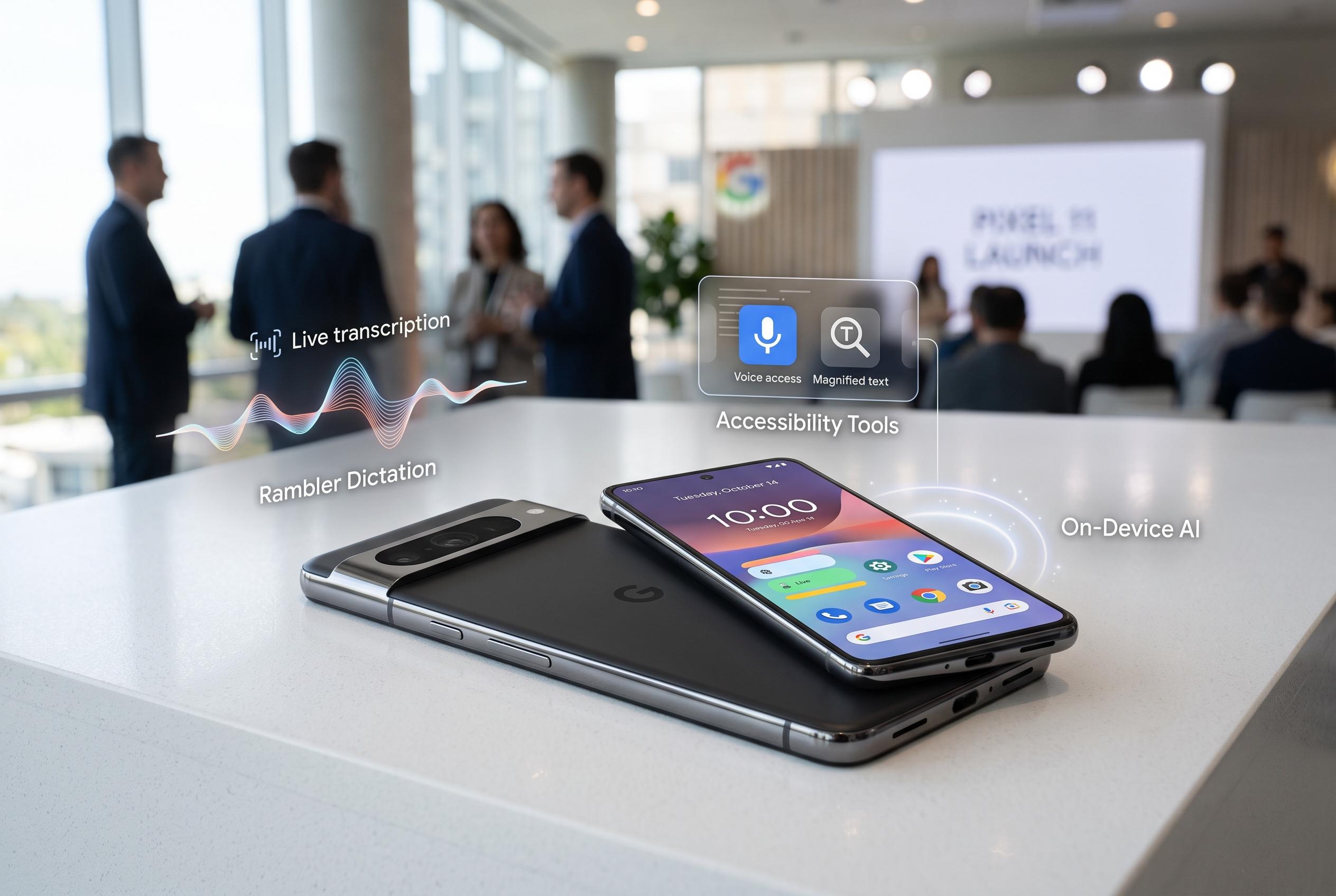

Google’s Made by Google 2026 event in New York shifted focus from hardware updates to software innovations and immersive presentation techniques, highlighting new features like Rambler dictation and accessibility tools alongside the Pixel 11 family.
Google used its Made by Google 2026 event in New York to frame the Pixel range less as a hardware refresh than as a broader argument for what a modern Android phone should do. Official details of the Pixel 11 family, the Pixel Watch 5 and the Pixel Tag tracker were released in the morning, hours before the evening presentation, a sign that the company was trying to get ahead of leaks and control the story around a heavily previewed launch.
What stood out most was not the devices alone but the decision to stage a live show around them. In an era when Apple relies heavily on prerecorded launches and Samsung leans on tightly scripted presentations, Google brought in Trevor Noah to keep the event moving and to push its executives into a more spontaneous format. That created some awkward moments, but it also made the demonstrations feel less like a polished sales pitch and more like a product showcase with an audience in the room.
The strongest case for the new Pixel line came from the software features. Google’s Rambler dictation tool was presented as a more forgiving way to turn speech into text, picking up fragmented or incomplete language and turning it into usable copy. That fits neatly with Google’s wider transcription work on Pixel phones, which already includes recording transcripts, language detection, transcript editing and summaries on supported devices, according to Google’s Pixel support pages. It also sits alongside features such as Magic Cue, Gemini Live and Call Screen, which Google says are meant to make the phone more proactive and less interruptive.
Accessibility was another clear theme. Google showed an American Sign Language-to-text model that runs in a privacy-conscious way: the phone tracks geometric points from the signer and sends only those coordinates for translation, while the video itself is discarded. That approach aligns with Google’s wider privacy claims for Pixel features such as Live Caption, which the company says is processed and stored on-device. Google has also continued to expand accessibility tools across Pixel and Android, including guided camera framing, improved magnifier functions and Live Transcribe updates.
Two of the more consumer-facing additions were more uneven. Magic Capture aims to do more of the photo selection work for the user by recording video and extracting still frames, an approach that could help people who miss the moment or do not want to think about camera technique. The other notable debut was Pixel Tag, Google’s answer to Apple’s AirTag and part of the wider Find Hub network. But the feature that drew the most scepticism was HiLight, the circular light near the rear cameras on the higher-end Pixel models. At launch, it appears limited to caller colours and a Gemini indicator, which makes it feel more like a novelty than a fully realised design element. Still, the event suggested Google is trying to make Pixel stand out through behaviour, not just specifications.
Disclaimer: This content is intended for informational purposes only. Readers are advised to exercise their own judgement, conduct due diligence, or consult a qualified expert before acting on any information provided.