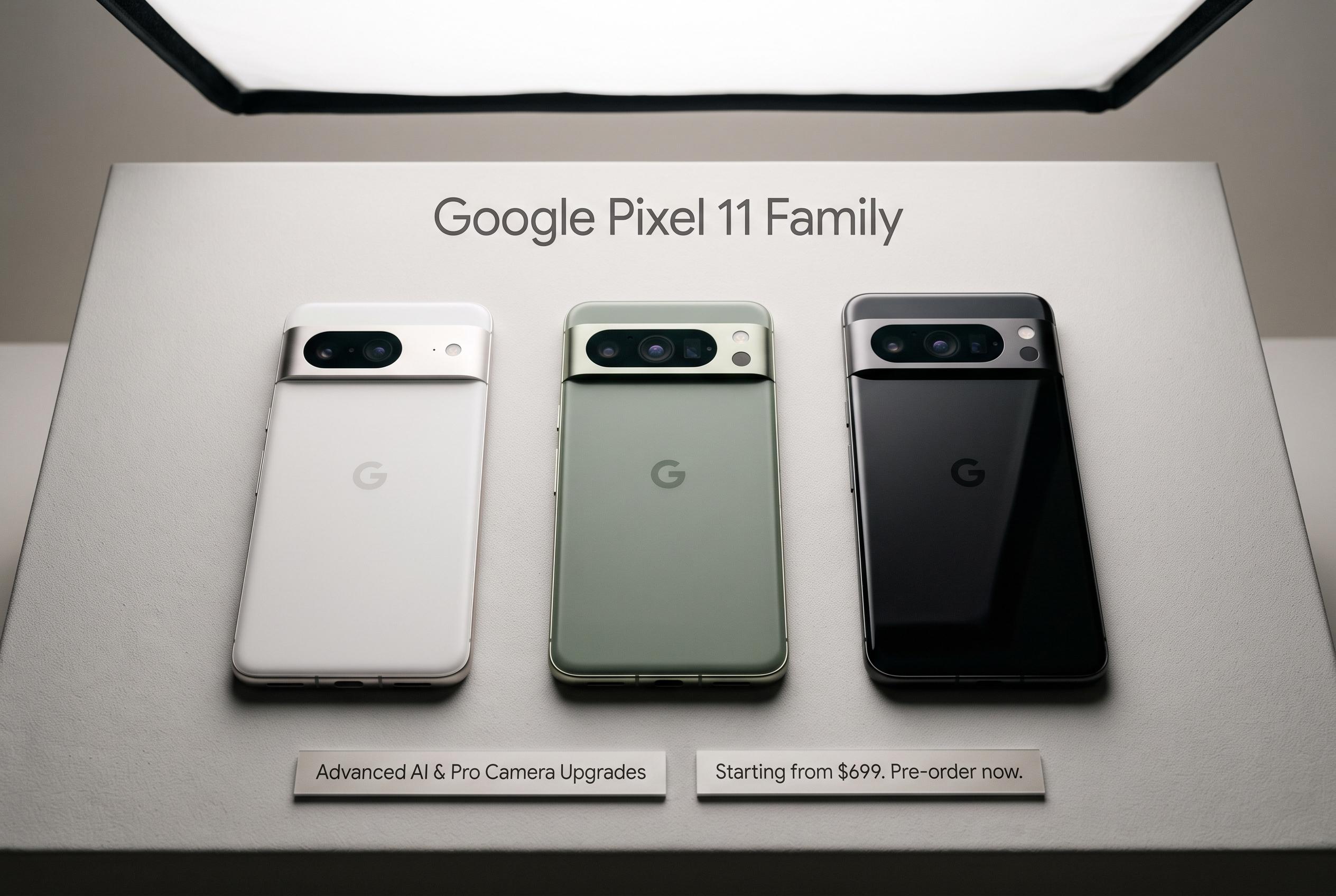

Google has launched its Pixel 11 series, featuring significant camera and AI enhancements, refined design, and competitive pricing, signalling a strategic push into premium mobile innovation.
Google has unveiled the Pixel 11 family, a launch that keeps the familiar Pixel design language but pushes more aggressively into artificial intelligence, imaging and charging upgrades. The line-up, announced at the Made by Google event on August 12 in New York, comprises the Pixel 11, Pixel 11 Pro and Pixel 11 Pro XL, with Google positioning the series around the idea of asking more from a phone rather than changing its shape dramatically.
The most visible changes are concentrated around the camera bar and display. Google has refined the rear module with a flush glass finish and an aluminium frame, while also adding IP68 water and dust resistance. The standard Pixel 11 uses a 6.3-inch Actua OLED panel with a 120Hz refresh rate and a claimed peak brightness of 3,000 nits, protected by Gorilla Glass Victus 2. The Pro models step up to Super Actua LTPO screens, with the Pro XL using a 6.7-inch panel and both versions reaching a quoted 3,600 nits at peak brightness.
Photography remains the main divider between the models. According to Google, the base Pixel 11 carries a 48-megapixel main camera, a 13-megapixel ultra-wide lens and a 10.8-megapixel telephoto camera with 5x optical zoom. The Pro and Pro XL move to a 50-megapixel main sensor, a 48-megapixel ultra-wide with macro focus and a 48-megapixel telephoto lens that supports much longer digital zoom, alongside a 42-megapixel front camera. The premium models also gain Video Boost for 8K recording at 30 frames per second, plus stabilisation features aimed at more demanding handheld video.
There is also a new HiLight notification system on the Pro models, using LEDs built into the camera bar to signal calls or Gemini activity when the phone is placed face down. That feature had been hinted at in pre-launch leaks, along with a matte black finish and updated lighting effects around the camera area. Google has paired the hardware with the Tensor G6 chip across the range, together with Titan M3 security hardware, and says the new processor improves AI tasks such as live translation and sign-language conversion in Gboard. Battery life is claimed to exceed 30 hours, with the Pixel 11 starting from a 4,985mAh cell, the Pro at 4,850mAh and the Pro XL at 5,115mAh. All three support Qi2 magnetic wireless charging through Google’s Pixelsnap system, with wired charging rated at up to 45W on the larger model.
Pricing is more aggressive than earlier rumours suggested. Android Central had reported possible starting prices of $899, $1,099 and $1,299, but Google’s European pricing begins at €999 for the Pixel 11, €1,199 for the Pixel 11 Pro and €1,399 for the Pixel 11 Pro XL. Storage now starts at 256GB, and Google is promising seven years of Android version updates and Pixel Drops. The Pro models also include six months of Google AI Pro. According to PhoneArena, pre-orders are expected to open immediately after the announcement, with retail availability likely to follow on August 20.
Disclaimer: This content is intended for informational purposes only. Readers are advised to exercise their own judgement, conduct due diligence, or consult a qualified expert before acting on any information provided.