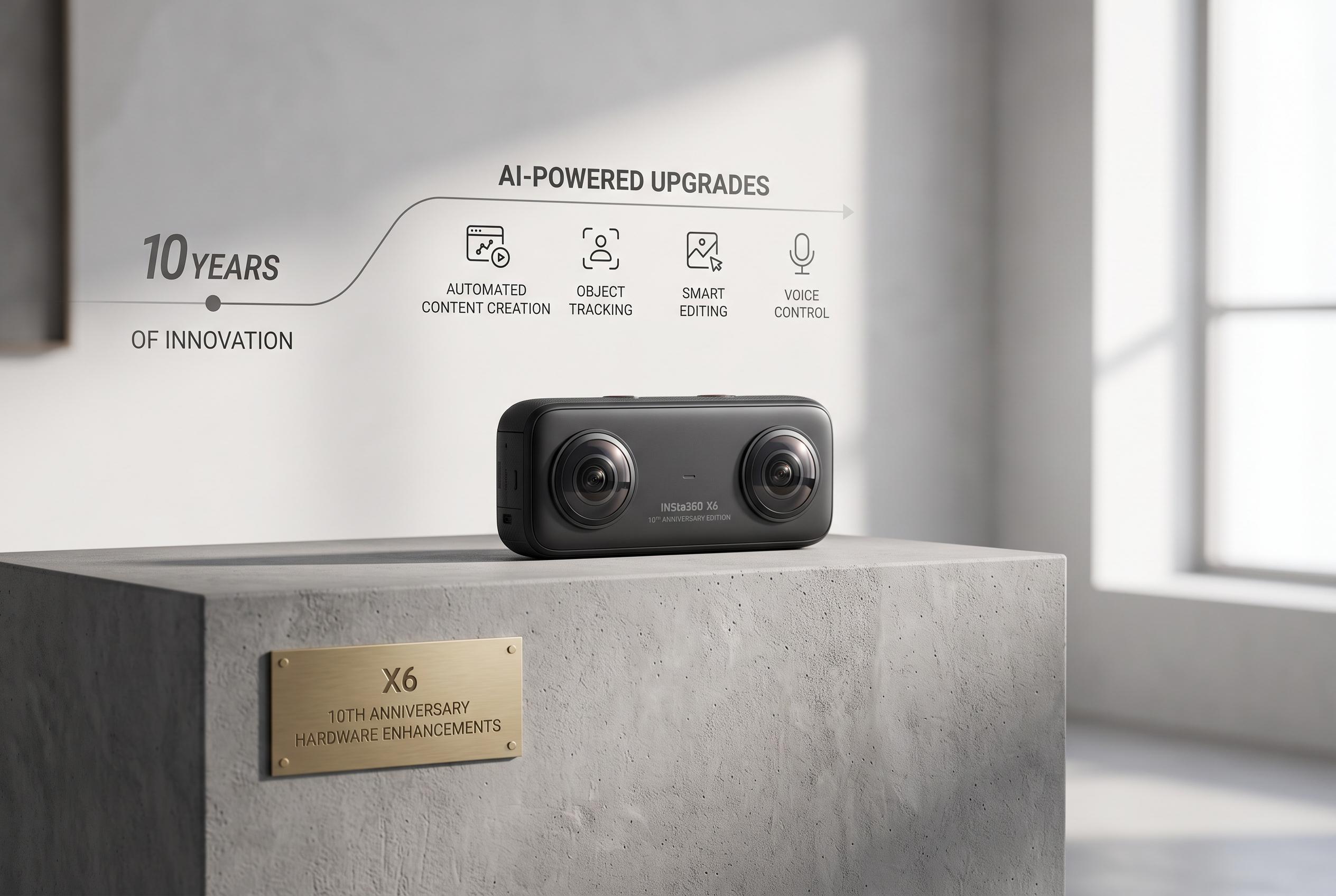

Marking its tenth anniversary, Insta360 unveils the X6 with significant hardware enhancements and new AI-driven features aimed at reducing manual editing and pushing 360 imaging towards more automated, user-friendly content production.
Insta360 has used the tenth anniversary of its 360 camera business to push the X6 towards a more automated model of content capture. Launched on 12 August and priced from RMB 3,999 in mainland China, the flagship is presented not just as a sensor upgrade, but as a sign that more of the creative process is being shifted from the user to the camera and its software.
The hardware changes are substantial. The X6 records 8K 360-degree video at up to 50 frames per second and uses two custom 1/1.1-inch square sensors developed with Sony. Insta360 says the new sensors provide 33% more surface area than those in the X5 and capture roughly four times as much light per frame, which should matter most in difficult conditions such as dim interiors and scenes with strong backlight. Early reviews from TechRadar, Tom’s Guide and T3 broadly support that positioning, describing the X6 as a meaningful step up in image quality, low-light performance and overall flexibility.
The bigger change is in workflow. 360 cameras have long promised freedom from aiming a lens during recording, but that convenience has usually come with a demanding editing burden afterwards. The X6 tries to cut that burden down. Its InstaFrame 2.0 mode can produce a ready-to-share 4K flat video, while automatic tracking now covers people, pets and objects. With the “POV Head Tracker” accessory, the framing can also respond to the wearer’s gaze, further reducing the need for manual adjustment.
Insta360 is also leaning harder on artificial intelligence after capture. The camera runs the company’s PanoMind 360 AI model, with an “AI Director” function that can scan footage on the device and build highlight reels automatically. Another tool, “Moments Pro”, lets users define a subject, mood, style and time range before generating a video in the cloud. The X6 additionally adds 3D spatial reconstruction, allowing footage to be explored as a navigable scene rather than only watched as a flat clip. That direction fits a broader company strategy: according to Insta360’s annual report, revenue rose 74.76% year on year in 2025 and increased by 83.11% in the first quarter of 2026, while investment also expanded into drones, gimbals, wireless microphones and custom chips. In that context, the X6 is both a product upgrade and a test of how far Insta360 can move 360 imaging from capture towards automated creation.
Disclaimer: This content is intended for informational purposes only. Readers are advised to exercise their own judgement, conduct due diligence, or consult a qualified expert before acting on any information provided.