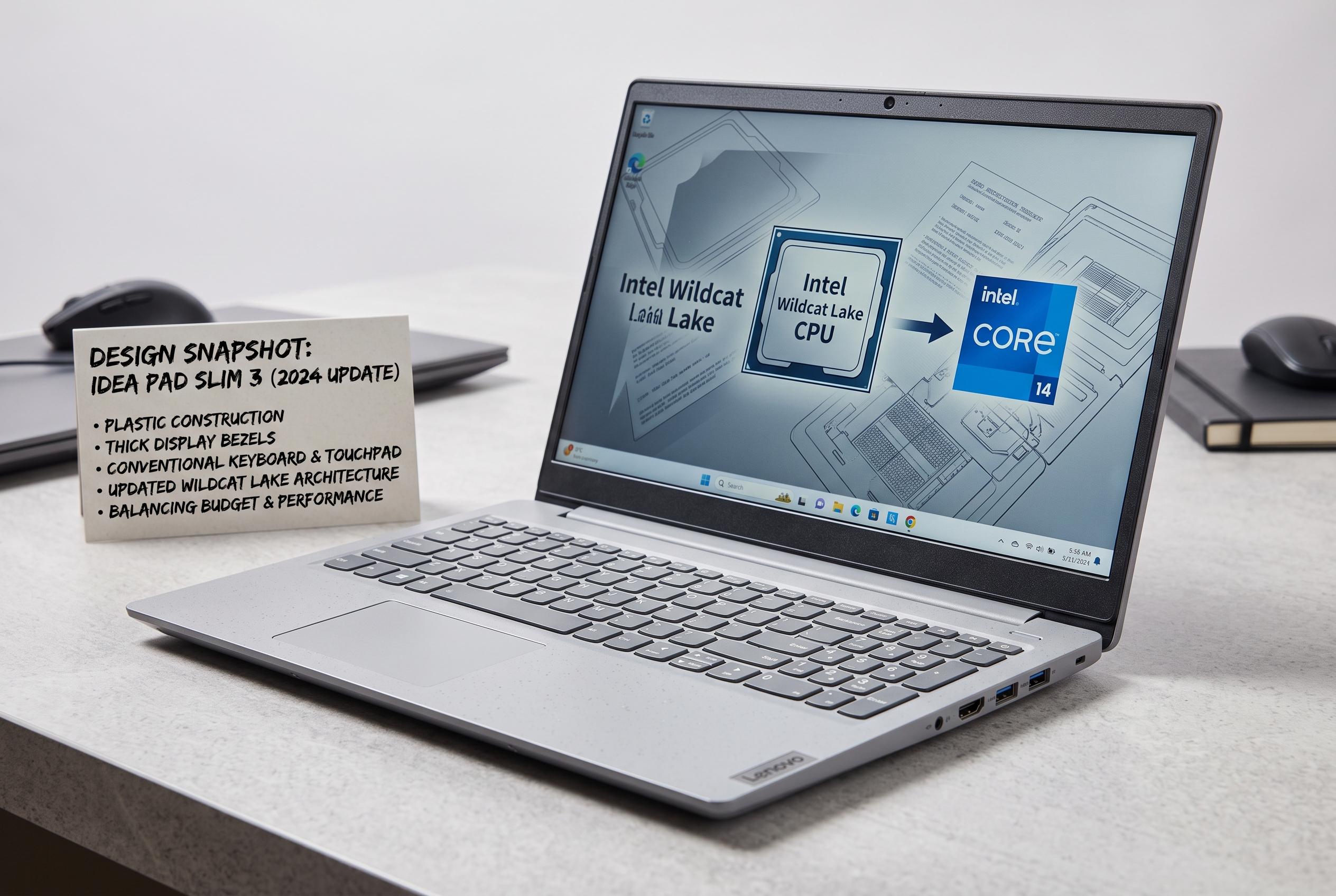

Lenovo’s IdeaPad Slim 3, powered by Intel’s new Wildcat Lake platform, aims at daily Windows users but struggles with dated design and limited features amid rising component costs and market pressures.
Lenovo’s IdeaPad Slim 3 arrives at a time when low-cost laptops are under fresh pressure. As component prices rise and budget buyers become more sensitive to trade-offs, manufacturers are being pushed to do more with less. The Slim 3 reflects that market reality: it is built around Intel’s new Wildcat Lake platform, sold under the Core Series 3 name, and aimed squarely at everyday Windows use rather than premium features or outright speed.
According to the review, the model on test uses the Core 7 350, one of the stronger Wildcat Lake chips. It combines two Performance cores, four low-power efficiency cores, integrated graphics with two Xe cores and an NPU rated at 49 TOPS. That is enough for routine productivity work, but Intel positions Wildcat Lake as a simpler, lower-power alternative to Panther Lake rather than a direct rival to it. Notebookcheck’s early analysis says the chip is best suited to entry-level systems and remains closer in class to older U-series parts than to higher-end mobile processors.
The laptop itself follows the same restrained logic. It comes with 16 GB of memory and a 1 TB SSD in the review unit, although lower-priced variants are likely to ship with less. That matters, because 16 GB is increasingly the sensible minimum for a daily-use Windows 11 machine. The display is a 15.6-inch IPS panel with a 16:10 aspect ratio and Full HD+ resolution, which is more modern than the chassis suggests. The review also notes a 120 Hz dynamic refresh rate on the higher trim, while cheaper versions are expected to use a standard 60 Hz screen.
Design, however, remains a weak point. Notebookcheck describes the machine as visually dated, with broad screen borders, a plastic body and a proprietary round power connector. The ports are functional rather than ambitious: two USB-A ports, one USB-C port, HDMI, an SDXC reader and a headphone jack, alongside the barrel charger. The review also points out that the laptop lacks Windows Hello facial or fingerprint sign-in, leaving PIN or password as the only login methods. That omission feels striking in 2026, even for a budget system.
Early usage suggests the machine is adequate, but not inspiring. Wi-Fi 7 and Bluetooth 5.4 are present, the speakers are acceptable, and Lenovo has kept the software extras relatively restrained, with McAfee notably absent. Gaming results are mixed: Quake would not launch at all, while Halo: Campaign Evolved ran at native resolution only with very low graphics settings, producing frame rates in the mid-20s. That is usable rather than impressive, but it does show the limits of a budget-oriented chip.
Pricing is still uncertain because the model is not yet widely available, though the review expects starting prices around $600, with better-equipped versions reaching roughly $800 to $950. That places it in a difficult bracket. PCWorld’s earlier coverage of the IdeaPad Slim 3i found similar value concerns, citing a plastic chassis, barrel charger and a lack of backlit keyboard. Taken together, the reports suggest Lenovo has built a competent low-cost laptop, but one that competes more on specification balance than on modern design or standout features.
Disclaimer: This content is intended for informational purposes only. Readers are advised to exercise their own judgement, conduct due diligence, or consult a qualified expert before acting on any information provided.