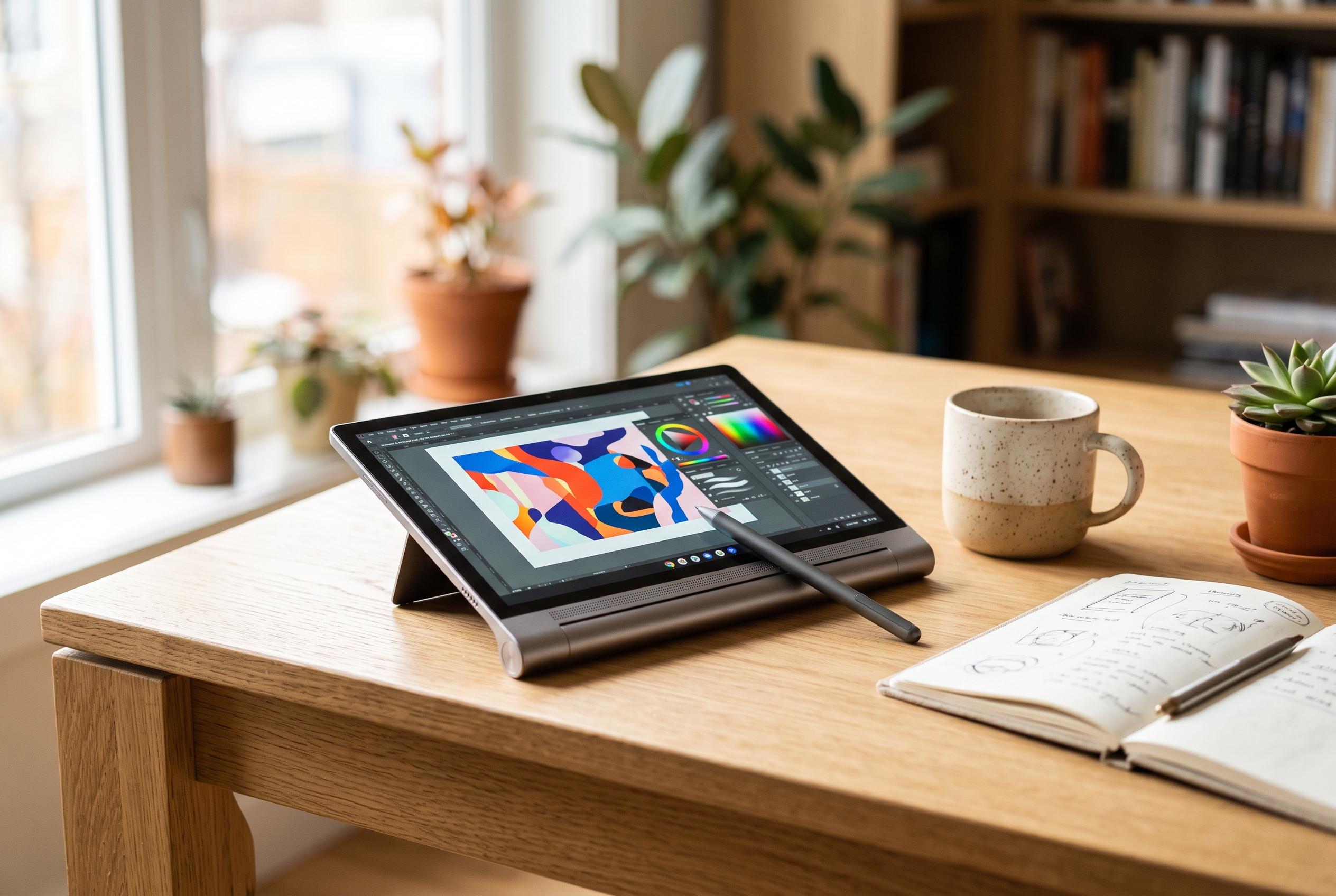

Lenovo’s compact Yoga Tab is now available for under €400 in Germany, reflecting a notable price correction on a well-equipped, creator-oriented Android tablet that continues to impress with its high-quality display and stylus features, even as it is superseded by newer models.
Lenovo’s compact Yoga Tab is now being sold by several German retailers for just under €400, a level that makes more sense when set against what has happened since its launch. The 11.1in Android tablet arrived as a premium-leaning creative model, but its US pricing has already softened from the $549.99 launch figure highlighted by PhoneArena, and on 3 September 2026 Lenovo moved the range on again by unveiling a Yoga Tab Gen 2. The current discount therefore looks less like a one-off bargain than a late-cycle price correction on hardware that is still well specified but no longer brand new.
That hardware remains unusually strong for the money. Lenovo positioned the tablet at IFA 2025 as a creator-focused device rather than a basic media slate, pairing a Snapdragon 8 Gen 3 platform with Android 15, up to 12GB of LPDDR5x memory and 256GB of UFS 4.0 storage. PhoneArena reported that the US bundle also included Lenovo’s Tab Pen Pro and a 2-in-1 Keyboard Pack, giving buyers a full productivity package from the outset. Lenovo’s own messaging went further, describing the device as an AI-assisted tablet for “young creatives” and shipping it with Adobe creative software and Perplexity Pro.
The screen is one of the clearest reasons the tablet still deserves attention. Lenovo’s PSREF sheet lists an 11.1in LTPS IPS panel at 3,200 x 2,000 with a 16:10 aspect ratio, 144Hz refresh rate, 98% DCI-P3 coverage, Dolby Vision support and 340ppi density. Typical brightness is rated at 600 nits, rising to 800 nits peak, and the panel is protected by 0.4mm Corning Gorilla Glass 7i. Computer Bild measured brightness as high as 721 cd/m² in testing, while both the official specification sheet and Lenovo’s launch material describe an all-metal body weighing about 458g and measuring 6.2mm thick, excluding the thicker camera section.
The pen is not a token extra. Lenovo’s specification material and LaptopMedia both say the Tab Pen Pro supports 8,192 pressure levels, tilt detection, palm rejection, haptic feedback, double-tap input and wireless charging when magnetically attached to the tablet. IT Pro found that emphasis justified, describing the Yoga Tab as particularly good for note-taking and highlighting a less common trick: the stylus can also act as a remote, letting users control volume, scrub through video or move through presentation slides. That matters because it makes the Yoga Tab more credible as a desk-side companion for meetings, lectures and sketching sessions rather than just another small Android screen.
The main qualification is performance in real use. On paper, the processor name suggests flagship behaviour, but LaptopMedia notes that Lenovo is using the QCM8650Q version of the Snapdragon 8 Gen 3 in a six-core layout, not the fuller eight-core configuration found in the larger Yoga Tab Plus. IT Pro’s Geekbench 6 results of 2,241 single-core and 5,912 multi-core, and LaptopMedia’s near-identical figures, confirm that the chip is powerful enough for mainstream workloads. Even so, Computer Bild reported a disconnect between benchmark numbers and day-to-day feel, saying menus could be sluggish and app launches oddly slow, possibly because of the interaction between the processor, Android 15 and Lenovo’s own interface layer.
Battery life is another area where the specifications and reviews do not line up neatly. Lenovo says the tablet uses a silicon-carbon battery and can stream YouTube for up to 12 hours. In practice, the independent tests are lower. IT Pro recorded 9 hours and 38 minutes in a looped video rundown, while Computer Bild reported 8 hours and 22 minutes of continuous use. Charging claims are also inconsistent across sources. PhoneArena wrote that the tablet supported 68W charging and came with a 45W adapter in the box in the US, but Lenovo’s PSREF document lists 45W USB-C charging support and says no power adapter is included. Computer Bild, meanwhile, said it saw roughly 54W fast charging and a full recharge in about an hour. For buyers, the practical lesson is simple: expect respectable endurance, but verify what charger, if any, is actually supplied in your region.
Elsewhere, the specification is broadly modern but not exhaustive. The camera system consists of a 13MP main rear camera, a 2MP macro sensor and a 13MP front camera with a 101-degree ultra-wide field of view; IT Pro says the front camera also supports face-tracking, and Computer Bild reported that the rear camera could record 4K video at 30fps. Connectivity is up to date with Wi‑Fi 7 and Bluetooth 5.4, and reviewers were positive about the quad-speaker system with Dolby Atmos. The omissions are worth noting, though: there is no microSD expansion, no 5G variant and no fingerprint reader, leaving face unlock and standard Android authentication as the main login options.
Taken together, that leaves the Yoga Tab looking like a very specific sort of bargain. At around €400, it is easier to justify as a bundled writing, sketching and light productivity tablet than as the fastest 11in Android device in its class. Buyers who value the display, the included pen features and the keyboard-ready design may find the package unusually complete for the price. Buyers who care more about snappier software behaviour, stronger battery margins or longer-term platform support should read the current discount for what it is: an attractive offer on a capable first-generation model that Lenovo has already begun to supersede with newer Yoga-branded tablets.
Disclaimer: This content is intended for informational purposes only. Readers are advised to exercise their own judgement, conduct due diligence, or consult a qualified expert before acting on any information provided.