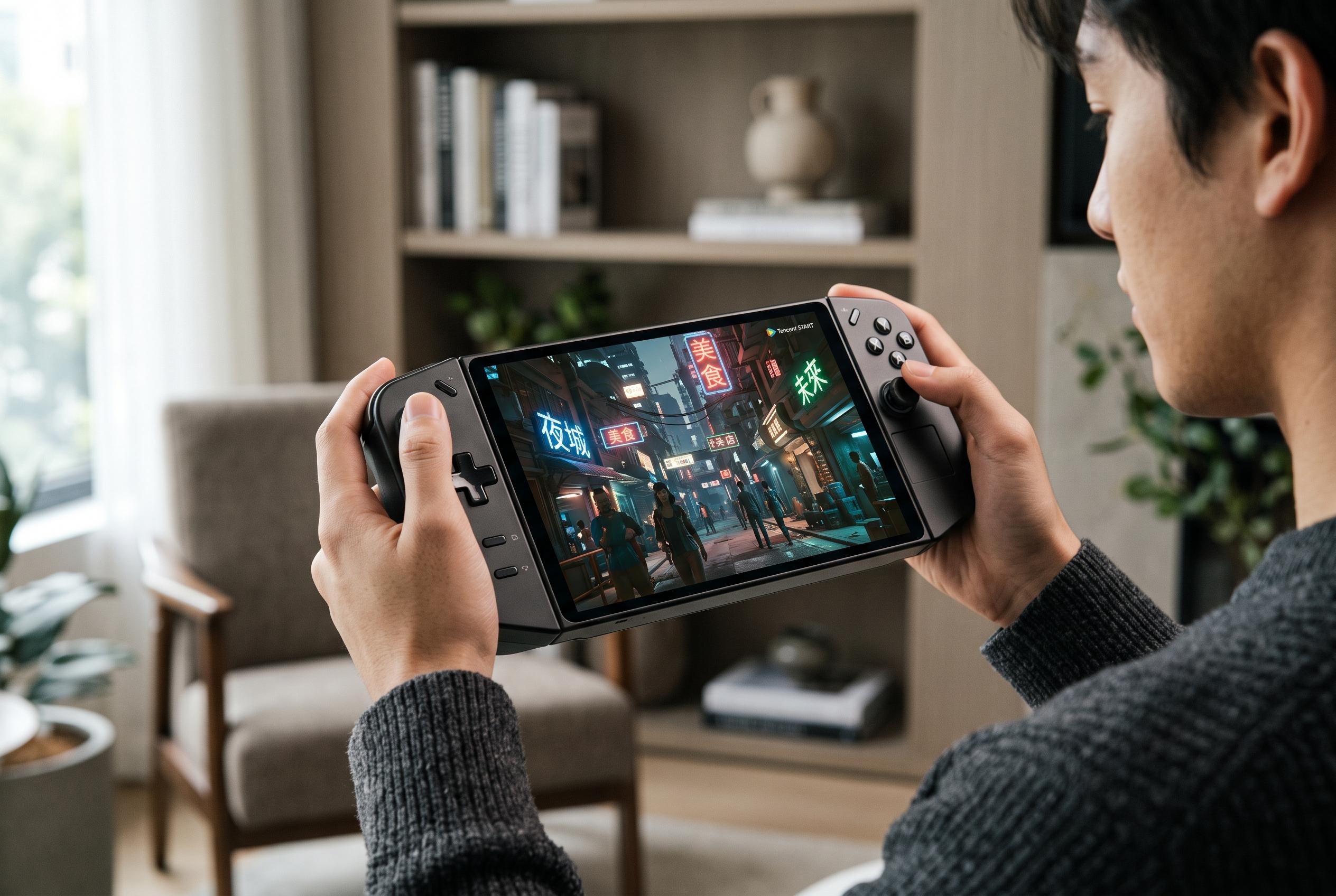

Lenovo is set to unveil the Legion C700, a lightweight, cloud-first gaming handheld that integrates streamed gameplay through Tencent’s START, marking a shift towards portable, console-like cloud gaming devices.
Lenovo will unveil the Legion C700 on 25 August in China, marking a notable shift in the handheld gaming market towards cloud-first devices. Rather than relying on local PC-class hardware to run demanding titles, the new model is built around streamed gameplay and remote access. Tencent’s START cloud gaming service is central to that approach, with Lenovo saying the device can run titles such as “Black Myth: Wukong” at up to 60 frames per second with latency below 10 milliseconds.
The hardware appears aimed at portability as much as performance. Lenovo has disclosed a 7.82-inch IPS LCD display with a 120Hz refresh rate, a thickness of 14.9mm and a weight of about 556 grams. That places it among the lighter handhelds in its class and reinforces its use case as a device for cloud gaming rather than a conventional Windows portable designed for local installation of large games.
Lenovo has also highlighted a control set that looks more ambitious than on many streaming-focused devices. The Legion C700 includes drift-resistant TMR analogue sticks, Hall-effect linear triggers, an omnidirectional D-pad, two rear buttons and dual shoulder controls. All inputs support full key remapping, while Lenovo’s own software adds one-touch launch options, offline and high-speed modes, and a control centre for live monitoring and on-the-fly changes to button mapping, stick sensitivity, fan speed and display settings.
The company is expected to reveal pricing and the remaining specifications at the launch event. For now, the Legion C700 stands out less as a rival to high-end Windows handhelds than as an attempt to make cloud gaming feel more console-like: thin, light and tightly integrated with Tencent’s streaming ecosystem.
Disclaimer: This content is intended for informational purposes only. Readers are advised to exercise their own judgement, conduct due diligence, or consult a qualified expert before acting on any information provided.