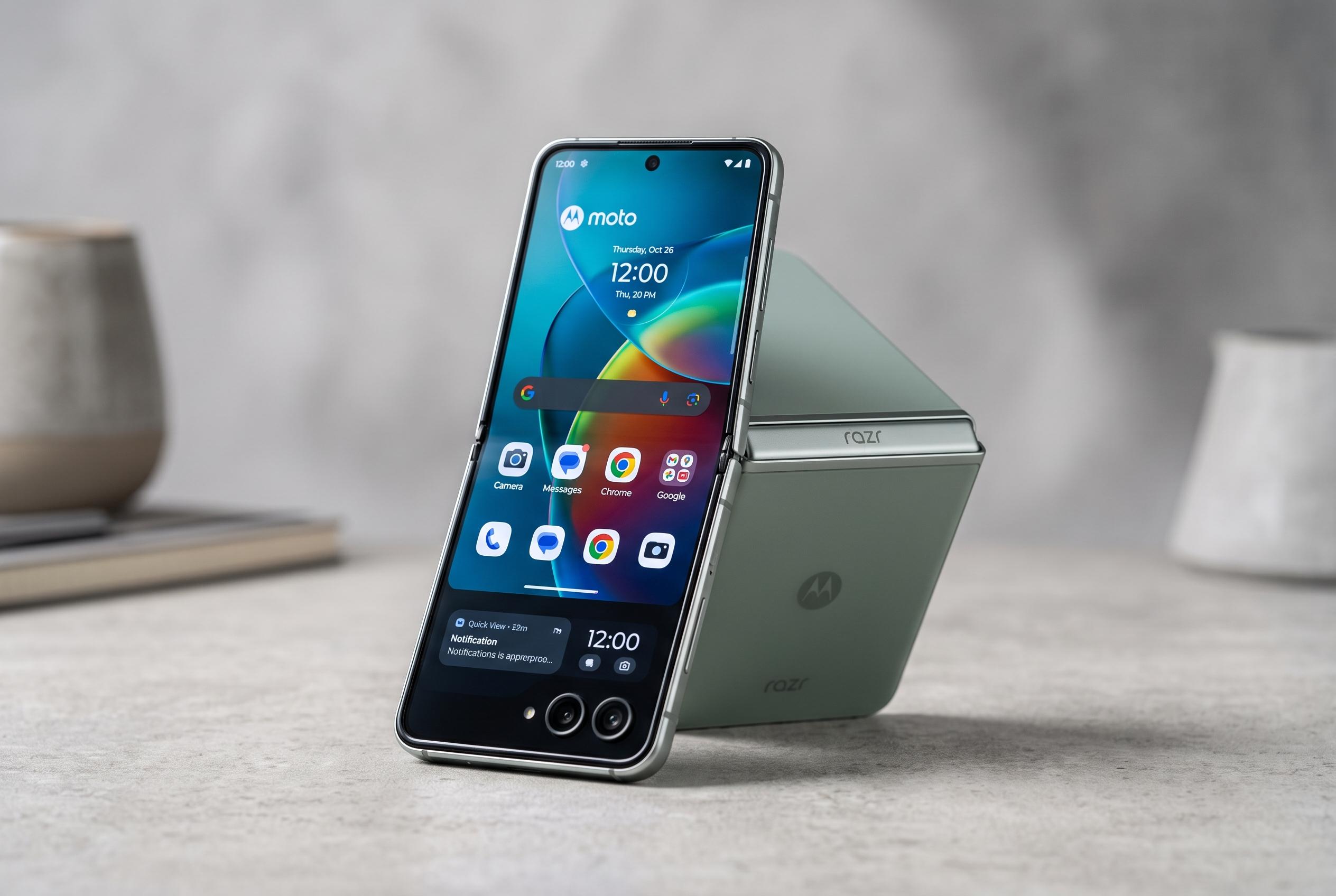

Motorola’s Razr Fold signals a strategic shift, competing head-to-head with Samsung, Oppo and Honor in the premium foldable market with high-end hardware, versatile displays, and promising battery life, aiming to redefine the foldable experience.
Motorola’s Razr Fold marks a serious shift for the company: its first book-style foldable is not being introduced as an experiment, but as a direct rival to Samsung, Oppo and Honor in the premium foldable class. The phone combines a 6.6-inch cover screen with an 8.1-inch inner display, the Snapdragon 8 Gen 5 platform, a 6,000mAh silicon-carbon battery and a triple 50MP rear camera array. In Australia, it starts at $2,799, placing it below Samsung’s Galaxy Z Fold 8 Ultra and alongside the Honor Magic V6, while also signalling that Motorola intends to compete on specification as much as on price.
Early hands-on and review impressions suggest the company has largely succeeded. The hardware is being praised for its tight hinge tolerances, solid closing action and unusually polished feel for a first-generation device. The textured Lily White finish has also been singled out as both practical and premium, helping grip while resisting fingerprints. There are weaknesses: the buttons sit awkwardly high on the frame and can be confused with one another, while the speaker layout requires some adjustment to get the best stereo effect. Even so, the overall impression is that Motorola has avoided the rough edges that often define a debut foldable.
The displays are among the Razr Fold’s strongest assets. The outer panel is tall enough to work like a normal handset screen for typing, messaging and quick tasks, reducing the need to unfold the device throughout the day. Open it up and the 8.1-inch internal OLED panel offers a bright, sharp 120Hz image with Dolby Vision support, giving the phone a tablet-like feel for reading, video and multitasking. Motorola says brightness can reach 6,200 nits, which should help outdoor visibility, while the stainless steel teardrop hinge and titanium support plate are designed to keep the crease subdued and the folding motion controlled.
Performance appears equally competitive. Motorola equips the phone with the Snapdragon 8 Gen 5, and benchmark comparisons from Android Central indicate that while older Snapdragon 8 Elite hardware can still edge it in some short-burst CPU and gaming tests, the Razr Fold holds up better in thermal and sustained-use scenarios. That matters in a foldable, where limited space makes heat dissipation difficult. Review testing also suggests the phone remains cool and responsive under load, with Motorola’s relatively light Android skin keeping the software fast and uncluttered. The downside is Moto AI, which has been described as underdeveloped, with the dedicated AI button not doing much out of the box.
Battery life and imaging are helping the Razr Fold stand out further. Motorola’s 6,000mAh battery, built with silicon-carbon chemistry, is being described as enough for a full day and into the next afternoon, while 80W wired charging, 50W wireless charging and 5W reverse wireless charging give it a clear practical advantage. The camera system, which uses a Sony LYTIA main sensor, a 3x periscope telephoto lens and a 122-degree ultrawide, is also drawing favourable comments, with strong stills, natural skin tones and useful zoom performance. Video remains the weaker area, but the foldable design helps by letting users shoot with the rear cameras while framing themselves on the cover screen, a setup that should appeal to buyers who care more about photography than handheld clips. Motorola also says the phone will receive up to seven years of Android and security updates and is aiming for broad international availability.
Disclaimer: This content is intended for informational purposes only. Readers are advised to exercise their own judgement, conduct due diligence, or consult a qualified expert before acting on any information provided.