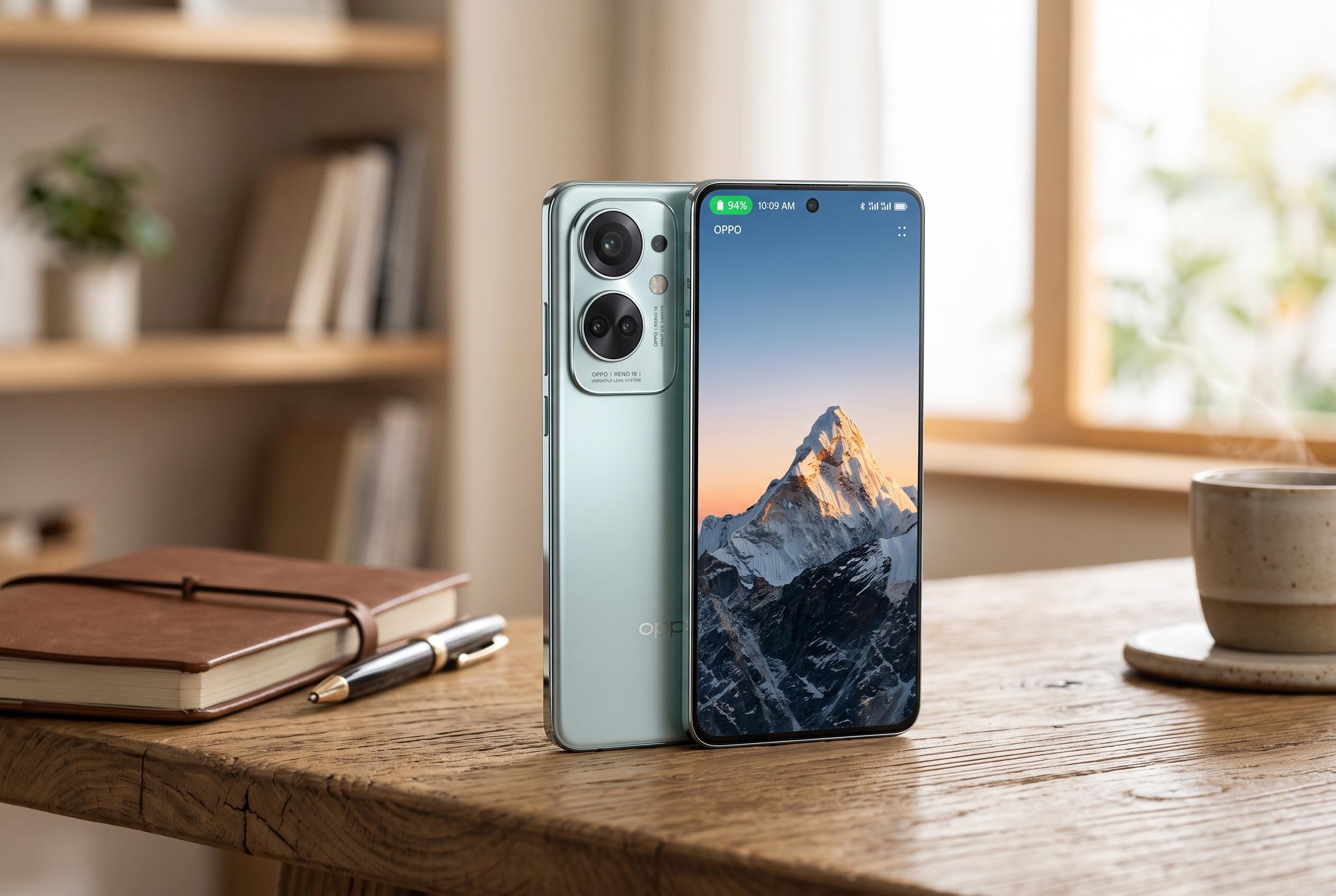

OPPO’s Reno16 offers a surprisingly polished mid-range experience, prioritising battery life and camera versatility, but its processor may hold back performance for demanding users.
OPPO’s Reno16 is a study in compromise, but one built with unusual care. The standard model sits alongside the Reno16 Pro in the new lineup, sharing a compact 6.32-inch AMOLED display, a 3.5x optical telephoto camera and a polished design language, while stepping down to the Snapdragon 7 Gen 4 instead of a more powerful flagship chip. The result is a phone that feels more premium than its processor would suggest, and more expensive than its silicon can easily justify.
That tension runs through the hardware. The aluminium frame, flat edges and integrated camera module give the handset a restrained, refined look, even if the styling inevitably recalls recent iPhone designs more than OPPO’s own past identity. In the Twilight Violet finish, the rear panel looks smart but does attract fingerprints. At 151.21mm tall and 72.42mm wide, with a thickness of about 8.22mm, it is genuinely compact by modern smartphone standards. OPPO also claims IP66, IP68, IP69 and IP69K resistance, which should make it unusually robust against dust, immersion and high-pressure water jets.
The display is one of the Reno16’s clearest strengths. It offers a 2,640 x 1,216 resolution, 120Hz refresh rate and 10-bit colour, with peak brightness said to reach 3,600 nits. Reviewers across the board praise the panel for sharp text, smooth motion and strong outdoor visibility. Stereo speakers add clarity for voices and general media playback, though the thin chassis limits bass and overall sound weight.
Performance is good enough for day-to-day use, but not especially ambitious. The Snapdragon 7 Gen 4, paired here with 8GB of RAM and 256GB of storage, handles messaging, browsing, streaming and multitasking with ease, while ColorOS 16 keeps animations fluid and responsive. Where the chip falls short is gaming, particularly with more demanding 3D titles, where some reviewers found it necessary to lower graphics settings. That leaves the Reno16 in an awkward position: fast enough for most people, but not obviously strong enough for its asking price.
ColorOS 16, based on Android 16, adds a long list of customisation options, including lock-screen tweaks, icon changes and notification-panel adjustments. It also introduces AI Snap Key, a configurable side button that can capture on-screen content, record a voice note or open AI Mind Space, a searchable archive for screenshots, documents, appointments and text. AI Mind Pilot is designed to bring together Gemini, ChatGPT and Perplexity in one interface, although access depends on signing in with an OPPO account. The downside, several reviews note, is the amount of pre-installed software, which makes the phone feel less tidy than it should at this level.
Battery life may be the strongest argument for buying it. In Europe, the Reno16 comes with a 6,000mAh battery and 80W SUPERVOOC charging, while other reviews of the same device point to a 6,700mAh cell in some market configurations. Either way, endurance is consistently described as excellent, with the phone comfortably lasting a full day and often stretching close to two. For users who value longevity, that is a major asset.
The camera system is equally central to the Reno16’s appeal. It pairs a 50-megapixel main sensor with optical stabilisation, a 50-megapixel ultrawide with autofocus, a 50-megapixel telephoto offering 3.5x optical zoom and optical stabilisation, plus a 50-megapixel front camera with autofocus and a wide field of view. In practice, the main camera delivers detailed images with balanced colours, the ultrawide is better than the weaker secondary cameras found on many mid-range rivals and the telephoto lens is the most useful of the group, especially for portraits and city scenes. Zoom beyond the optical range is mostly there for marketing, as quality falls off quickly.
OPPO launched the Reno16 in Italy at €899, later cutting the introductory price to €749. That pricing places the phone in difficult company, particularly when several rivals offer stronger processors for similar money. Yet the Reno16 does have a clear audience: buyers who want a compact handset with strong battery life, a well-rounded camera package and a polished software layer. For them, the phone makes a coherent case. For everyone else, the Snapdragon 7 Gen 4 remains the one compromise that is hardest to ignore.
Disclaimer: This content is intended for informational purposes only. Readers are advised to exercise their own judgement, conduct due diligence, or consult a qualified expert before acting on any information provided.