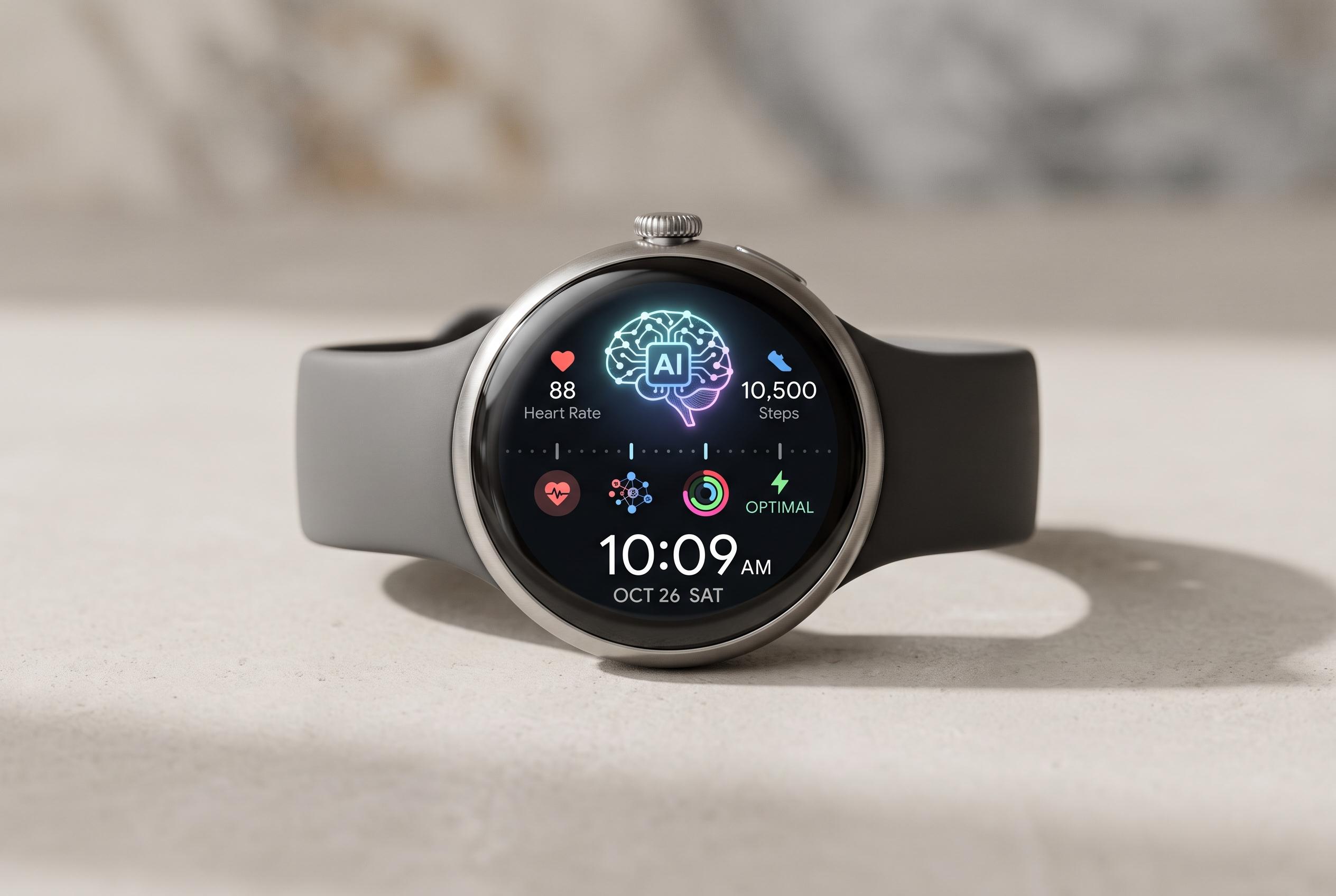

Google’s Pixel Watch 5 offers a subtle update focused on faster AI responses and advanced health monitoring, elevating its role as a wrist-worn assistant without a hardware overhaul.
Google’s Pixel Watch 5 is a measured update rather than a reinvention, but it pushes the line further towards a wrist-worn assistant that can do more than count steps and mirror notifications. According to Google and hands-on reports from Android Central and Tom’s Guide, the new model keeps the familiar rounded design while focusing on faster AI responses, more detailed health tracking and stronger safety tools.
At the centre of the update is Gemini Intelligence, which Google has woven more deeply into the watch experience. The company says the watch can surface context-aware information through At a Glance, show travel details such as boarding passes, and retrieve useful data from services such as Gmail with a raised wrist. Google is also adding proactive suggestions, allowing the watch to surface calendar details or other relevant prompts before a user asks. A one-handed double-pinch gesture is designed to make quick approvals and replies easier without reaching for a phone.
The hardware story is less dramatic, but still important for responsiveness. Android Central reports that the watch uses Qualcomm’s Snapdragon W5 Gen 2 Accelerated platform and a dual-chip layout, with Google claiming 50% more RAM, a 12% CPU increase and performance that is up to 20% faster. The display remains a domed AMOLED panel reaching 3,000 nits, and the watch comes in 41mm and 45mm sizes. Reviewers note that the design is closely related to the Pixel Watch 4, with the main changes centred on new colour options, updated bands and a Stephen Curry special edition.
Health tracking is where Google is making its strongest pitch. The Pixel Watch 5 adds what the company calls Health Guardian, built around breathing emergency detection, blood pressure trends, insulin resistance trends and sleep breathing quality. Tom’s Guide says the breathing emergency feature uses multiple sensors, including PPG, accelerometer and barometer data, together with on-device AI, to spot sustained oxygen drops and, if needed, contact emergency services with the wearer’s location. Google says the feature will launch first in Europe. The watch also adds more precise GPS route tracking, a new strength-training mode and smarter recovery guidance that can adjust workout suggestions based on sleep and heart-rate variability.
Sleep and battery life have also been refined. Google says sleep-stage detection is more accurate, while Smart Wake is designed to rouse users during lighter sleep before an alarm. There is also a bedtime watch face and automation that can pause audio when the wearer falls asleep. Battery life is rated at up to 30 hours on the 41mm model and 40 hours on the 45mm version, with fast charging and a repairable build. Android Central reports that pricing starts at $399 for the 41mm Wi-Fi model in the US, while TechRadar notes that LTE versions and the larger model cost more. The result is a watch that looks familiar but is more capable, especially for users who want AI-assisted convenience and more ambitious health monitoring on the wrist.
Disclaimer: This content is intended for informational purposes only. Readers are advised to exercise their own judgement, conduct due diligence, or consult a qualified expert before acting on any information provided.