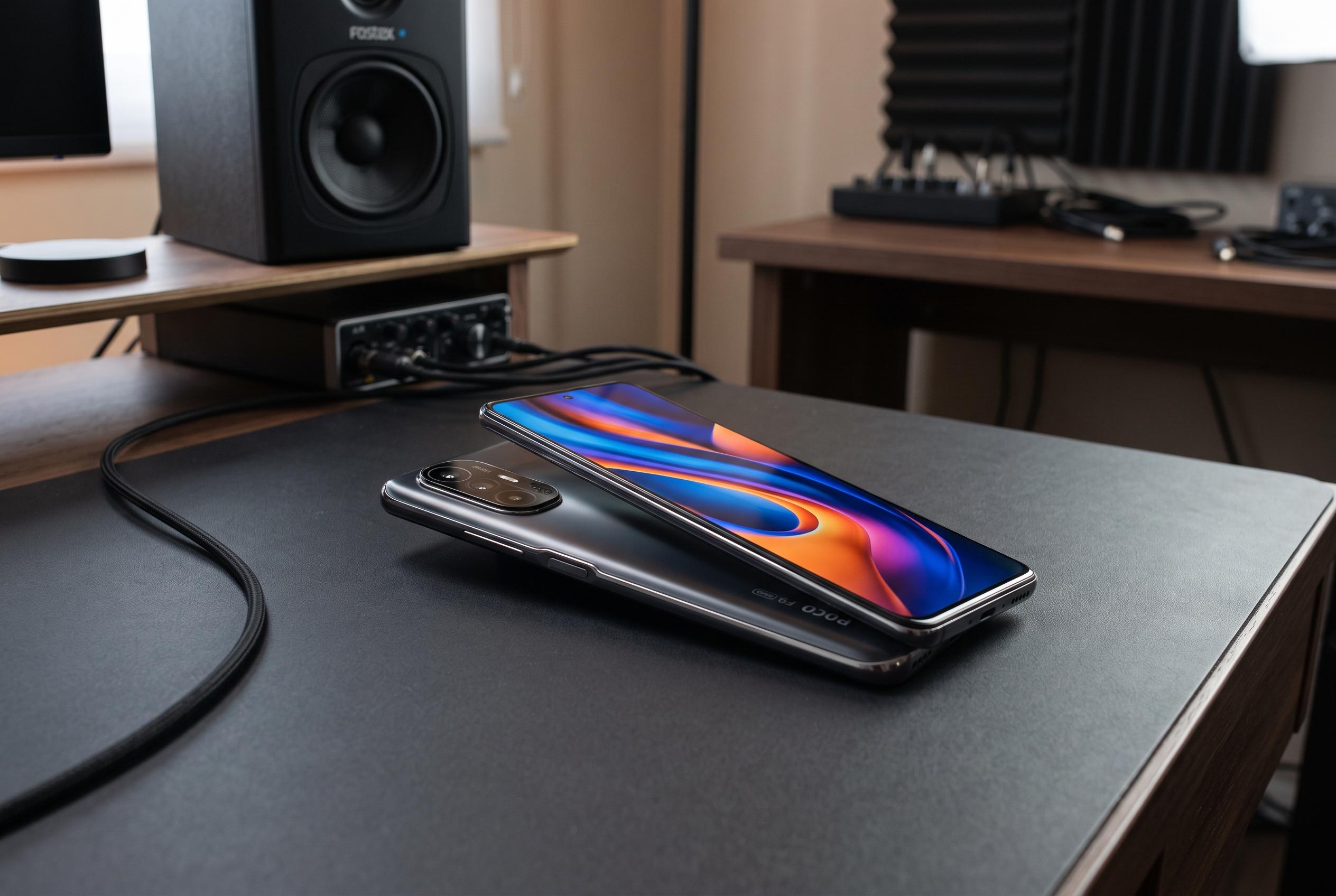

Poco launches the F9 Ultra and F9 Pro with a focus on premium display, sound, and battery features, while maintaining an unchanged flagship Snapdragon chip to counteract rising memory costs and keep prices competitive.
Poco has unveiled the F9 Ultra and F9 Pro as its latest performance-led phones, but the more revealing part of the launch is the company’s explanation for what did not change. Speaking to TechRadar, Poco Global’s Kang Lou said: “From our end, we believe performance is not always about chasing the latest chipset”, linking the decision to keep the Snapdragon 8 Elite Gen 5 in the Ultra to higher memory costs across the industry. TechRadar said that choice still comes with a higher entry price than last year’s model, with the F9 Ultra starting at $799 and £899, compared with $729 and £749 for the F8 Ultra. (techradar.com)
Poco is presenting the range as an “all-round performance flagship”, with its launch material foregrounding display speed, charging and audio rather than a processor jump. The rollout is wide, but not truly global. Android Central reported that the F9 Ultra is heading to 25 countries, including the UK, Germany, Spain, Thailand and the UAE, but not India. PetaPixel added that there is still no official US retail launch, meaning American buyers would be looking at the device as an imported global-market phone rather than a formally supported domestic release. (mi.com)
On the technical side, the Ultra remains the showcase device. Poco’s official product page says it uses TSMC’s 3nm N3P process, a 2+6 all-big-core CPU design and clock speeds of up to 4.6GHz, alongside UFS 4.1 storage and LPDDR5X-9600 memory. Poco also advertises an AnTuTu V11 score of 4,165,108, but its own launch notes make clear that this was produced by internal testing on the Ultra at roughly 25C rather than by an independent benchmark lab. (po.co)
Both models combine Qualcomm silicon with a separate VisionBoost D8 chip, which 9to5Google described as a 12nm part handling AI frame insertion and super-resolution processing. Poco’s own explanation goes further, saying the chip uses a GEX module and pre-trained AI models to improve image detail and apply motion interpolation. The Pro uses the Snapdragon 8 Elite Gen 5 V series variant, while the Ultra gets the standard flagship version. Poco’s headline gaming claim is support for up to 185 frames per second, but its own fine print says that figure depends on the game and usage conditions, and TechRadar reported that more than 20 titles currently support the enhanced frame rate, including Call of Duty: Mobile and PUBG Mobile. (9to5google.com)
The displays are central to the sales pitch. According to 9to5Google, the F9 Pro uses a 6.59in panel at 2510×1156, while the F9 Ultra moves to 6.9in at 2608×1200. Both panels are rated at 185Hz and come with Gorilla Glass 7i, ultrasonic fingerprint readers, 480Hz 10-point touch sampling and 4,800Hz instant touch sampling. PetaPixel added a more unusual detail: Poco’s HyperRGB approach replaces a conventional RGBG subpixel arrangement with dedicated red, green and blue subpixels. The same report said the M11 panel material is claimed to improve luminous efficiency by 20% and extend panel lifespan by 5%. (9to5google.com)
Cameras and sound are where Poco tries hardest to separate the Ultra from the Pro. The official Ultra page describes it as the brand’s first phone with a 200MP main camera, paired with optical stabilisation, a 50MP 5x periscope telephoto and a 50MP ultra-wide. PetaPixel reported that the Pro keeps the same 200MP main sensor but switches to a 50MP 2.5x floating telephoto that can focus as close as 10cm, alongside a 50MP ultra-wide. Audio follows a similar split. 9to5Google said the Pro has symmetrical stereo speakers, while the Ultra adds an independent 1620 rear subwoofer for a 2.1-channel layout. In a hands-on review, Android Central described the result as “the best onboard sound of any phone”. (po.co)
Battery capacity is another Ultra-only escalation. Poco says the flagship model carries an 8,050mAh battery, versus 6,330mAh in the Pro, while both phones support 100W wired and 50W wireless charging. 9to5Google added 27W wired reverse charging and 22.5W wireless reverse charging to the specification list. Poco’s product material claims up to two days of battery life and points to a 3D IceLoop cooling system with a 6,300 sq mm LHP area and 17,820 sq mm of graphite coverage, which it says can cut SoC temperatures by as much as 3C. Yet Android Central’s reviewer said the handset still “overheats while gaming”, a reminder that launch-page thermal claims and sustained real-world behaviour are not always the same thing. (po.co)
In the Philippines, the F9 Pro starts at P49,999 for 12GB of RAM and 256GB of storage, with an introductory price of P33,999, while the equivalent F9 Ultra is priced at P55,999 and discounted to P45,999 until 16 September. The local launch package also includes Redmi Buds 8 Active, a two-year warranty and screen-replacement cover during the promotional window. Abroad, pricing rises sharply: Android Central and PetaPixel both put the Ultra at about €1,099 before launch discounts in western markets, climbing to roughly €1,399 for the 16GB/1TB version. The result is a pair of phones aimed less at winning a pure silicon race than at offering bigger batteries, unusually ambitious audio hardware and aggressive display specifications at a price that still sits below the most expensive mainstream flagships. (newsbytes.ph)
Disclaimer: This content is intended for informational purposes only. Readers are advised to exercise their own judgement, conduct due diligence, or consult a qualified expert before acting on any information provided.