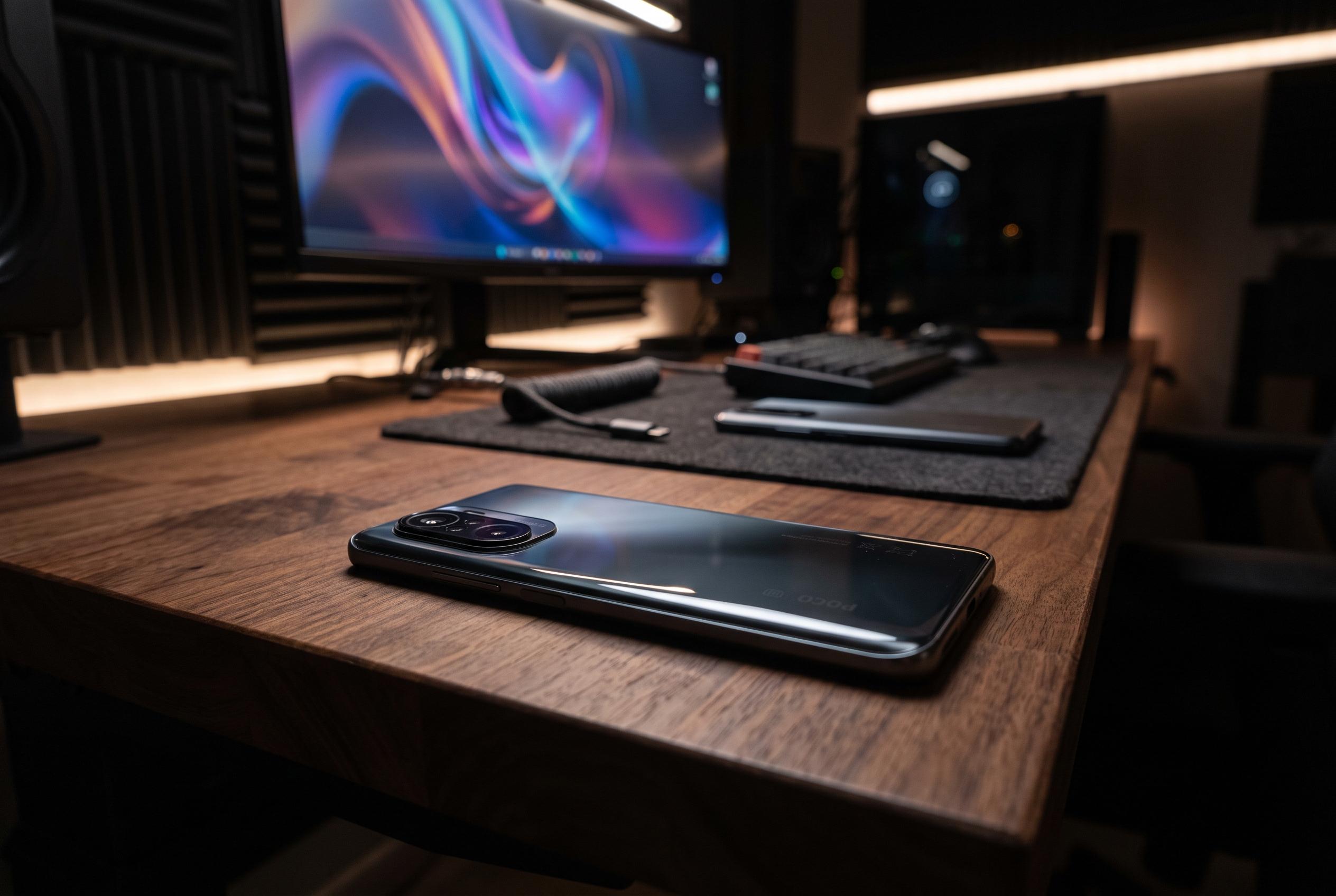

Poco has launched the F9 Pro globally, offering flagship-level hardware at a competitive price point, but with notable compromises compared to the Ultra model and its Chinese counterparts, raising questions about its true value for gamers and tech enthusiasts alike.
Global orders for Poco’s new F9 Pro opened this week with pricing that makes it the cheaper entry point to the F9 range, but only just. The handset starts at $699, while the F9 Ultra opens at $799, and launch coverage from Android Authority, AndroidPure and 9to5Google shows that early-bird discounts narrow the effective gap even further in some markets. That leaves the Pro competing not only on price, but on how much of the Ultra’s headline hardware it manages to keep.
On paper, Poco has preserved much of the flagship formula. The F9 Pro uses Qualcomm’s Snapdragon 8 Elite Gen 5 V Series, while the Ultra gets the full Snapdragon 8 Elite Gen 5. Android Authority described the Pro chip as the same basic platform with weaker graphics, and Tech-ish went further, saying the V Series version has fewer GPU compute units and less dedicated graphics memory. Both devices are reported to use Poco’s VisionBoost D8 graphics hardware, UFS 4.1 storage and HyperOS 3, but 9to5Google says only the Ultra adds an independent rear subwoofer to its Bose-tuned speaker system.
That distinction matters because Poco is clearly selling the F9 family as gaming-first hardware. The company is advertising a 185Hz display mode and 185FPS gameplay, yet Android Authority and 91mobiles both noted that the claim applies only to a limited pool of supported titles, at roughly 20 games. The Pro still appears well equipped for sustained loads, with 3D IceLoop cooling and a large vapour chamber-style thermal setup, but the supporting reports suggest buyers should treat the 185FPS figure as a selective showcase rather than a system-wide experience.
Even the screen story is less straightforward than the launch marketing suggests. Android Authority said the two phones share a 6.9-inch 185Hz OLED panel, but AndroidPure and 9to5Google described the Pro as the smaller device, at roughly 6.6 inches or 6.59 inches, while reserving the 6.9-inch display for the Ultra. Across the reports, the broad picture is consistent: very high refresh rates, aggressive brightness claims and a focus on gaming smoothness. The disagreement is over whether the Pro inherits the Ultra’s full panel size or trims back to a more compact format.
The rest of the specification sheet follows the same pattern. According to 9to5Google, the Pro combines a 200-megapixel main camera with a 50-megapixel floating telephoto offering 2.5x optical zoom and an 8-megapixel ultra-wide sensor, while the Ultra upgrades the secondary cameras to a 5x periscope telephoto and a 50-megapixel ultra-wide. Both are said to include 32-megapixel front cameras, IP68 protection, 100W wired charging, 50W wireless charging and reverse charging. 91mobiles also highlighted the Pro’s smaller footprint, while Android Authority said it comes in Black, White and Aurora Green, with the green finish glowing after exposure to light.
The more revealing comparison may be with Xiaomi’s own Chinese-market devices. Tech-ish and The Tech Outlook both said the F9 Pro and F9 Ultra are reworked versions of the Redmi K100 Pro and Redmi K100 Pro Max unveiled in China on 11 August. If that reading is correct, the global models arrive with notable battery cuts. Tech-ish said the F9 Pro’s 6,330mAh cell is 2,250mAh below the Redmi K100 Pro, while the Ultra’s 8,050mAh battery is 1,020mAh smaller than the K100 Pro Max. Poco has therefore kept the fast-charging story intact, but not the full battery capacity of the Chinese originals.
Pricing also becomes less simple once memory tiers and regional tags are taken into account. AndroidPure listed the F9 Pro at $699 or €899.99 for 12GB RAM with 256GB storage, rising to $769 or €999.99 for 12GB and 512GB. For the Ultra, it gave figures of $799 or €1,099.99 for 12GB and 256GB, $949 or €1,199.99 for 16GB and 512GB, and $1,199 or €1,399.99 for 16GB and 1TB. Android Authority’s UK figures were £799 recommended for the Pro and £899 for the Ultra, falling to £639 and £709 respectively on launch promotion. The nominal $100 step-up, in other words, understates how far apart the two phones move once storage, RAM and regional tax-inclusive pricing are factored in.
The launch itself also sat inside a broader Poco push. The Tech Outlook said the company introduced the F9 pair alongside the X8 5G, with the X8 line due in India on 3 September. The F9 devices did not get the same clear local timetable. AndroidPure said no India pricing was visible when it checked Poco’s global listings, and 91mobiles reported that an India release had not been confirmed at all, adding that such a launch might be unlikely because Poco’s X-series is the brand’s stronger play there. For now, the F9 Pro looks designed less as a mass-market bargain than as a carefully trimmed flagship alternative that asks buyers to decide whether the savings over the Ultra are meaningful enough.
Disclaimer: This content is intended for informational purposes only. Readers are advised to exercise their own judgement, conduct due diligence, or consult a qualified expert before acting on any information provided.