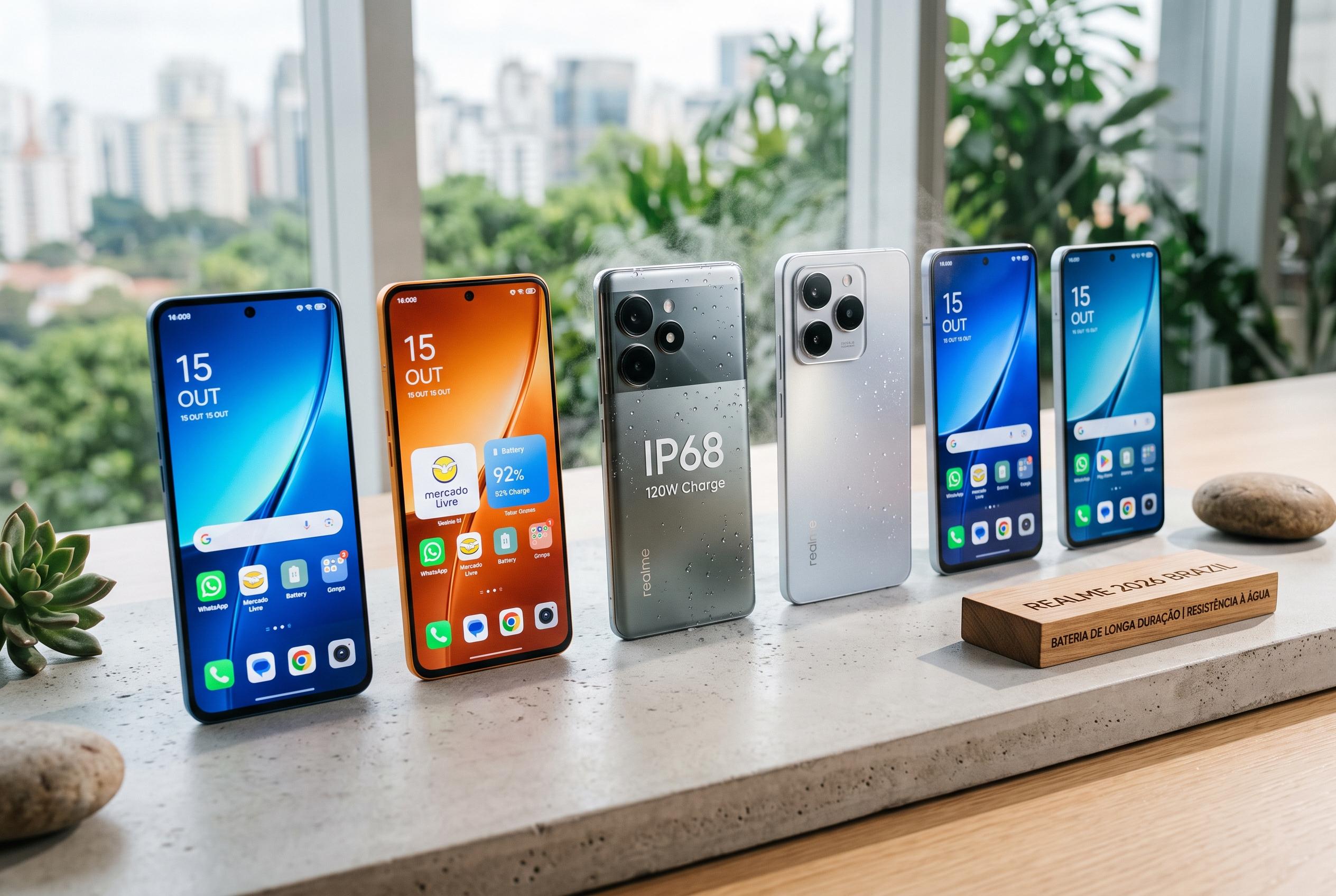

Realme’s 2026 device range in Brazil introduces a strategic focus on long battery life, vibrant OLED displays, and water resistance, offering consumers a clear segmentation of performance and endurance options in an evolving smartphone market.
Realme’s 2026 phone range in Brazil is built around three clear priorities: long battery life, bright OLED displays and strong water resistance. The company’s best-known devices also lean heavily on fast charging and newer chipsets, making the line-up easy to segment for buyers who care most about performance, endurance or price. For shoppers weighing a premium handset against a cheaper one, the differences are now sharper than before.
At the top of the range is the Realme GT 7 Pro, which Realme’s own specifications place on the Snapdragon 8 Elite platform with up to 16GB of RAM and 512GB of storage. The phone uses a 6.78-inch AMOLED LTPO panel with a peak brightness rating of 6,500 nits, a 6,500mAh battery and 120W charging. Its camera system combines a 50MP periscope lens, a 50MP main sensor with optical image stabilisation and an 8MP ultrawide unit. That combination makes it the brand’s most complete flagship, although its price and lack of eSIM support may put off some buyers.
The standard Realme GT 7 aims at the same audience but uses MediaTek’s Dimensity 9400e instead of Qualcomm’s flagship chip. Realme positions it as a high-performance handset rather than a pure flagship, but it still pairs a 6.78-inch 120Hz AMOLED screen with a 7,000mAh silicon-carbon battery and 120W charging. The larger battery makes it especially attractive for people who want high-end speed without giving up all-day, and often multi-day, endurance.
Among the numerically named models, the Realme 16 Pro Plus is the most camera-focused. It combines a 200MP main sensor with OIS, a 50MP periscope lens offering 3.5x optical zoom and a 50MP front camera, alongside a 6.8-inch AMOLED display with a 144Hz refresh rate. The handset is powered by Qualcomm’s Snapdragon 7 Gen 4, with 12GB of RAM and 512GB of storage, and uses a 7,000mAh battery with 80W charging. That makes it a strong mid-premium option for users who care more about imaging and battery life than top-tier gaming performance.
The regular Realme 16 is a more restrained choice. It has a 6.57-inch AMOLED screen, a 120Hz refresh rate, a 6,550mAh battery and 45W charging, all in a more compact body. Realme pairs it with MediaTek’s Dimensity 6400 Turbo, which is aimed at balancing efficiency and everyday performance. Its camera setup is simpler, with a 50MP main sensor and a modest 2MP secondary camera, so it is better suited to daily use than serious photography.
Realme’s P-series is designed for endurance above all else, and the P4 Power is the clearest example. It carries a 10,001mAh battery, 80W charging and 27W reverse charging, meaning it can also power other devices. The phone adds a 6.8-inch AMOLED display with 144Hz refresh rate, MIL-STD-810H durability and IP69 resistance. With the Dimensity 7400 Ultra inside, it is less about raw speed than about keeping going in harsh conditions and on very long days.
At the entry level, the Realme C85 Pro and C75 5G serve different needs. The C85 Pro uses a Snapdragon 685, a 7,000mAh battery and a 6.8-inch AMOLED panel, but it remains a 4G-only model. The C75 5G, by contrast, uses MediaTek’s Dimensity 6300, a 6.67-inch IPS LCD display and 5G support, but it has the smallest battery in this guide at 5,828mAh. For buyers, that makes the C85 Pro the better value if battery life matters more than 5G, while the C75 5G is the more future-proof low-cost option.
For most buyers, the best Realme phone in 2026 depends on priorities rather than simple rankings. The GT 7 Pro is the strongest all-rounder, the GT 7 offers near-flagship power with exceptional battery life, the 16 Pro Plus is the photography pick, and the P4 Power is the endurance specialist. Realme’s broader strategy is clear: sell phones that are competitive on screen quality, fast charging and durability, then differentiate them by battery size, camera hardware and chipset class.
Disclaimer: This content is intended for informational purposes only. Readers are advised to exercise their own judgement, conduct due diligence, or consult a qualified expert before acting on any information provided.