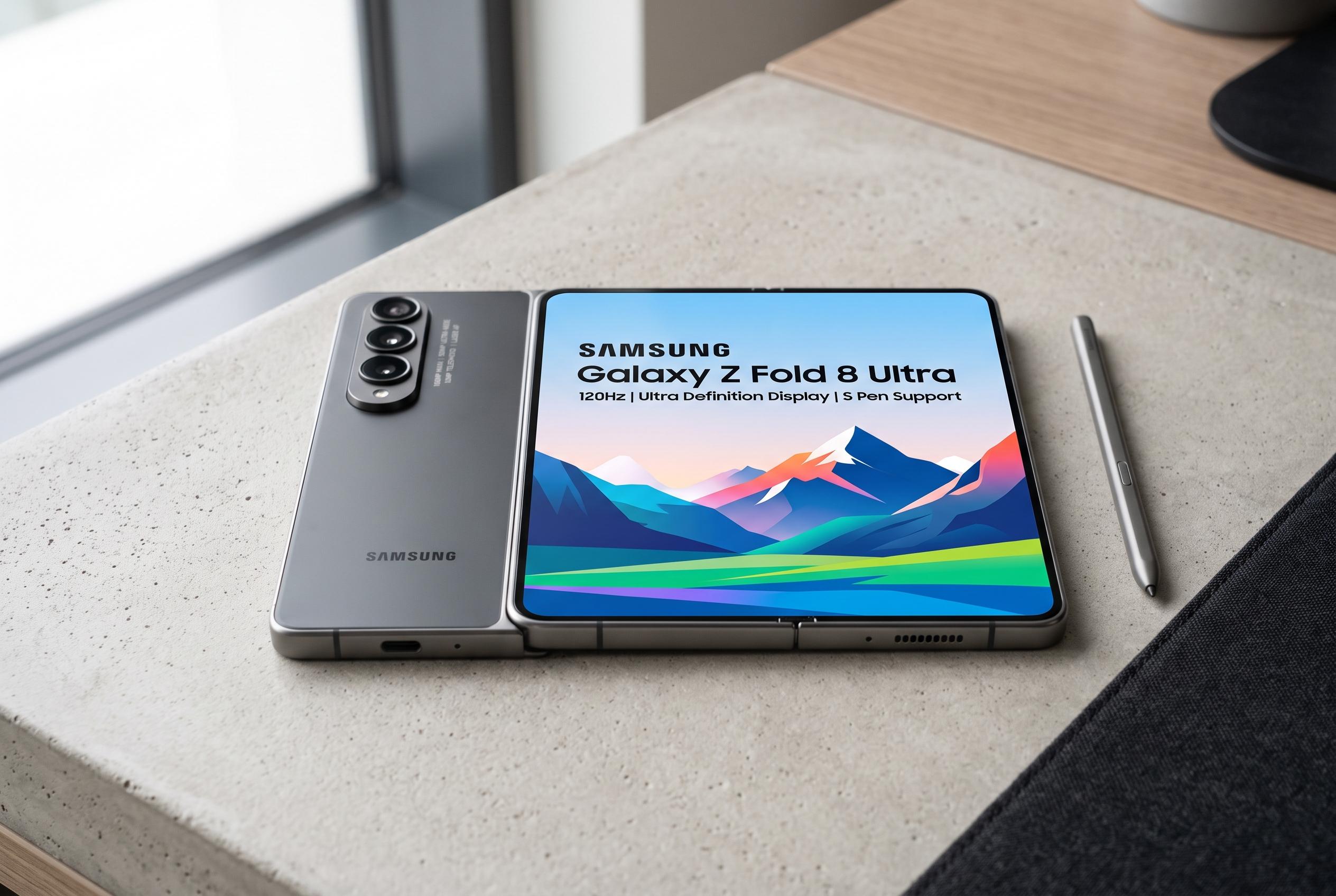

Samsung’s latest foldable, the Galaxy Z Fold 8 Ultra, enhances key features like a brighter screen and larger battery, but offers evolutionary improvements rather than radical changes, raising questions about its premium pricing and camera trade-offs.
Samsung has spent years treating its book-style foldable as a work in progress, but the Galaxy Z Fold 8 Ultra suggests the company is now focused on refinement rather than reinvention. It is still the familiar slab-like folder, yet nearly every meaningful change points to a better finished product: a brighter main screen, a larger battery, faster charging and a more polished hinge feel. The question is whether those gains are enough to justify the premium price, especially when Samsung’s own cheaper Fold 8 is drawing attention for being more radical in shape and, in some tests, quicker.
The hardware is the clearest step forward. According to TechRadar, the Fold 8 Ultra feels thinner and flatter, with a near-creaseless 8-inch inner AMOLED display and an updated Flex Titanium panel that helps the screen lie more evenly when open. The anti-reflective coating is also a practical improvement, making the screen easier to use in bright light. Android Headlines said the display now reaches 3,000 nits at peak brightness, up from 2,600 nits on last year’s model, and that the more generous battery gains are just as important. Samsung has moved to a 5,000mAh silicon-carbon cell, which marks a notable increase over the previous generation and brings a more convincing endurance story.
Performance is strong, though not flawless. The phone uses Qualcomm’s Snapdragon 8 Elite Gen 5 for Galaxy and ships with Android 17 and One UI 9, giving it access to Samsung’s latest software tools and Google’s Gemini integration. Android Headlines found the phone quick in daily use and generally well suited to gaming and multitasking, but also noted that it can still run warm during heavy camera use, recording and long gaming sessions. The absence of a vapour chamber is a surprise at this price, and the benchmark results were not always flattering, with the cheaper Fold 8 sometimes edging it out despite sharing the same processor family.
Camera hardware remains the most obvious compromise. Samsung has upgraded the ultrawide sensor to 50 megapixels, but the 10MP 3x telephoto unit is unchanged and still looks undersized for a phone carrying the “Ultra” badge. Android Central’s photo test found that the Fold 8 Ultra delivered the best results among Samsung’s book-style foldables, especially through the main camera and in zoom shots up to 10x, but it also showed limits in difficult lighting and at longer ranges. TechRadar similarly described the camera package as strong overall but not exceptional for a device at this price. In practical terms, the Fold 8 Ultra is more than capable, but it is not the class leader in zoom or low-light imaging.
That leaves value and longevity. Samsung is promising seven years of Android version upgrades and security patches, which is among the strongest support commitments in the Android market. That matters for a device costing $2,099.99, because long software support helps offset the upfront expense. Still, the Fold 8 Ultra is not an easy recommendation for existing Fold 7 owners. The upgrade is real, but it is evolutionary rather than transformative. For buyers moving up from an older foldable, or from a conventional phone and looking for a premium large-screen device, it is one of Samsung’s most accomplished foldables yet. For everyone else, the price premium and the still-unsolved camera trade-offs remain hard to ignore.
Disclaimer: This content is intended for informational purposes only. Readers are advised to exercise their own judgement, conduct due diligence, or consult a qualified expert before acting on any information provided.